In summary:
- Accessing Taino art requires a researcher’s mindset, focusing on interpretation and conservation, not just location.
- The Pomier Caves offer the highest quantity of art, but Cueva de las Maravillas provides superior accessibility and preservation conditions for study.
- Ethical photography without flash is non-negotiable; specific low-light techniques are required to protect pigments that have survived for centuries.
- Taino influence is not just ancient history; it’s a living heritage visible in modern Dominican language, cuisine, and even DNA.
For the art lover and adventurer, the Dominican Republic offers a profound journey into the past, far beyond its sun-drenched beaches. The island is a treasure trove of Taino rock art, a complex visual lexicon etched and painted onto the walls of its limestone caves. Many travelers know of a few famous sites, and the common advice revolves around basic tour logistics. They are told where to go, but not how to see. They are shown the art, but not how to read it. This approach barely scratches the surface of a rich, symbolic world that has endured for centuries.
But what if the true key to this experience wasn’t just finding the caves, but understanding the field protocol required to ethically document and interpret them? The real journey lies in moving past the mindset of a tourist and adopting the careful, curious approach of a field researcher. This guide is built on that principle. We will not merely list locations; we will deconstruct the symbolism, analyze the materials, and outline the methodologies for safe visitation and documentation. This is about learning to decipher the visual messages of the past, understanding the threats to their survival, and appreciating the living Taino heritage that permeates the island today.
This comprehensive guide is structured to build your expertise sequentially, from decoding individual symbols to planning a full-scale photographic expedition. Follow along as we explore the meaning, methods, and profound cultural legacy of the Taino’s sacred art.
Summary: A Researcher’s Guide to Finding and Understanding Taino Cave Art
- What Does the “Frog” Symbol Signify in Taino Cave Art?
- How to Photograph Cave Art Without Damaging the Pigments?
- Pomier Caves vs National Park of the East: Which Has More Art?
- Charcoal or Grease: How Did Tainos Create Lasting Pigments?
- The Permit Mistake That Blocks You from Entering Pomier Caves
- How to Visit the Cueva de las Maravillas and Other Caves Safely?
- How to Identify Taino Influence in Modern Dominican Daily Life?
- How to Build a Photography Itinerary Covering Coast, Mountain, and Desert?
What Does the “Frog” Symbol Signify in Taino Cave Art?
The frog, or coquí, is one of the most recurrent and symbolically dense figures in the Taino visual lexicon. It is far more than a simple representation of local fauna; it is a direct link to the core of Taino cosmology. The frog is intrinsically tied to Atabey, the supreme mother goddess of fertility, fresh water, and childbirth. Archaeological analysis consistently reveals petroglyphs of Atabey depicted with the head and torso of a woman but the distinct legs of a frog, cementing the creature’s role as her primary avatar. This connection is not merely symbolic; it is a fundamental expression of the Taino worldview, where water, life, and feminine power are inextricably linked.
The symbol’s significance extends beyond fertility. The coquí represents natural harmony and a connection to the spiritual realm. The Tainos believed the frog’s nocturnal singing was a form of communication with their ancestors, a sacred soundscape that connected the living world with the world of spirits. In Puerto Rican cave art, for example, the frog often appears with prominent, oversized eyes, symbolizing its importance in the nocturnal world and its role as a watchful guardian. Its presence near water symbols in cave art reinforces its role as a gatekeeper to sacred, life-giving resources. This symbolic tradition was remarkably consistent, with archaeological evidence demonstrating over 3,000 years of continuous use, from around 2000 BCE to the 1500s CE.
When you encounter a frog petroglyph, you are not just looking at an animal; you are witnessing a complex statement about creation, ancestry, and the sacred balance of the natural world. Identifying its variations—from frog-human hybrids representing Atabey to its placement near spiral symbols indicating life cycles—allows for a much deeper reading of the ritual landscape of the cave.
How to Photograph Cave Art Without Damaging the Pigments?
Ethical documentation is the primary responsibility of any researcher or enthusiast visiting a rock art site. The cardinal rule is absolute and non-negotiable: never use a flash. The intense, concentrated burst of light from a camera flash, especially its UV component, causes cumulative and irreversible damage to ancient pigments. Over time, these flashes bleach the colors and accelerate the deterioration of the organic binders that have held the art to the stone for centuries. The goal is documentation, not destruction. Adherence to strict conservation standards requiring a 75 μW/lm maximum UV exposure limit is paramount for preserving these sensitive materials for future generations.
This is where the true challenge and skill for the photographer lie. Instead of relying on the brute force of a flash, you must master low-light techniques. This involves using a tripod for stability, a remote shutter to eliminate shake, and a wide-aperture lens (f/2.8 or lower) to gather as much ambient light as possible. The process becomes a slow, deliberate dance with darkness, requiring patience and a deep understanding of your equipment’s manual settings. This is not point-and-shoot photography; it is a methodical scientific process.
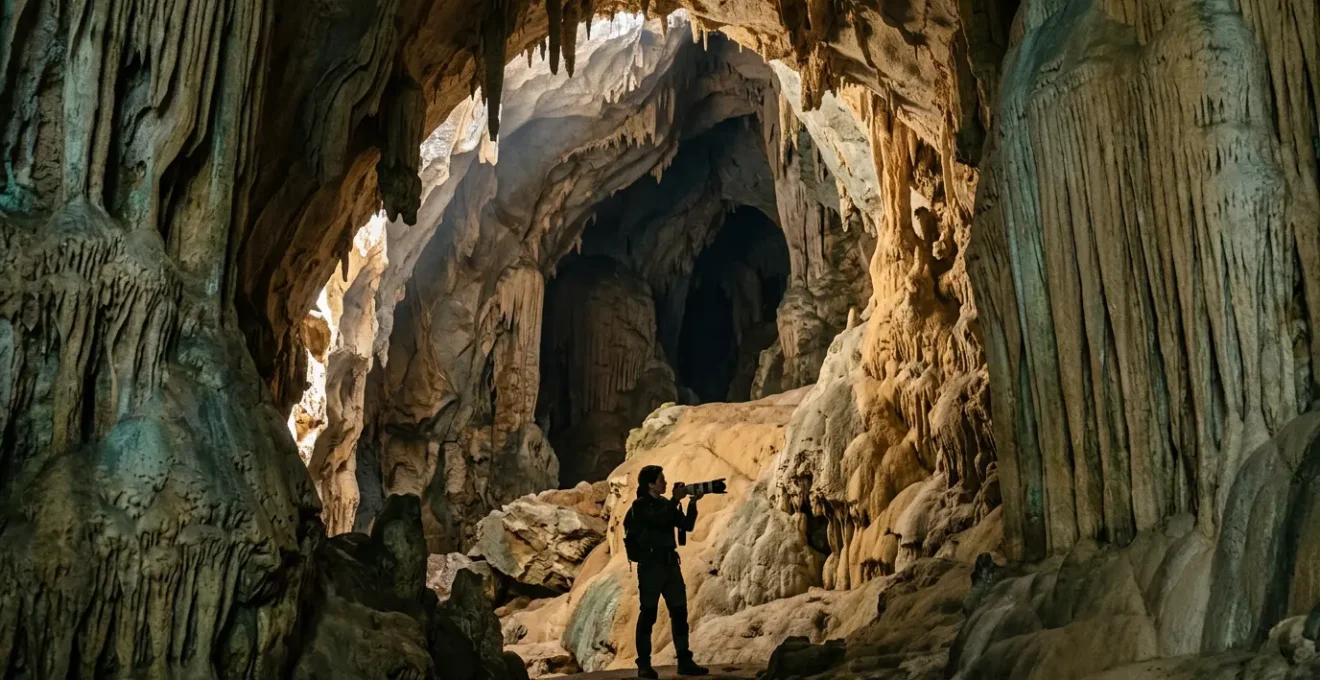
This image captures the essence of responsible cave photography: a moment of intense concentration and respect for the environment, where technology serves conservation.
To achieve professional results, you must employ a “field protocol” for your camera settings. This means moving beyond basic adjustments and embracing more advanced methods that yield high-quality images without compromising the integrity of the artwork. Techniques like exposure bracketing and focus stacking are essential tools in the field speleologist’s kit.
Your Action Plan: Technical Settings for Flash-Free Cave Photography
- Embrace Chiaroscuro: Use a single, controlled, off-camera LED light source (with a warm gel if possible) held at a sharp angle to the artwork. This “light painting” or chiaroscuro technique reveals texture and detail without flooding the site with harmful light.
- Master the Exposure Triangle: Set your camera to Manual mode. Start with a wide aperture (e.g., f/2.8), a high ISO (1600-3200 is a good range to balance sensitivity with noise), and adjust your shutter speed for a correct exposure (this may be several seconds).
- Use Bracketed Exposures: Take a series of 3-5 shots of the same composition at different exposure levels (e.g., -1, 0, +1). In post-processing, these can be combined into a High Dynamic Range (HDR) image that captures detail in both the deep shadows and bright highlights.
- Employ Focus Stacking: For large panels or uneven surfaces, take multiple images, adjusting the focal point slightly for each shot from foreground to background. Specialized software can then merge these into a single, razor-sharp image from front to back.
- Document with Rich Metadata: Your work has scientific value. Use your camera’s settings to embed GPS coordinates if possible, and keep a field notebook detailing the cave conditions, time of day, and specific settings used for each shot.
Pomier Caves vs National Park of the East: Which Has More Art?
When planning a research-focused trip, a common question is one of quantity versus quality and accessibility. The two most significant concentrations of Taino art in the Dominican Republic are the Pomier Caves (Cuevas del Pomier) and the caves within the National Park of the East (Parque Nacional del Este), particularly the famous Cueva de José María. While both are immensely important, they offer vastly different experiences for the researcher and adventurer.
On sheer volume, the Pomier Caves are unparalleled in the Caribbean. This vast system, a true ritual landscape, contains an astonishing number of artworks. However, this incredible density of art comes with significant challenges. The site has been under constant threat from limestone quarrying operations for decades. Blasting from the nearby mine has caused structural damage to the cave systems, and access is tightly controlled and often difficult. While the main caves are accessible with a mandatory guide, many of the 54 documented caves are off-limits or require special permission and expertise to navigate.
The National Park of the East, by contrast, offers a different proposition. While the total number of artworks may be less than Pomier’s staggering inventory, the concentration and condition of the art, particularly in Cueva de José María, are exceptional. The art here is noted for its vibrancy and bold placement in “assemblage sets.” However, access is even more restricted than at Pomier, often requiring research permits and being primarily for scientific expeditions rather than general tourism. The table below provides a direct comparison based on current archaeological data.
This comparative data, drawn from publicly compiled archaeological findings, helps clarify the trade-offs between the two primary sites. It highlights that Pomier leads in raw numbers, but the Park of the East has its own unique stylistic significance.
| Feature | Pomier Caves | East National Park |
|---|---|---|
| Total Artworks | 6,000 drawings, carvings and pictographs | 1,200+ painted images in Jose Maria Cave alone |
| Cave Systems | 54 caves documented | Multiple sites including Cueva del Puente |
| Art Style | Charcoal mixed with animal fat, white chalk, red clay | Black/brown pigments, rarely red and white |
| Dating | 11th century to Spanish arrival (Carbon-14 dated) | 13th-15th centuries (radiocarbon dated) |
| Access Level | Guided tours required, Caves 1-2 most accessible | More restricted, primarily research access |
Charcoal or Grease: How Did Tainos Create Lasting Pigments?
The longevity of Taino pictographs is a testament to their sophisticated understanding of natural materials. The question isn’t a simple “either/or” of charcoal or grease; it’s about a complex and deliberate recipe combining mineral pigments with organic binders. This is the heart of pigment archaeology: understanding not just what we see, but how it was made and why it has survived. Scientific analysis confirms that many of these artworks have maintained their integrity for over 500 years of preservation, withstanding humidity, darkness, and time.
The primary black pigment was indeed charcoal, likely sourced from specific sacred trees and finely ground into a powder. For reds and yellows, the Tainos used iron oxide-rich clays (ochre). But the pigment powder alone is not paint. The genius of Taino chemistry was in the binder—the “grease” or adhesive that made the pigment stick to the porous limestone walls. This was not just generic animal fat. Field research and analysis suggest a complex mixture. Animal fat would have provided a water-resistant base, but other ingredients were crucial.
This macro view reveals the raw, textural beauty of the materials used in this ancient art form, showcasing the granular nature of charcoal and the powdery fineness of ochre clay.
The most fascinating ingredient, confirmed by experts, was a combination of bat guano and plant resin. As archaeologist Dr. Jago Cooper from the British Museum explains, the Tainos had a deep, practical knowledge of their cave environments. They understood the chemical properties of the very ground they walked on. As he states in a study published by the British Museum, the process was ingenious. The insight provided by Dr. Cooper’s archaeological study is invaluable.
The paintings were made with bat excrement which had over many decades absorbed naturally-occurring yellow, brown and red minerals from the cave floors. Sometimes plant resin was added to help the bat excrement (guano) paint adhere to the walls of the caves.
– Dr. Jago Cooper, British Museum Archaeological Study
This created a durable, adhesive paint that chemically bonded with the limestone surface, allowing the art to endure for half a millennium.
The Permit Mistake That Blocks You from Entering Pomier Caves
For the serious visitor to the Pomier Caves, the biggest barrier is not physical difficulty but bureaucracy and misinformation. Many travelers arrive expecting a standard national park entrance, only to be turned away. The critical mistake is assuming you need a government-issued permit from a ministry in Santo Domingo. This is incorrect and will lead to lost time and frustration. The Pomier Caves are managed directly by a private foundation, the Cuevas de Pomier Foundation (Fundación Cuevas de Pomier), and all arrangements must be made with them on-site.
Understanding the correct “field protocol” for access is crucial. The process is actually quite straightforward if you know the right steps, but it’s often poorly communicated in online travel guides. You do not pre-book through a central system. You travel to the site, located in San Cristóbal province, and arrange everything there. This includes paying the modest entrance fee and, most importantly, hiring a mandatory local guide. These guides are indispensable, not just for access but for their knowledge of the caves. Be aware that the tours are conducted almost exclusively in Spanish, so arranging for your own translator is highly advisable if you are not fluent.
For those daunted by the logistical uncertainties of Pomier, there is an excellent and highly accessible alternative. The Cueva de las Maravillas (“Cave of Wonders”) is perhaps the most well-managed and visitor-friendly rock art site in the country. It serves as a perfect case study in successful conservation and accessibility. Declared a national park in 1997, it houses around 500 paintings and engravings in a single, vast cavern. Unlike Pomier’s rugged conditions, this site features an excellent lighting system, concrete ramps, well-maintained footpaths, and even a modern elevator, making it accessible to a much wider range of visitors without compromising the art’s safety.
Alternative Site Success: Cueva de las Maravillas
This enormous cave system located between San Pedro de Macorís and La Romana houses hundreds of well-preserved Taino pictographs and petroglyphs. It is renowned for being one of the most accessible caverns in the Dominican Republic. This is thanks to a state-of-the-art lighting system designed to illuminate the art without causing damage, extensive ramps and a secure footpath, and even a modern elevator for entry and exit. The management here has successfully balanced mass tourism with strict conservation, creating a model for other sites. It is arguably the best-prepared cave for educational and photographic tourism in the country.
How to Visit the Cueva de las Maravillas and Other Caves Safely?
Visiting a cave art site is a privilege that comes with significant responsibilities. Whether you are in the highly developed Cueva de las Maravillas or a more remote cave, your presence has an impact. As conservation experts warn, each visitor affects the delicate subterranean environment. Our breath increases CO2 levels, our body heat raises the temperature, and the lint from our clothes introduces foreign particulates. Caves are living systems, and the guiding principle for any visit must be to minimize your footprint. This means adhering strictly to the established rules, which are in place not to limit your experience, but to preserve the site for centuries to come.
At a well-managed site like Cueva de las Maravillas, the safety protocol is clear and rigorously enforced. The most important rule is the absolute prohibition of photography and recording of any kind during the standard tour. This is not just about light damage; it’s about controlling visitor flow and ensuring everyone focuses on the guide’s expert interpretation. You must also speak softly to avoid disturbing the natural acoustics and, crucially, never touch the cave walls or the artwork. The oils and microbes on our hands can cause irreparable damage to both the rock surface and the ancient pigments.
Proper attire is also a component of safety—both for you and the cave. Comfortable, closed-toe footwear with good grip is essential for navigating potentially slippery paths. Lightweight, breathable clothing is recommended for the humid cave environment. By respecting these protocols, you transition from a passive tourist to an active participant in the conservation of this irreplaceable world heritage. Following the guide’s instructions is not just a suggestion; it is your part of the pact to protect this sacred space.
Your Action Plan: Essential Safety Protocol for Cave Visits
- Observe All Restrictions: At sites like Cueva de las Maravillas, it is strictly forbidden to take pictures, record video, or use any music devices during the tour. Your primary tool is observation.
- Maintain Voice Control: Speak softly and avoid shouting. Sound travels differently in caves, and loud noises can be disruptive to both other visitors and the cave’s natural state.
- Dress Appropriately: Wear comfortable, airy clothes suitable for a humid environment. Sensible, closed-toe footwear with good traction is an absolute must for safety.
- Respect Designated Boundaries: Always stay on the marked paths and behind any barriers. This prevents soil compaction, protects fragile floor formations, and minimizes your overall environmental impact.
- Follow Your Guide’s Lead: Listen attentively to your guide’s instructions. At Cueva de las Maravillas, excellent tours are available in English, French, and Spanish, and the guides are trained in both the history of the art and the safety of the cave.
How to Identify Taino Influence in Modern Dominican Daily Life?
The story of the Taino people does not end with the arrival of Columbus. While their population was decimated by colonization, their culture was not extinguished. It was absorbed, adapted, and integrated into the very fabric of modern Dominican and Caribbean life. For the observant researcher, evidence of this living heritage is everywhere, from the language people speak to the food they eat. Recognizing this Taino legacy transforms a visit from a historical inquiry into a vibrant, contemporary cultural experience.
Language is one of the most powerful carriers of this heritage. Dozens of Taino words are fully integrated into modern Spanish and have even passed into English. Words for local flora and fauna like ceiba (a sacred tree), iguana, and coquí are of Taino origin. Even common English words like hurricane (from hurakán), barbecue (from barbacoa), and hammock (from hamaca) are gifts from the Taino lexicon. This linguistic survival is a powerful reminder of who first named the features of this island landscape.
This influence is just as palpable in the kitchen. The traditional casabe bread, a dry, flat bread made from yuca (cassava), is a direct culinary inheritance from the Taino. The complex process of grating the yuca and using a cibucán (a woven press) to squeeze out its poisonous juices before baking is a technique that has been passed down through generations, a process depicted in the very cave art we study. The most profound evidence, however, lies in the people themselves. Powerful DNA studies reveal that an estimated 60% of Puerto Ricans and up to 33% of Dominicans carry Taino mitochondrial DNA. This is not a lost people; their legacy is written in the genetic code of the islands.
Key takeaways
- The frog symbol is not just an animal but the avatar of Atabey, the supreme goddess, representing fertility, water, and ancestral connection.
- Ethical photography is paramount, requiring the complete avoidance of flash and the mastery of low-light techniques to prevent irreversible pigment damage.
- The Taino are not a “lost” civilization; their language, cuisine, and genetic heritage are deeply embedded in modern Dominican culture.
How to Build a Photography Itinerary Covering Coast, Mountain, and Desert?
Building a comprehensive photographic itinerary of Taino rock art requires thinking like a field expedition leader. It’s about logically sequencing locations to trace the stylistic and environmental variations in the art. The Dominican Republic’s diverse geography—from coastal mangroves to central mountains and arid southwestern regions—directly influenced the Taino’s artistic expression. A successful itinerary connects these dots, creating a narrative journey across the island’s ritual landscape.
A logical route, the “Taino Trail,” begins at the coast, moves inland to the central mountains, and culminates in the distinct arid regions of the southwest. Starting at Los Haitises National Park allows for documenting art with strong maritime themes in a unique setting accessible by boat. This serves as a perfect introduction before moving to a more controlled environment. A transitional stop at Cueva de las Maravillas provides an opportunity to practice ethical photography in an accessible, well-lit setting, calibrating your equipment and techniques before tackling more challenging sites.
The heart of the expedition is the central mountains, home to the Pomier Caves. Here, in the San Cristóbal hills, you will document the largest concentration of art, with its distinct charcoal figures. The itinerary should then move southwest, exploring smaller, less-known caves where the art style adapted to the arid environment. This geographical progression allows you to not only capture a diverse portfolio of images but also to build a visual thesis on how the Taino worldview was shaped by, and reflected in, their immediate environment. The table below outlines the key characteristics to look for in each region.
| Region | Art Style | Best Light | Access Level |
|---|---|---|---|
| Coastal (Los Haitises) | Maritime themes, fishing scenes | Morning natural light | Boat + short hike |
| Central Mountains (Pomier) | Black/brown pigments, large ceremonial figures | Controlled artificial only | Guide required |
| Eastern (National Park) | Bold placement, assemblage sets, vibrancy | Deep cave, artificial needed | Research permit needed |
By following this research-oriented approach—decoding symbols, mastering ethical documentation, navigating logistics, and understanding the living culture—your journey to the Dominican Republic can become a true exploration. You will return not just with photographs, but with a profound connection to the enduring legacy of the Taino people. The next step is to begin planning your own expedition into this fascinating visual world.