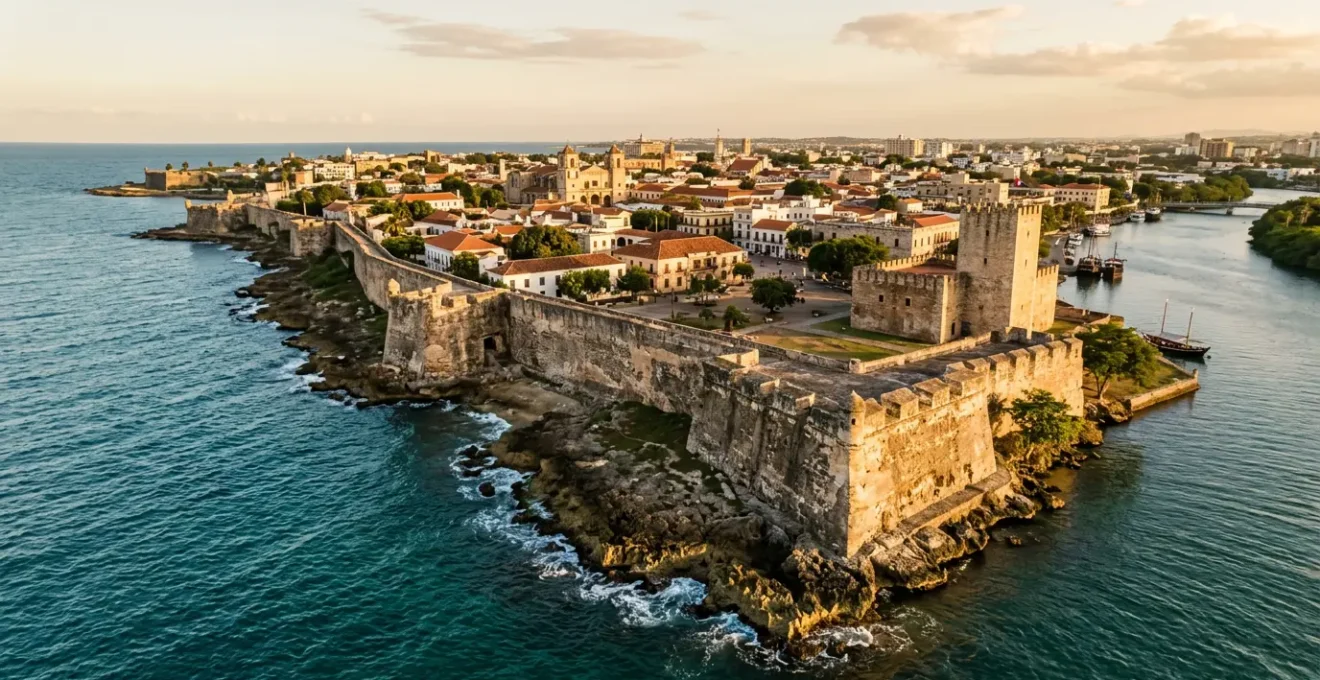
The defensive walls of Santo Domingo are less a monument to Spanish power and more a testament to a single, catastrophic strategic failure in 1586 that permanently altered the city’s destiny.
- Sir Francis Drake’s raid succeeded not through overwhelming force, but by exploiting incomplete fortifications and a flawed defensive doctrine.
- The event’s devastation halted the city’s economic growth, leading to a unique, sober architectural style and a reactive, underfunded military posture for centuries.
Recommendation: To truly understand the city, a military history enthusiast must trace the path of its attackers and learn to read its history in the very ruins and architectural compromises they left behind.
For the modern visitor, the colonial walls of Santo Domingo present a picturesque backdrop of coral stone ramparts against a Caribbean sky. Many walk these fortifications, imagining the clashes between Spanish defenders and swashbuckling pirates. This romanticized view, however, misses the far more compelling and brutal story etched into the stone. Most guides will point out the main gates and the imposing Fortaleza Ozama, dutifully mentioning the infamous 1586 raid by Sir Francis Drake as a key historical event.
But this approach merely scratches the surface. It treats the city’s defenses as a static museum piece rather than what they truly are: a dynamic, evolving case study in 16th-century military engineering, strategic miscalculation, and reactive adaptation. The common narrative fails to connect Drake’s raid to its devastating long-term consequences—the economic stagnation, the architectural compromises, and the shift in colonial power that left Santo Domingo a shadow of its former self. The key to understanding these walls lies not in celebrating their strength, but in analyzing their catastrophic failure.
This analysis reframes the story. We will not simply tour the walls; we will dissect their defensive doctrine. We will investigate why the choice of building material itself was a strategic compromise. We will trace the tactical genius of Drake’s assault, which left a permanent “scar” on the city’s psyche and development. By examining the ruins, comparing its defenses to more successful Spanish fortresses like San Juan, and even looking back at the lessons from the very first failed settlement of La Isabela, we can uncover a history of reactive fortification shaped more by crisis and necessity than by a grand imperial design.
This strategic exploration will reveal the true narrative of the first city in the Americas, a story told not just in its surviving monuments, but in its scars and its ghosts. The following sections provide a complete tactical briefing.
Summary: A Strategic Dissection of Santo Domingo’s Fortifications
- Why Is the Fortaleza Ozama Built with Coral Stone?
- Francis Drake’s Invasion: How to Trace His Path of Destruction in the City?
- The Hospital San Nicolás: Why Is the First Hospital Now a Ruin?
- In What Order Should You Visit the Gates of the City Wall?
- Santo Domingo vs San Juan: How Do the Fortifications Differ?
- How to Trace the Steps of Columbus and Drake in the First City?
- Why the Dominican Baroque Style Is Unique in the Americas?
- How to Visit the Ruins of La Isabela to Understand the First Failed Settlement?
Why Is the Fortaleza Ozama Built with Coral Stone?
The selection of coral limestone for the Fortaleza Ozama and the city walls was not an aesthetic choice, but a decision rooted in the harsh realities of early colonial logistics and military pragmatism. For a military historian, this material itself tells a story of compromise. Coral stone was abundant, easily quarried from the coastline, and required less skilled labor to work than harder imported stones. This made it the ideal material for a nascent colony that needed to erect defenses quickly and cheaply with the resources at hand.
However, from a purely defensive standpoint, it was a suboptimal choice. While colonial builders often constructed walls up to two feet thick, which provided thermal insulation and adequate protection against early threats like pirate raids with small arms, coral stone is relatively soft and porous. It is far more vulnerable to cannon fire than the dense granite or engineered masonry used in later, more sophisticated European fortifications. The very composition of the walls speaks to the colony’s initial defensive doctrine: a focus on repelling small-scale incursions rather than withstanding a full-scale military siege by a major European power.
The use of coral stone, therefore, represents the first chapter in Santo Domingo’s story of reactive fortification. It was a solution born of necessity, prioritizing speed and local availability over long-term resilience against evolving military technology. This initial compromise would prove to have dire consequences when the threat level escalated dramatically.
Francis Drake’s Invasion: How to Trace His Path of Destruction in the City?
The 1586 raid by Sir Francis Drake was not merely an attack; it was a clinical and devastating dissection of Santo Domingo’s strategic vulnerabilities. It exposed the fatal flaw in the city’s defensive doctrine and left a permanent scar on its development. To understand the city, one must trace the path of its most effective adversary. Drake’s brilliance lay in his intelligence gathering and his refusal to attack the city’s strongest point: the harbor entrance defended by the Fortaleza Ozama.
Instead, he landed his forces west of the city, marching overland to attack the incomplete and poorly manned landward walls. The Spanish defenders, focused on a naval assault, were caught completely by surprise. The result was an asymmetric failure of staggering proportions. Drake’s assault on Santo Domingo cost the city a staggering 25,000 ducats ransom with only 7 English killed. For a month, he occupied the city, systematically looting and burning its most important buildings, including the cathedral and the Alcázar.
Strategic Failure: The Unfinished Wall
Drake’s 1586 attack succeeded because the western and northern walls were dangerously incomplete, exposing Santo Domingo’s fundamental vulnerability. His forces exploited this gap, rendering the formidable seaside fortress irrelevant. After occupying the city for a month and leaving it in ruins, the strategic calculus of the Spanish Empire shifted. The Spanish subsequently stopped investing heavily in Santo Domingo, viewing it as a lost cause. The city never recovered its former importance, being bypassed for the colonial Baroque developments and massive military investments that flourished elsewhere in Spanish America, such as in Mexico and Peru.
This event, the “Drake Scar,” was the turning point. It proved that the city’s single-ring defense was inadequate and that its economic and symbolic heart was frighteningly exposed. The path of destruction he carved became the blueprint for all future defensive planning, a constant, humiliating reminder of a flawed strategy.
The Hospital San Nicolás: Why Is the First Hospital Now a Ruin?
The skeletal ruins of the Hospital San Nicolás de Bari, the first hospital in the Americas, are more than just a picturesque relic. They are a physical manifestation of the long-term consequences of the “Drake Scar.” The hospital’s demise was not a single event, but a slow, agonizing decline initiated by the 1586 invasion and compounded by centuries of neglect and natural disasters. Drake’s forces looted and heavily damaged the structure, but its ruin was sealed by the economic abandonment that followed.
The Hospital San Nicolás suffered not only from Drake’s 1586 invasion but from multiple subsequent disasters. The San Zenón cyclone in 1930 and various earthquakes over centuries structurally weakened the building, leading to its eventual abandonment. As Santo Domingo’s prominence waned in favor of colonies like Mexico and Peru, funding for maintaining such grand public structures dwindled.
– Multiple disasters contributing to the hospital’s ruin, Hoy Digital
With the Spanish Crown diverting funds and focus to more profitable and strategically vital colonies like Mexico, Peru, and later, San Juan, there was simply no capital available to repair and maintain grand public works in Santo Domingo. The hospital, once a symbol of the city’s primacy, became a casualty of its diminished status. Each subsequent pirate attack and natural disaster chipped away at a structure that was no longer a priority for a struggling colony.
The following timeline illustrates this process of slow decay, where a single military catastrophe created the conditions for terminal decline.
| Period | Event | Impact on Hospital |
|---|---|---|
| 1586 | Drake’s Invasion | Initial damage and looting |
| 17th-18th centuries | Multiple pirate attacks | Repeated damage to structure |
| 1930 | San Zenón Cyclone | Major structural weakening |
| Various dates | Earthquakes | Progressive deterioration |
| Post-1586 | Economic decline | Lack of maintenance funds |
The ruin of the Hospital San Nicolás is, therefore, a crucial piece of evidence for the military historian. It proves that the most lasting damage from an attack is often not the immediate destruction, but the long-term strategic and economic fallout.
In What Order Should You Visit the Gates of the City Wall?
A tour of Santo Domingo’s gates should not be a random walk, but a strategic reconnaissance mission through time. By visiting the gates in a specific order, a military history analyst can read the evolution of the city’s defensive doctrine, from its early, almost secretive, beginnings to its later, more monumental declarations of control. This sequence allows you to trace the city’s reactive responses to escalating threats.
Begin your survey at the oldest gate and move toward the later additions, observing the changes in design, scale, and strategic purpose. Each gate is a chapter in the city’s military story. You will see a shift from small, easily defended posterns designed for sorties to grand, imposing gates meant to project power and control landward access, a direct response to the lessons learned from Drake’s overland assault.
Your Strategic Reconnaissance Route: A Gate-by-Gate Analysis
- Puerta de la Misericordia (1543): Start here. Analyze its original design as a small postern gate. Its modest size and location reflect an early doctrine focused on containing minor threats and allowing for secret sorties, not repelling a large land army.
- Puerta del Conde (1655): Proceed to this main western gate. Note its larger scale and more formidable structure. Built after Drake’s raid, its purpose is clearly to control the vulnerable western approach. It is a direct architectural answer to the 1586 failure.
- Riverside Wall Sections: Continue to the sections near Fortaleza Ozama. Observe how the wall integrates with the river, forming a natural barrier. Assess the fields of fire from the fortress to the river mouth, the city’s originally perceived strong point.
- Fort San Jose & Fort Santa Barbara: Explore these secondary structures. Their placement reveals a later attempt to create a more layered defense and cover blind spots in the original single-ring wall, a shift towards a nascent ‘defense in depth’.
- Fort San Gil: Conclude your tour here. Examine the 18th-century modifications. These later works show the final evolution of Santo Domingo’s defensive thinking before it was completely eclipsed by other Caribbean strongholds.
This structured walk transforms a simple tour into an active analysis, allowing you to witness firsthand how military strategy was written, erased, and rewritten in the stone of the city’s ramparts.
Santo Domingo vs San Juan: How Do the Fortifications Differ?
To fully appreciate the strategic limitations of Santo Domingo’s defenses, a comparison with its regional rival, San Juan, Puerto Rico, is essential. While both were key Spanish colonial outposts, they represent two vastly different military investment strategies and defensive doctrines. Santo Domingo was the first, a prototype built on a budget; San Juan was the perfected, heavily-funded fortress designed to be the keystone of Spanish power in the Caribbean.
After the “Drake Scar” of 1586, Spain’s strategic priorities shifted. Santo Domingo was deemed too vulnerable and less vital than the deep, defensible harbor of San Juan, which guarded the primary shipping lanes for treasure fleets. As a result, investment poured into Puerto Rico, creating one of the most formidable defensive systems in the world. The scale difference is telling: while Santo Domingo relied on a single wall and a handful of forts, San Juan’s Castillo San Cristóbal alone was a behemoth. San Cristóbal became the largest Spanish fortress in the New World, covering a massive 27 acres with 450 cannons.
This divergence in strategy is best understood through a direct comparison of their core defensive features.
| Feature | Santo Domingo | San Juan |
|---|---|---|
| Strategy | Single ring wall system | Defense in depth with multiple layers |
| Primary forts | Fortaleza Ozama (1502-1508) | El Morro & San Cristóbal system |
| Construction period | 16th century core | 17th-18th century expansion |
| Terrain | Coastal plain | Defensible islet with elevation |
| Garrison type | Citizen militia based | Large permanent military garrison |
| Design purpose | Repel early raids | Withstand naval sieges |
This table makes the contrast stark. Santo Domingo was built to survive, relying on a reactive, militia-based defense. San Juan was built to dominate, employing a proactive, professional, and multi-layered defense in depth. The comparison reveals that Santo Domingo’s fortifications are not an example of peak Spanish military engineering, but rather a fascinating fossil of an earlier, less sophisticated, and ultimately failed defensive philosophy.
How to Trace the Steps of Columbus and Drake in the First City?
Walking through Santo Domingo’s Colonial Zone offers a unique opportunity to trace the parallel, yet violently divergent, paths of its founder and its most infamous raider. This is not just a walk through space, but a journey through the city’s dual identity: the idealized vision of Christopher Columbus’s family versus the brutal reality imposed by Sir Francis Drake. To the strategic observer, this duality is everywhere.
The Columbus family’s legacy is seen in the grand, aspirational structures. The Alcázar de Colón, home of his son Diego, is a palace that speaks of establishing a noble European dynasty in the New World. The Cathedral of Santa María la Menor was intended as the spiritual heart of a new empire. These places represent the city’s intended destiny. Drake’s path, in contrast, is a trail of violation and desecration. He entered not through the main harbor but through the city’s soft underbelly. He made his headquarters in the very cathedral he defiled, a profane act of dominance. This juxtaposition of creation and destruction provides a powerful narrative framework for exploring the city.
The Cathedral was the spiritual heart of Columbus’s vision, but it was the profane headquarters for Drake’s men
– Colonial history interpretation, Santo Domingo Walking Tours Guide
By following a “Founder vs. Raider” itinerary, one can physically experience this historical tension. Each stop becomes a point of contrast between the dream and the reality, the plan and the brutal improvisation of war.
- Begin at Alcázar de Colón: Contemplate the ambitions of the Columbus dynasty, a vision of established power and prestige.
- Visit the Cathedral Primada de América: Picture it first as the center of Columbus’s spiritual vision, then as Drake’s chaotic headquarters during the 1586 occupation.
- Walk from the western gates: Trace the likely path of Drake’s forces as they bypassed the harbor defenses and poured into the vulnerable city.
- Follow Calle Las Damas to Fortaleza Ozama: Imagine the fierce but ultimately futile resistance at the fortress, the city’s last line of defense.
- End at the Ozama River: Look upon the harbor that was the gateway for Columbus’s new world, a defensive barrier that Drake cleverly circumvented, rendering it strategically irrelevant.
Why the Dominican Baroque Style Is Unique in the Americas?
The architectural style of Santo Domingo’s colonial-era churches and buildings is conspicuously different from the ornate, exuberant Baroque found in other Spanish centers like Mexico City or Lima. This is not an accident of taste, but a direct consequence of the city’s post-1586 military and economic reality. The city’s unique style can be described as a “Baroque of Sobriety,” a style born from fear and poverty rather than wealth and confidence.
After Drake’s devastation, Santo Domingo became a low-priority outpost. The constant threat of further pirate attacks, combined with a lack of royal investment, meant that new construction had to be defensive in nature. Church facades were built to resemble fortresses, with thick walls, few windows, and bold, simple decorative elements. The goal was resilience, not ostentation. There was neither the money for, nor the strategic sense in, creating the kind of delicate, elaborate facades (known as Churrigueresque) that were fashionable elsewhere.
The ‘Baroque of Sobriety’: An Architectural Response to Trauma
After Drake’s 1586 devastation, Santo Domingo never received the investment for elaborate Baroque architecture that flourished in Mexico and South America. The constant threat of pirate attacks created a ‘Baroque of Sobriety’—characterized by restrained, fortress-like church facades rather than ornate Churrigueresque styles. Furthermore, the local coral stone was difficult to carve into fine detail, which naturally led to bold, large-scale decorative elements instead of the delicate stucco work seen in other colonies. This created a uniquely Dominican architectural language, one defined by its defensive posture and material constraints.
The very materials dictated the style. The local coral stone, being difficult to carve finely, lent itself to massive, simple forms rather than intricate details. What might be perceived as a lack of sophistication is, to the historian’s eye, a clear sign of a city under duress. The architecture of Santo Domingo is the architecture of a garrison town, where every public building had to double as a potential strongpoint. It is the most visible and permanent evidence of the “Drake Scar.”
Key Takeaways
- Santo Domingo’s defenses were a product of reactive, underfunded fortification, not proactive, grand strategy, making them vulnerable.
- The 1586 raid by Sir Francis Drake was a catastrophic strategic failure for the Spanish, exposing a flawed defensive doctrine and permanently halting the city’s growth.
- The city’s unique “Baroque of Sobriety” architecture and its numerous ruins are direct physical evidence of the long-term economic and psychological impact of Drake’s attack.
How to Visit the Ruins of La Isabela to Understand the First Failed Settlement?
To fully grasp the strategic context of Santo Domingo’s founding, a historian must look back to Spain’s first, failed attempt at colonization in the Americas: La Isabela. Established by Columbus on his second voyage in 1493, La Isabela was a disaster. A visit to its ruins, located on the north coast, serves as a critical prologue to the story of Santo Domingo. It reveals the harsh lessons in survival and settlement strategy that the Spanish had to learn before they could build a lasting presence.
La Isabela failed for a clear set of strategic reasons. It was built in an unhealthy location near swamps, leading to rampant disease. It had a poor harbor and lacked a defensible high-ground position. The colony was plagued by starvation, internal rebellion among the colonists, and a complete failure to establish a stable relationship with the native Taíno population. It was a chaotic and desperate failure, a lesson in what not to do.
Santo Domingo, founded just a few years later in 1498 by Bartholomew Columbus, was a direct response to these failures. Its location was chosen for its strategic advantages: a protected river mouth harbor, a more elevated and healthier position, and a more defensible plain. The very planning of Santo Domingo shows an evolution in Spanish thinking, moving from the haphazard approach at La Isabela to a more deliberate, planned, and militarized model of colonization. La Isabela’s primary threats were internal (disease, starvation), while Santo Domingo was designed from the outset to face external threats.
- Identify La Isabela’s Fatal Flaws: Poor harbor, disease from swamps, lack of defensible high ground.
- Compare with Santo Domingo’s Strategic Choices: Protected harbor at the Ozama River mouth, elevated and healthier location.
- Examine Archaeological Evidence: At La Isabela, the mix of European and Taíno artifacts shows a story of failed integration and conflict.
- Contrast Primary Threats: La Isabela faced internal collapse, whereas Santo Domingo’s design anticipated external military attack.
- Understand the Evolution: La Isabela’s chaotic failure directly led to Santo Domingo’s more planned, grid-based, and militarized approach.
By applying this strategic lens, viewing the city not just as a collection of monuments but as a landscape of military cause and effect, the military history enthusiast can unlock a far deeper and more rewarding understanding of the first city of the Americas. Every ruin, every wall, and every architectural choice tells a part of this compelling story of ambition, failure, and adaptation.