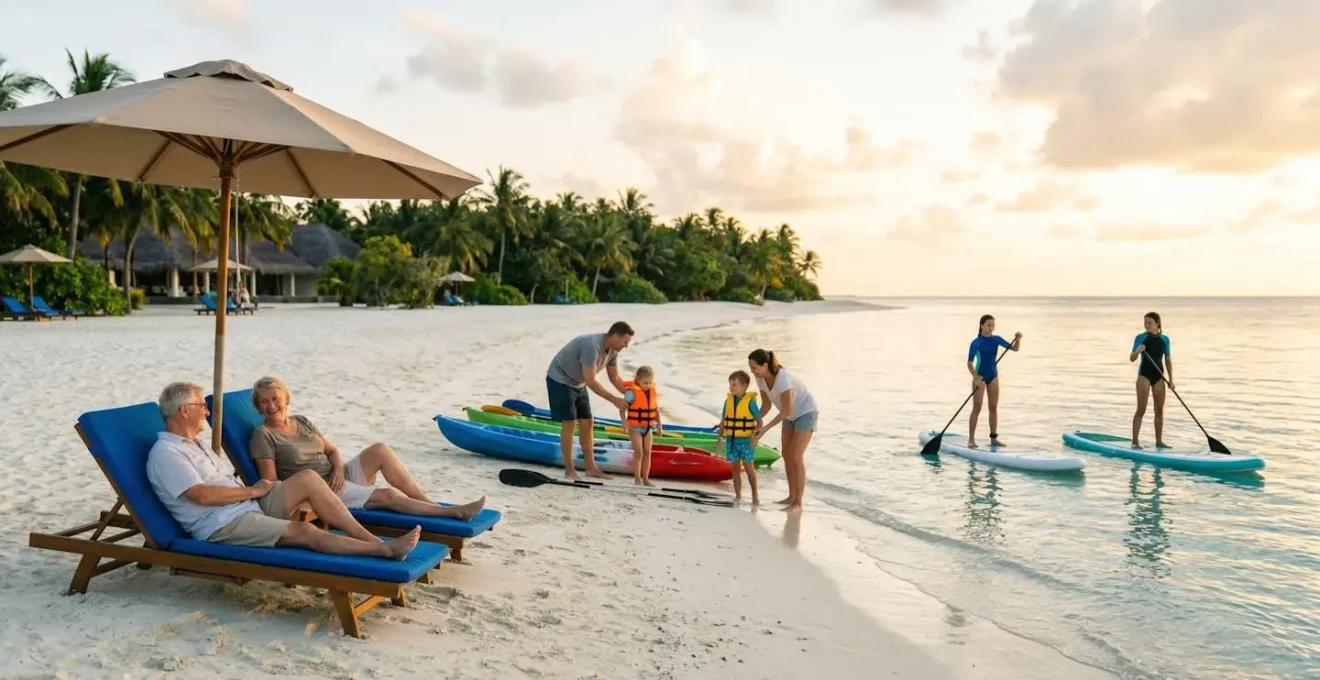
Planning a trip for multiple generations doesn’t have to mean splitting up or defaulting to the pool; the key is architecting activities with different roles for everyone.
- You can turn a deep-sea fishing trip into a “mission crew” with specific, engaging jobs for non-fishers.
- Tandem kayaks or horseback rides on the beach allow stronger family members to support and share the experience with less mobile ones.
Recommendation: Stop looking for one-size-fits-all activities and start designing experiences where everyone can participate together, at their own comfort level.
As the family’s designated travel planner, you face a unique challenge: crafting a vacation that delights a 7-year-old, a 17-year-old, and a 70-year-old—simultaneously. The typical solution often involves compromise that satisfies no one, like splitting the group up or defaulting to sedentary resort life. You’re told to book a resort with a kids’ club or find a tour that’s “easy enough for everyone,” which usually translates to “boring for someone.” This approach misses the entire point of a multi-generational trip: creating shared memories.
But what if the solution wasn’t about finding the perfect one-size-fits-all activity, but about changing your perspective? What if you could become the architect of the experience, not just the booking agent? The secret to successful “soft adventure” for the whole family lies in designing activities with variable-intensity roles. This means choosing adventures where family members can participate at different levels of physical engagement while still being part of the same core experience. Instead of just watching from the sidelines, everyone has a purpose.
This guide will walk you through the practical strategies for architecting these experiences in a destination like the Dominican Republic. We will explore how to evaluate options from golf to deep-sea fishing, not on their face value, but on their potential for inclusive, multi-layered participation. You will learn to see every activity as a platform for creating a shared story, where every family member gets to be a main character.
To help you build this perfect family adventure, this article breaks down the key decisions you’ll face. From choosing the right golf course to structuring a balanced week-long itinerary, each section provides a framework for creating inclusive and memorable experiences.
Summary: A Practical Guide to Architecting Shared Family Adventures
- Teeth of the Dog or Corales: Which Golf Course Justifies the Green Fee?
- Beach vs Mountain Riding: Which Experience Is More Comfortable for Beginners?
- How to Kayak the Mangroves Without Getting Exhausted against the Current?
- Catch and Release: How to Fish Deep Sea Without Depleting Local Stocks?
- When to Book Your Tee Time to Avoid the Mid-Day Heat Stroke?
- How to Choose the Right Punta Cana Resort When They All Look the Same?
- How to Rent a Private Villa in Casa de Campo Without Hidden Fees?
- How to Build a High-Adrenaline Itinerary for 7 Days in DR?
Teeth of the Dog or Corales: Which Golf Course Justifies the Green Fee?
When you’re looking at premium golf courses in the Dominican Republic, the high green fees for Teeth of the Dog and Corales can seem daunting, especially for a mixed-ability family group. The decision isn’t about which course is “better,” but which one offers the best platform for a shared family experience. Both are championship-level courses, but their features cater to multi-generational play in slightly different ways. Teeth of the Dog, with its seven iconic holes along the ocean, offers superior spectator views for non-golfers who can ride along.
The key to justifying the cost is to leverage the course’s flexibility. Both courses offer multiple tee boxes, allowing beginners and grandparents to play from forward tees while experienced players are challenged from the back. However, Teeth of the Dog is generally more amenable to 9-hole rounds, a crucial option for managing the energy and attention spans of a diverse group. This allows for a significant “win” – a world-class golf experience that doesn’t consume the entire day or exhaust less enthusiastic players. Remember to book a “non-golfer rider” spot for family members who just want to enjoy the scenery and company.
Ultimately, the value is unlocked by planning. Instead of a grueling 18-hole marathon, architect a shorter, more engaging outing. Consider a “scramble” format where everyone plays from the best shot, removing pressure and fostering teamwork. The green fee then becomes an investment in a unique, collective memory on one of the world’s most beautiful courses, rather than just a fee for a round of golf.
| Feature | Teeth of the Dog | Corales | Family Consideration |
|---|---|---|---|
| Green Fee (Resort Guest) | $395/round | $395/round | Non-golfer riders: $50/person |
| Ocean Holes | 7 holes | 6 holes | Better spectator views at Teeth of the Dog |
| Course Difficulty | Championship level | Championship level | Both offer multiple tee boxes for varying skills |
| 9-Hole Option | Available | Limited | Teeth of the Dog better for shorter family rounds |
| Practice Facilities | Full range included | Full range included | Both include family-friendly practice areas |
| Pace of Play | 4.5 hours (18 holes) | 4.5-5 hours | Morning tee times (7:30am) best for families |
Beach vs Mountain Riding: Which Experience Is More Comfortable for Beginners?
Horseback riding is a classic family adventure, but the choice between a beach and a mountain trail can make or break the experience for beginners or less mobile family members. Comfort isn’t just about the saddle; it’s about the entire environment. A beach ride often presents a lower barrier to entry. The flat, open sand makes mounting and dismounting significantly easier, and the typical 1-2 hour duration is more manageable for those with limited stamina. There’s also a unique advantage: non-riders can often walk alongside the group on the beach, making it a truly inclusive activity where no one is left behind at the stables.
Mountain rides, however, offer their own set of comforts. The trails are often shaded by a lush canopy, providing crucial protection from the intense Caribbean sun—a major factor for older adults and young children. The varied scenery and winding paths can be more engaging for easily bored teenagers, and many tours incorporate rest stops at scenic viewpoints. These stops are perfect opportunities for less mobile family members to relax and wait comfortably, rejoining the group without feeling rushed. This transforms a potential challenge into a planned part of the experience.
The best choice depends on your family’s specific needs. If easy access and the ability for non-riders to participate are paramount, the beach is likely your best bet. If sun protection and maintaining engagement through varied scenery are the priorities, a mountain trail offers a more structured and comfortable adventure. Both can be excellent “soft adventures” when planned with these factors in mind.
Ultimately, the comfort level is determined by preparation and support. Choosing an operator with experienced guides who are adept at assisting riders of all ages and abilities is as important as the location itself. This ensures that the focus remains on the joy of the ride and the shared experience, not on physical discomfort.
How to Kayak the Mangroves Without Getting Exhausted against the Current?
The serene beauty of kayaking through mangrove tunnels is an iconic “soft adventure,” but the reality of paddling against a current or wind can quickly turn it into an exhausting ordeal for a multi-generational group. The solution isn’t to paddle harder; it’s to plan smarter by leveraging equipment, strategy, and timing. The single most effective tool is the tandem kayak. By pairing a stronger paddler (like a parent or teen) with a child or less mobile adult in the rear steering position, you instantly balance the workload. This allows the person in front to set the pace or simply relax and act as the designated “wildlife spotter,” transforming their role from physical laborer to chief explorer.
Equipment choice is critical. Opt for sit-on-top kayaks, which are far more stable and easier to get in and out of than traditional sit-in models, requiring less flexibility and strength. When booking a tour, ask specific questions about the route. The best operators for family groups use “lazy river” routes that strategically follow the tidal flow, letting nature do most of the work. Also, inquire about the guide-to-guest ratio; a low ratio (1:5 or better) ensures that help is always nearby if a kayak falls behind or needs assistance.
Finally, timing is everything. Morning tours are almost always preferable, as winds tend to be calmer. Before booking, also confirm the maximum weight capacity of the tandem kayaks to ensure safety for all pairings; kayak manufacturer safety standards often list a 425-pound maximum per tandem kayak, with a 250-pound limit per person. By architecting the experience this way—with the right partners, the right gear, and the right route—you ensure the mangrove tour is remembered for the peaceful scenery, not the sore muscles.
- Pair strong paddlers with children or less mobile adults in tandem kayaks.
- Place the stronger paddler in the rear position for better steering control.
- The front paddler acts as the ‘wildlife spotter’ with binoculars, reducing the pressure to paddle constantly.
- Choose sit-on-top kayaks for easier entry and exit, which requires no special flexibility.
- Book tours that use ‘lazy river’ routes, utilizing tidal flow for minimal paddling effort.
- Select morning tours when winds are typically calmer.
Catch and Release: How to Fish Deep Sea Without Depleting Local Stocks?
A deep-sea fishing trip is a thrilling prospect, but for a multi-generational family, it presents two challenges: keeping non-fishers engaged for hours on a boat and ensuring the activity is sustainable. The answer to both lies in shifting the goal from “maximum catch” to “maximum experience.” Choosing a charter that practices catch and release for billfish and other protected species is the first, non-negotiable step. This immediately frames the outing as an interaction with nature, not an extraction from it, a valuable lesson for all ages.
The real secret to multi-generational success, however, is to implement the “Mission Crew” concept. This strategy transforms passive waiting into active, collaborative participation by assigning specific, important roles to every family member, regardless of their interest in fishing. It’s a brilliant way to architect an inclusive experience.
The “Mission Crew” Concept: Turning Spectators into Participants
Successful multi-generational fishing charters assign specific roles to keep everyone engaged. The ‘First Mate’ (typically a teen) manages snacks and drinks, the ‘Marine Biologist’ (often children) identifies species using laminated charts provided by the crew, the ‘Captain’s Log Keeper’ documents catches with photos and notes, while the ‘Spotter’ (grandparents) watches for wildlife like dolphins and seabirds with binoculars. This approach transforms a passive boat ride into an active team mission where everyone contributes to the day’s success.
Choosing the right vessel is equally important. Prioritize boats with ample covered shade areas and clean, accessible bathrooms. A stable catamaran hull can also be a trip-saver, significantly reducing the chances of seasickness. Opt for a half-day (4-hour) trip instead of a full day to match the energy levels of the whole group. By focusing on a charter operator that emphasizes education, provides light tackle for kids, and has a comfortable boat, you’re not just booking a fishing trip; you’re setting the stage for a shared family sea adventure.
When to Book Your Tee Time to Avoid the Mid-Day Heat Stroke?
In a tropical destination like the Dominican Republic, scheduling a golf outing is as much about managing the climate as it is about playing the game. For a multi-generational group with varying tolerance for heat, choosing the right tee time is a critical health and safety decision. The mid-day sun (from 11 am to 3 pm) should be avoided at all costs. This leaves two strategic windows for comfortable play: the early morning and the late afternoon.
The early morning tee time (7:00-8:00 AM) is often the gold standard for families. Temperatures are at their coolest, the course is less crowded, and you can finish a round by noon. This frees up the rest of the day for group activities like lunch and pool time, catering to those who don’t want the entire day to revolve around golf. The only drawback is the early wake-up call, which might be a tough sell for teenagers. This timing prioritizes physical comfort and efficient scheduling.
Alternatively, the ‘Golden Hour’ tee time (3:00-4:00 PM) offers a different kind of magic. While it’s still warm when you start, the temperature drops as you play into the evening. The real benefit is the experience: the beautiful, soft light is perfect for photos, and it creates a relaxed, unhurried atmosphere. This timing allows for a leisurely morning and appeals to the late-risers in your group. You can plan for non-golfers to join the players at the clubhouse for sunset drinks, creating a wonderful full-family conclusion to the day. The main risk is not finishing all 18 holes before dark, which is why this slot is often ideal for a more casual 9-hole round.
How to Choose the Right Punta Cana Resort When They All Look the Same?
Scrolling through websites of Punta Cana resorts can feel like a blur of infinity pools and palm-fringed beaches. They all promise luxury and relaxation, but for a multi-generational family, the true value lies beneath the glossy photos. The key is to shift your focus from amenities to programming. Don’t ask “Does it have a pool?” Ask “What can my 70-year-old mother, my 14-year-old son, and I do together at the pool?” The best resorts are those that actively facilitate shared experiences rather than just providing separate facilities for different age groups.
Look for resorts that have mastered the art of “layered activities.” For example, instead of just a standard water aerobics class, a top-tier resort might offer it in a large, lagoon-style pool where grandparents can participate in the shallow end, parents can get a workout in the middle, and kids can splash and play on the periphery, all within sight and sound of each other. This principle applies across the board. Look for cooking classes that accommodate different skill levels, beach games that are fun for all abilities (like a giant chess board or bocce ball), or live music that appeals to a broad range of tastes.
Your research should become a targeted investigation. Email the resort’s concierge or recreation director before booking. Ask for a sample weekly activity schedule. Are there family movie nights? Are the evening shows appropriate and enjoyable for all ages? A resort that can provide a detailed, thoughtful schedule is one that has genuinely considered the multi-generational challenge. It’s a priority that matters to families; according to 2024 family travel statistics, 81% of families prioritize resorts with activities suitable for all ages. A resort that simply points you to the kids’ club and the adult-only pool has missed the point entirely.
How to Rent a Private Villa in Casa de Campo Without Hidden Fees?
Renting a private villa in an exclusive community like Casa de Campo can seem like the ultimate solution for a large family—offering space, privacy, and flexibility. However, the initial rental price is often just the beginning. To avoid sticker shock, you must understand the difference between the rental cost and the true cost of living within the resort. The most significant “hidden” fee is the mandatory daily resort access fee, which can add up quickly for a large group over several days.
The second major cost factor is transportation. Unlike an all-inclusive resort where everything is a short walk away, the sprawling nature of Casa de Campo makes a golf cart not just a luxury, but a necessity. This rental fee is another mandatory daily expense. Finally, there’s the cost of food. While a private chef might seem more affordable per day than all-inclusive rates, you must also factor in the cost of groceries, which the chef’s fee does not cover. It’s crucial to create a realistic budget that accounts for these non-negotiable extras.
| Cost Factor | Private Villa | All-Inclusive Resort |
|---|---|---|
| Base Accommodation | $1,500/night | $3,000/night (5 rooms) |
| Daily Resort Access Fees | $50/person = $500/day | Included |
| Golf Cart Rental | $75/day (mandatory) | Walking distance/shuttle |
| Private Chef | $200/day + groceries | All meals included |
| Kids Club/Activities | Not available | Included |
| True Daily Cost | $2,275 + food | $3,000 all-in |
Beyond the financials, there’s a hidden cost in “family energy.” An all-inclusive resort removes the daily cognitive load of meal planning, activity coordination, and decision-making. As Professor Lynn Minnaert, a tourism expert, astutely points out, this can be the most valuable feature for a multi-generational group. As she stated in a commentary on family travel benefits, “For multi-generational groups, the value isn’t always in the lowest price – it’s in removing the stress… Sometimes paying more for all-inclusive actually costs less in family energy.” When choosing between a villa and a resort, you must weigh the financial costs against the logistical and emotional labor involved.
Key Takeaways
- The goal is shared experience, not identical participation. Focus on activities that allow for different levels of engagement.
- Become an “experience architect.” Your role is to design activities with variable-intensity roles, not just book tours.
- Prioritize energy management. Choose shorter activities or schedule events during cooler parts of the day to avoid burnout.
Putting It All Together: Your 7-Day Blueprint for a Balanced Family Adventure
The title of this section might mention “high-adrenaline,” but the real goal for a multi-generational trip is “high-engagement.” Building a successful 7-day itinerary is an exercise in balance, not in packing every moment with thrills. The most effective strategy is the “Hub & Spoke” model. This framework alternates between “hub” days, where the entire family participates in a gentle group activity, and “spoke” days, where the group might split for different-intensity adventures before reuniting for a shared meal.
This approach directly nurtures the adaptability and sense of adventure that parents want for their children; in fact, research from the Family Travel Association shows that 84% of parents believe travel helps children become more adventurous. A sample Hub & Spoke itinerary might look like this: Day 1 is arrival and resort orientation (Hub). Day 2, the teens go ziplining while the grandparents visit a local market, and everyone meets for dinner (Spoke). Day 3 is a gentle catamaran cruise for all (Hub). This rhythm prevents burnout, gives everyone something to look forward to, and provides the perfect mix of shared memories and individual freedom.
This model allows you to consciously build in moments of rest and lower-intensity fun, which are just as important as the big adventures. A day spent at the beach with optional watersports available allows individuals to choose their own level of adrenaline, from napping under a palm tree to parasailing. The key is choice within a group setting. Your role as the family’s recreation director is to create a structure that fosters connection without forcing constant togetherness.
Your 5-Step Itinerary Audit for Multi-Generational Harmony
- Assess Participants: List every family member and their “adventure tolerance” on a scale of 1 (Relax) to 5 (Adrenaline).
- Inventory Activities: Brainstorm all potential activities (from spa days to canyoning) and assign them an intensity score from your 1-5 scale.
- Check for Coherence: Apply the “Hub & Spoke” model. Map out your 7 days, ensuring a balance of group “Hub” days and split-activity “Spoke” days. Is there at least one full rest day?
- Audit for Memories: Review the plan. Is there at least one “peak memory” activity tailored to each generation (e.g., a quiet sunrise walk for grandparents, a thrilling activity for teens)?
- Integrate and Book: Build the final calendar, plugging the activities into your framework. Prioritize and book the high-demand or essential activities first.
Now that you are equipped with these strategies, you can move from being a vacation coordinator to a true architect of family memories. Start by outlining your “Hub & Spoke” framework and begin the exciting process of designing an adventure that everyone will be talking about for years to come.