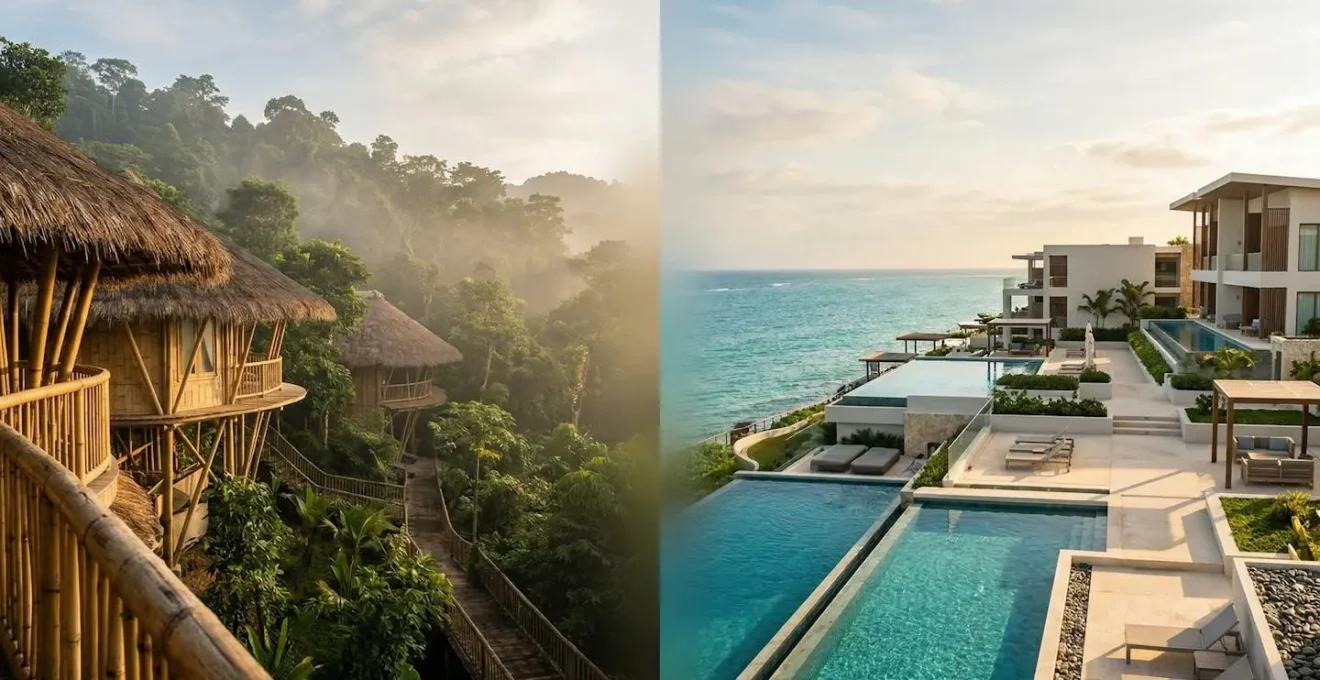
Your ideal vacation choice isn’t about the place, but what your mind needs: predictable comfort or transformative connection.
- All-inclusive resorts masterfully deliver convenience and abundance, ideal for social relaxation and decompression.
- Eco-lodges offer authentic experiences and nature immersion, satisfying a desire for adventure and personal growth.
Recommendation: Diagnose your “travel personality” first. The best choice is the one that aligns with your deeper vacation goals, not just the brochure.
The great vacation debate often boils down to a simple, yet profound, choice: the sprawling, all-inclusive resort versus the secluded, rustic eco-lodge. Online forums are filled with checklists comparing amenities, activities, and costs. But this spreadsheet approach often misses the most crucial factor: you. The decision isn’t just about infinity pools versus jungle trails; it’s about understanding your own “travel personality” and the psychological needs you hope to satisfy.
Many guides will tell you it’s a simple matter of budget or destination preference. They’ll present a false dichotomy of luxury versus austerity. But what if the true key isn’t in what these places *have*, but in how they make you *feel*? This guide steps into the role of a travel psychologist, moving beyond features to focus on fulfillment. We will dissect the underlying satisfaction profiles of each accommodation style, helping you diagnose whether your spirit craves the effortless comfort of a resort or the meaningful connection of an eco-lodge.
This exploration will analyze the deep-seated differences in value, dining, family experiences, and connectivity. We’ll even show you how to blend both styles for a truly holistic getaway. The goal is to equip you with a new lens for decision-making, ensuring your next trip doesn’t just provide a break, but genuine restoration.
Summary: Eco-Lodge vs All-Inclusive: A Psychological Choice
- Does an Eco-Lodge Actually Cost Less Than a Resort?
- Buffet Dining vs Farm-to-Table: Which Meal Plan Satisfies You More?
- Can Kids Have Fun at an Eco-Lodge Without a Kids’ Club?
- How to Combine Both Resort and Eco-Lodge in One 10-Day Trip?
- The Wi-Fi Reality: What to Expect in Remote Lodges vs Resorts?
- How to Prepare for a Stay in an Off-Grid Jungle Lodge?
- Is the “Club Level” Upgrade Worth the Extra $1000 per Week?
- How to Distinguish Real Ecotourism from “Greenwashing” in the DR?
Does an Eco-Lodge Actually Cost Less Than a Resort?
The most common assumption is that eco-lodges are the budget-friendly alternative to pricey all-inclusive resorts. While this can be true on the surface, the financial reality is more nuanced and speaks directly to what you value. For instance, a recent market analysis shows sustainable accommodation costs on average $151 less per night. However, this simple figure doesn’t capture the whole story. The real difference lies in the cost structure and the type of value you receive for your money.
An all-inclusive resort operates on a model of perceived abundance and convenience. The upfront cost covers food, drinks, and baseline activities, removing financial decision-making during your stay. This is psychologically comforting for travelers who want to relax without constantly calculating expenses. Conversely, an eco-lodge’s price often reflects the uniqueness of the experience and its contribution to conservation and local communities. The value isn’t in unlimited cocktails but in a guided night walk with an expert biologist or a meal sourced from the on-site garden. One offers a predictable, bundled product; the other offers a unique, often unrepeatable, experience.
To truly compare, you must look beyond the nightly rate and consider what is included, what is extra, and where the money ultimately goes. This comparative table breaks down the typical value proposition of each model.
| Cost Factor | All-Inclusive Resort | Eco-Lodge |
|---|---|---|
| Base Rate (5 nights) | Under $800 per person | $500-$800 per person |
| Hidden Extras | Premium WiFi, top-shelf drinks, spa treatments | Minimal – most activities included |
| Local Impact | Economic leakage to international chains | Direct support to local communities |
| Value Type | Convenience & abundance | Unique experiences & conservation |
Ultimately, the “cheaper” option depends on your definition of value. If you seek hassle-free abundance, the all-inclusive package may represent a great deal. If you value unique access, education, and direct community support, the eco-lodge provides a different, but equally compelling, return on investment.
Buffet Dining vs Farm-to-Table: Which Meal Plan Satisfies You More?
Nowhere is the philosophical divide between resorts and eco-lodges more apparent than at the dinner table. The choice between a sprawling buffet and a curated farm-to-table meal is a choice between two fundamentally different types of satisfaction: the joy of unlimited options versus the pleasure of a meaningful story.
The all-inclusive buffet is a masterpiece of logistics, designed to cater to every palate and preference simultaneously. As the Restaurant Times Editorial points out in their industry analysis, its appeal is clear. This dining style is perfect for the “Planner” personality who values efficiency and predictability, or for families needing to satisfy diverse and picky eaters without conflict or delay.
Buffet diners seek variety, speed, and value, making it a popular choice for families, tourists, and large groups.
– Restaurant Times Editorial, Restaurant Times Industry Analysis
In contrast, the eco-lodge dining experience is rooted in connection and place. It satisfies the “Explorer” personality who craves authenticity and discovery. The menu is often limited by seasonality and what is locally available, but each dish comes with a narrative—the farmer who grew the vegetables, the fisherman who caught the fish, the specific regional tradition it represents. This trend is becoming even more pronounced, with a clear move towards hyperlocal sourcing.
Case Study: The Hyperlocal Sourcing Trend
According to recent industry analysis, restaurants are taking farm-to-table to the next level by growing produce on-site. An increasing number of guests are drawn to establishments that showcase unique regional flavors through features like rooftop herb gardens and backyard vegetable patches. This creates dining experiences that are deeply and demonstrably connected to the land, offering a story that is as satisfying as the food itself.
The question is not which is “better,” but which form of satisfaction you seek. Do you want the security of endless choice, or the thrill of a dish that tells a story and connects you to the very ground you’re standing on?
Can Kids Have Fun at an Eco-Lodge Without a Kids’ Club?
For many parents, the words “kids’ club” are synonymous with “vacation.” It represents a sanctuary of supervised fun that allows adults precious time to themselves. The absence of this feature at most eco-lodges can seem like a major drawback. However, this perspective overlooks a fundamental shift in the nature of family fun: the transition from supervised entertainment to shared discovery. While a resort’s kids’ club positions parents as supervisors who drop off and pick up, an eco-lodge casts the entire family as a team of adventurers.
The “fun” at an eco-lodge is not a pre-packaged program but an organic extension of the environment. Instead of video games and craft tables, the activities are real-world adventures that engage curiosity and build resilience. This approach doesn’t just entertain children; it fosters a deeper connection with nature and, more importantly, with their families. As one family’s experience highlights, these shared activities create a different, often more powerful, kind of memory.
Kids are encouraged to use the wood-burning hot tub, skate on the pond in winter and ski. Activities include beachcombing, clamming, salmon fishing, wildlife-watching, berry picking and campfires – creating stronger shared family memories than any structured kids’ club could provide.
– Family testimony, Take The Family
The key is that parents are not spectators but active participants. The “entertainment” is the act of learning and exploring together. Here are some of the activities that replace the structured schedule of a kids’ club:
- Wildlife spotting: Learning to identify local birds, monkeys, and insects with magnifying glasses becomes a family treasure hunt.
- Adventure activities: Kayaking, swinging on vines, and climbing canopy towers are challenges overcome as a team.
- Educational programs: Plant identification, animal tracking, and basic astronomy lessons turn parents and children into fellow students of nature.
- Creative experiences: Drawing wildlife or making crafts from found materials connects creativity directly to the surrounding environment.
So, can kids have fun? Absolutely. It’s a different model of fun—less about distraction and more about engagement. It requires a shift in parental mindset from “How can my kids be entertained?” to “What can we discover together?”
How to Combine Both Resort and Eco-Lodge in One 10-Day Trip?
The idea of choosing between comfort and connection presents a false dilemma; for many travelers, the ideal vacation contains elements of both. This is especially true for multi-generational trips, where a grandfather’s desire for a comfortable lounge chair must coexist with a grandchild’s thirst for adventure. It’s no surprise that as families travel together more, the demand for these hybrid itineraries is growing; in fact, bookings including two or more generations have doubled between 2021 and 2023. Structuring a trip that incorporates both a resort and an eco-lodge isn’t a compromise—it’s a sophisticated strategy for psychological satisfaction.
The key is to think of your vacation in phases. A well-designed hybrid itinerary allows you to cater to different mental and emotional states throughout your journey. You can start with the effortless comfort of a resort to decompress from work and travel stress, then transition to the immersive adventure of an eco-lodge for a period of deep engagement, and finally return to the resort for relaxation and reflection before heading home. This “bookend” approach provides the best of both worlds.
A successful hybrid trip requires deliberate planning. Here is a sample framework for a 10-day itinerary that balances relaxation with adventure:
- Days 1-3: Resort Decompression Phase. Arrive, settle in, and let the easy rhythm of the all-inclusive take over. This is the time to unwind, adjust to the time zone, and shift into vacation mode without having to make any major decisions.
- Days 4-6: Eco-Lodge Immersion Phase. With your batteries recharged, move to the eco-lodge. This is the heart of your adventure. Engage in all the activities, connect with nature, and embrace the digital detox.
- Day 7: Buffer & Transition Day. Allow a low-key day for travel between the two locations. This prevents the feeling of a rushed or stressful transit and allows for a mental reset.
- Days 8-10: Resort Recovery & Reflection Phase. Return to the comfort of a resort. This isn’t a repeat of the first phase; it’s a time to relax your body after adventurous activities, reflect on your experiences, and ease back into “civilization” before the journey home.
An alternative strategy is to use a resort as a comfortable “hub” and take multi-day or single-day excursions to nearby eco-lodges or nature reserves. This model works well for travelers who want a consistent home base but still crave doses of authentic adventure.
The Wi-Fi Reality: What to Expect in Remote Lodges vs Resorts?
In our hyper-connected world, the availability of Wi-Fi can be a deciding factor for any accommodation. However, when comparing resorts and eco-lodges, it’s crucial to see Wi-Fi not just as a utility, but as a statement of philosophy. The approach each takes to connectivity reveals its core purpose: one aims to keep you seamlessly linked to the outside world, while the other offers the increasingly rare luxury of an intentional disconnection.
All-inclusive resorts typically treat Wi-Fi as a standard utility, like hot water or air conditioning. They understand that their guests—whether on a “workcation” or simply wanting to share updates on social media—expect to be connected. The signal is usually available property-wide, though there’s often a catch: basic access may be free, but the high-speed, streaming-quality connection often comes with an extra fee, a notable exception to the “all-inclusive” promise.
Eco-lodges, particularly those in remote locations, present a starkly different reality. For them, limited or non-existent Wi-Fi is not a bug; it’s a feature. They are selling an escape from the constant digital chatter. By removing the temptation to scroll, they encourage guests to connect with their immediate surroundings, their travel companions, and themselves. Some may offer a weak signal in a central common area for essential communications, but the implicit message is clear: the real connection is happening right here, in the real world.
Choosing between these two models depends entirely on your travel personality and goals. If staying connected is a non-negotiable for work or peace of mind, the resort is your safe bet. But if your goal is a true mental reset, the “poor” connectivity of an eco-lodge might be the most valuable amenity it offers.
How to Prepare for a Stay in an Off-Grid Jungle Lodge?
A stay at an off-grid jungle lodge promises unparalleled connection to nature, but it requires a different level of preparation than a typical hotel stay. The luxuries here are not material but experiential, and being well-prepared ensures you can fully embrace them. Preparation falls into two categories: what you pack in your bag, and what you pack in your mind. The right gear is important, but the right mindset is essential.
Physically, the jungle environment demands respect. Lightweight, moisture-wicking clothing is paramount. Forget cotton; synthetic blends or merino wool will keep you comfortable in the humidity and dry quickly after a rain shower. A reliable headlamp is your most important tool after sundown, and a portable power bank is a wise investment for charging essential devices like a camera or e-reader, as electricity may be limited to certain hours.
Mentally, the key is to embrace flexibility. The jungle operates on its own schedule. A planned hike might be delayed by a sudden downpour, but that downpour might bring out a host of unique frogs and insects. Being “off-grid” means letting go of a rigid itinerary and being open to the serendipitous moments the environment provides. It’s a shift from a consumer of experiences to a participant in an ecosystem. This audit will help you ensure you are ready.
Your 5-Point Off-Grid Preparation Plan: A Pre-Trip Audit
- Gear Check: Have you packed for the elements? This includes a waterproof jacket, quick-dry clothing, sturdy footwear, insect repellent, and a basic first-aid kit. A headlamp is non-negotiable.
- Power Strategy: How will you charge essentials? Inventory your devices and ensure you have a fully charged power bank or solar charger, as outlets may be scarce or only available at certain times.
- Digital Provisioning: Have you downloaded your world? Pre-load your phone or tablet with offline maps (like Maps.me), books, music, and movies. Assume you will have zero connectivity.
- Mindset Shift: Are you ready to be flexible? Mentally prepare for plans to change due to weather or wildlife sightings. Practice seeing interruptions as opportunities, not inconveniences.
- Communication Plan: Have you informed your contacts? Let someone know your itinerary and when you expect to be back “on the grid.” This is a crucial safety step for any remote travel.
By preparing both your luggage and your attitude, you can move beyond simply visiting the jungle and start to truly experience it. The goal is to be self-sufficient enough that you can stop worrying about logistics and focus on the magic around you.
Is the “Club Level” Upgrade Worth the Extra $1000 per Week?
The “Club Level” or “Concierge Floor” at an all-inclusive resort is the pinnacle of the convenience model. For a significant premium, it promises an elevated experience: a private lounge, top-shelf spirits, dedicated staff, and an atmosphere of exclusivity. For the traveler whose personality values seamless service and the removal of all minor frictions, this can feel like a worthwhile investment. It’s the ultimate expression of predictable, high-quality comfort.
However, when we apply the travel psychologist’s lens, that $1000 represents a fascinating choice in the “value spectrum.” For the same cost, a traveler could fund an entire multi-day, fully-guided experience at a high-end eco-lodge. The question then becomes: what is the better “upgrade”? Is it a more comfortable version of a predictable experience, or is it a completely different, more transformative experience altogether?
The answer depends on what you seek. If your goal is maximum relaxation with minimal effort, the Club Level delivers. But if your goal is growth, connection, or a unique story to tell, that same $1000 invested in an eco-lodge experience offers a different, arguably deeper, form of value. This shift in consumer priority is a growing trend. For example, research by the Center For Responsible Travel shows that 21% of consumers are willing to pay more for accommodations with a better environmental record. This suggests that for a significant portion of travelers, “value” is being redefined away from simple material luxury and towards purpose-driven experiences.
Instead of a private buffet, the eco-lodge “upgrade” might be a private tour with the lodge’s resident naturalist. Instead of premium-brand alcohol, it’s the opportunity to learn about local distilling traditions from a community member. The Club Level insulates you in a bubble of comfort; the eco-lodge pierces that bubble, connecting you more deeply with the destination. Neither is inherently better, but they satisfy profoundly different desires for what a “premium” travel experience should be.
Key takeaways
- The choice between an eco-lodge and a resort is a psychological one that reveals your core travel needs: comfort or connection.
- Define value on your own terms. Is it the convenience of abundance found in resorts, or the unique, story-rich experiences of eco-lodges?
- You don’t have to choose. A hybrid itinerary can offer the perfect balance of resort decompression and eco-lodge immersion.
How to Distinguish Real Ecotourism from “Greenwashing” in the DR?
While the question specifically mentions the Dominican Republic, the challenge of “greenwashing”—the practice of making misleading claims about environmental practices—is a global issue in the tourism industry. As more travelers seek sustainable options, more businesses are using terms like “eco-friendly” and “green” as marketing tools without substantive action to back them up. Discerning a truly authentic eco-lodge from a greenwashed resort requires you to become a savvy detective, looking past vague promises for concrete evidence.
The first clue is specificity. A genuine eco-lodge will be transparent and proud of its practices. They won’t just say they’re “eco-friendly”; they will tell you exactly how. They will provide data on their water recycling program, name the local farms that supply their kitchen, and explain how their buildings were constructed with sustainable, local materials. Vague language is the biggest red flag. Authenticity lies in the details.
The second area to investigate is community integration. True ecotourism is a partnership with the local population, not just the environment. Does the lodge employ local staff at all levels, including management? Does it support local artisans, guides, and businesses? Or does the money flow primarily to an international parent company? A lodge that is deeply woven into the local social and economic fabric is far more likely to be authentic than one that operates as a separate, foreign-owned entity.
To cut through the marketing noise, you need a reliable framework. This checklist, based on the “Three Ps” of sustainability (People, Planet, Profit), helps you ask the right questions and spot the difference between genuine commitment and clever branding.
Your Greenwashing Detection Checklist
- PEOPLE: Investigate staffing. Are staff members from the local community? Critically, are they represented in management and guide positions, or only in housekeeping and service roles?
- PLANET: Demand specifics. Don’t accept “we’re green.” Ask for concrete data: What are your water and waste management metrics? What percentage of your energy is renewable?
- PROFIT: Follow the money. Does the lodge’s business model ensure that a significant portion of your payment stays within the local economy? Look for named local suppliers and partners.
- RED FLAGS: Be wary of vague, undefined terms like “eco-friendly,” “green,” or “natural” used without any supporting evidence, certifications, or data.
- GREEN FLAGS: Look for public-facing impact reports, recognized third-party certifications (like Rainforest Alliance or Green Globe), and menus that explicitly name local farms and change with the seasons.
By using this critical lens, you empower yourself to support genuine ecotourism and make choices that have a positive impact, whether in the Dominican Republic or anywhere else your travels take you.
Frequently Asked Questions about Eco-Lodge vs. Resort Travel
What’s the typical Wi-Fi situation at eco-lodges?
Most remote eco-lodges offer limited or no Wi-Fi, focusing on digital detox as a feature. Some provide Wi-Fi in common areas only for essential communications.
How does resort Wi-Fi compare?
All-inclusive resorts typically offer Wi-Fi throughout the property, though premium high-speed access often costs extra, challenging the ‘all-inclusive’ promise.
What are alternatives to staying connected?
Download offline maps and entertainment before arrival, use local SIM cards for emergencies, and embrace journaling as a way to document experiences.