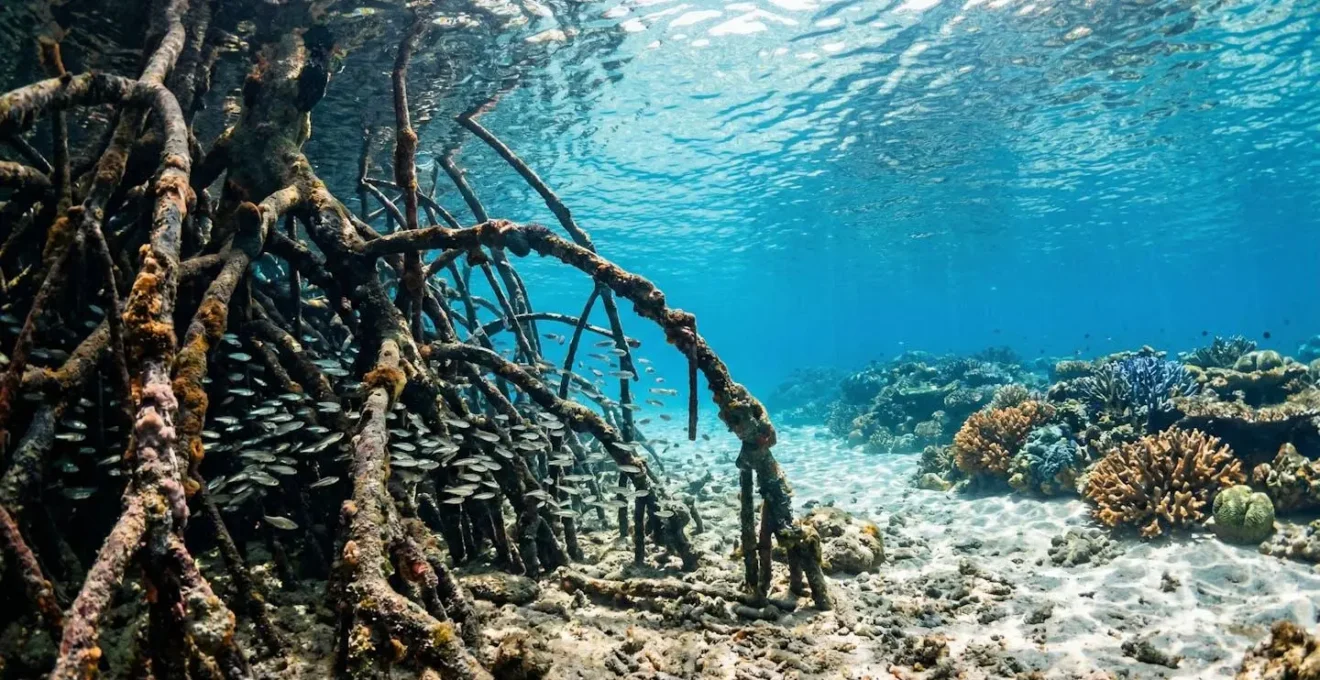
The pristine beaches, vibrant reefs, and iconic wildlife of the Dominican Republic are not separate attractions, but products of a single, deeply interconnected ecological engine.
- Mangroves are the heart of this engine, acting as a complex filtration system for corals and critical nursery grounds for reef fish.
- When this natural infrastructure is compromised, consequences like massive sargassum blooms arise; when it thrives, it supports everything from the sand on the beach to the whales offshore.
Recommendation: To be a true nature lover, shift your perspective from visiting individual sites to understanding and supporting the health of the entire interconnected system.
The image of the Caribbean is often a simple one: brilliant white sand, turquoise water, and a vibrant coral reef just beneath the surface. It’s a picture of paradise, a collection of beautiful but separate postcards. As a nature lover, you appreciate the beauty, but you’re here for the story behind it—the science. You suspect, correctly, that this idyllic scene is not a happy accident but the result of a complex, hidden engine working tirelessly behind the curtains. The common advice focuses on individual elements: don’t touch the coral, use reef-safe sunscreen. These are important, but they miss the bigger picture.
This is where we must shift our perspective from looking at individual pieces to understanding the whole machine. The true key to the health of the coral reefs, the clarity of the water, and the stability of the entire coastal economy isn’t found on the reef itself, but in the dense, tangled, and often-overlooked mangrove forests lining the shore. These ecosystems are not just another part of the landscape; they are the master regulators, the kidneys and the cradle of the entire coastal system. This is a lesson in systems thinking, seeing the invisible threads that connect a muddy lagoon to a multi-million dollar tourism industry.
This guide will take you on a journey through this interconnected web. We won’t just list facts; we will unravel the bio-feedback loops and ecological dependencies that make the Dominican Republic such a powerhouse of biodiversity. By understanding how the system works, from the fish that create the sand to the nutrients that feed the flamingos, you will learn to see the environment not as a collection of sights, but as a single, living organism. And in doing so, you will understand what real ecotourism and conservation truly mean.
To truly grasp the intricate dance between these vital ecosystems, this article breaks down the most critical connections. Follow along as we explore the surprising roles of fish, the threat of seaweed, the life within the lagoons, and how you can become a part of the solution.
Summary: The Interconnected World of Mangroves and Reefs
- Why the DR Is the Top Choice for Nature Lovers Seeking More Than Just Resorts?
- Why the Parrotfish Is Crucial for Those White Sandy Beaches?
- The Impact of Sargassum: What Travelers Need to Know About Seaweed?
- Laguna de Oviedo or Gri-Gri: Which Lagoon Teems with More Life?
- How to Participate in Coral Restoration Programs as a Diver?
- When Do the Flamingos Return to the Salt Flats?
- How to Book an Ethical Whale Watching Tour That Respects the Animals?
- How to Distinguish Real Ecotourism from “Greenwashing” in the DR?
Why the DR Is the Top Choice for Nature Lovers Seeking More Than Just Resorts?
The Dominican Republic’s allure for the discerning nature lover lies not just in the quality of its individual ecosystems, but in their proximity and profound interdependence. While other destinations offer stunning beaches or lush rainforests, the DR presents the entire ecological story in one accessible location. The Caribbean region is a global stronghold for mangroves, and this concentration is the starting point for understanding the island’s unique appeal. It’s a place where the concept of ecological interdependence is not a theoretical lesson but a visible reality.
What sets the DR apart is the ability to witness the “ridge-to-reef” system in action. This term describes the crucial flow of water, nutrients, and life from the forested mountains down through the coastal plains, into the mangrove forests, and finally out to the coral reefs. Each stage influences the next. The rainforests capture water, the rivers carry it, and the mangroves act as the final, critical checkpoint. This interconnectedness creates a resilience and diversity that is rare. The Caribbean Tourism Organization highlights this unique value proposition, noting that the DR allows visitors to experience this entire chain firsthand, seeing how a healthy forest upstream directly contributes to a vibrant reef offshore.
This is why the DR is more than a resort destination; it is a living laboratory of systems thinking. It offers the chance to move beyond single-issue environmentalism and appreciate how a network of healthy habitats creates a whole that is far greater than the sum of its parts. The true luxury here is not just the five-star hotel, but the opportunity to see a fully functioning, world-class ecological system at work, a system where the mangroves are the quiet, unassuming heroes.
Why the Parrotfish Is Crucial for Those White Sandy Beaches?
That iconic, powder-soft white sand you travel thousands of miles to enjoy? You can thank a fish for that. And that fish, in turn, can thank the mangroves. This is one of the most direct and surprising examples of ecological interdependence. The hero of this story is the parrotfish, a brightly colored resident of the coral reef with a very important job. It’s a grazer, using its powerful, beak-like mouth to scrape algae off coral skeletons. This “cleaning” service is vital, as it prevents the coral from being smothered and allows it to thrive.
But the parrotfish’s work has a remarkable side effect. In the process of eating algae, it also ingests bits of the coral’s calcium carbonate skeleton. Its digestive system grinds this material down into fine particles, which it then excretes as pure, white sand. The scale of this production is staggering; research from NOAA Fisheries indicates that a single large parrotfish can produce over 5 tons of sand per year. The Dutch Caribbean Nature Alliance notes that the parrotfish spends up to 90% of its day performing this dual role of reef cleaner and sand factory.
This is where the system connects back to the mangroves. Parrotfish are reef-dwellers, but their health and numbers depend on the clean, clear water that healthy coral requires. Mangroves provide this by trapping sediment and pollutants from land-based runoff. Without healthy mangroves, the water becomes cloudy, stressing the coral, reducing algae for the parrotfish to eat, and ultimately, shutting down the very natural engine that creates those world-famous beaches. So, when you admire a pristine beach, you are witnessing the final product of a healthy ridge-to-reef system, a bio-feedback loop where mangroves enable corals to thrive, and parrotfish turn that thriving reef into a postcard-perfect shoreline.
The intricate process shown here, where the fish’s feeding directly produces sand, is a powerful visual reminder of how living organisms literally build the environments we cherish. It is a perfect illustration of a functioning ecosystem where every role is essential.
The Impact of Sargassum: What Travelers Need to Know About Seaweed?
In recent years, a new and unwelcome character has entered the Caribbean story: Sargassum. These massive floating mats of seaweed wash ashore, blanketing those pristine beaches in a thick, decaying brown layer, releasing a pungent smell and making swimming impossible. For the traveler, it’s a frustrating disruption. For the ecologist, it is a clear symptom of a system out of balance. Sargassum is not the problem itself; it is a distress signal from an ocean overwhelmed by excess nutrients.
Sargassum blooms naturally in the open ocean, but the recent explosive growth is fueled by increased nutrient runoff from agriculture and deforestation far inland. These nutrients, primarily nitrogen and phosphorus, flow down rivers and into the sea, acting as a super-fertilizer for the seaweed. The economic consequences are immense. A 2018 estimate put the cost to clean up Sargassum across the Caribbean at over $120 million. This is where the protective role of mangroves becomes critically clear. Mangrove forests are master filters, with complex root systems that trap sediment and absorb vast quantities of these very nutrients before they can reach the open ocean.
A healthy, intact mangrove coastline is the best natural defense against the sargassum crisis. By filtering the water, they effectively starve the sargassum blooms of the fuel they need to grow uncontrollably. Some forward-thinking tourism companies have recognized this connection and are shifting from reactive clean-up to proactive, nature-based solutions.
Case Study: Iberostar’s Mangrove-Centric Strategy
Facing the dual threats of coastal erosion and sargassum, the Iberostar group has placed mangroves at the heart of its sustainability strategy. Recognizing that 80% of its properties are on the seafront, the company has invested in planting over 1,500 mangroves in the Dominican Republic. This isn’t just for show; it’s a core business strategy to protect their assets by strengthening the natural systems that defend the coastline and maintain water quality, directly combating the conditions that lead to sargassum influxes.
The presence of sargassum is a powerful lesson in cause and effect. It demonstrates that deforestation in one area can lead to a ruined beach vacation in another, and that the best solution is often not a bulldozer on the beach, but a conservation project in the wetlands.
Laguna de Oviedo or Gri-Gri: Which Lagoon Teems with More Life?
For the nature lover wanting to see a mangrove ecosystem up close, the Dominican Republic offers spectacular choices like Laguna de Oviedo in the Jaragua National Park or Laguna Gri-Grí on the north coast. The question isn’t which one is “better,” but rather, what makes a mangrove lagoon a vibrant hub of life? The answer, once again, lies in understanding the system. A thriving mangrove lagoon isn’t just a body of water with trees; it’s a dynamic environment whose health is a direct indicator of the health of the entire coastal region.
These lagoons are the nurseries of the sea. Their tangled, submerged roots provide a complex, protected habitat for the juvenile stages of countless species of fish and crustaceans. Many of the colorful fish you later see on the coral reef spent their vulnerable youth sheltering here. This nursery function is so critical that studies have shown there can be as many as 25 times more fish on reefs adjacent to healthy mangrove areas compared to those where mangroves have been removed. Furthermore, these lagoons are biodiversity hotspots in their own right; research indicates a single mangrove system can support up to 80 different species of fish, birds, and invertebrates.
So, how can you, as a visitor, assess the health of a lagoon? You can learn to read the signs. An ecologist looks for key indicators that signal a functioning system. Clear water indicates the mangrove roots are effectively trapping sediment. A high diversity of wading birds suggests a healthy food chain, with plenty of fish and invertebrates to eat. The presence of many small, juvenile fish swimming among the roots confirms its role as a productive nursery. The absence of large algae blooms shows that the mangroves are successfully filtering excess nutrients. Learning to spot these signs transforms a boat tour from a passive viewing experience into an active investigation of ecological health.
Action Plan: How to Spot a Healthy Mangrove Lagoon
- Check Water Clarity: Look for relatively clear water, especially away from river mouths. This shows the mangrove roots are doing their job of trapping sediment.
- Scan for Juvenile Fish: Peer into the root systems. A healthy lagoon will be teeming with small, young fish using the roots for shelter.
- Count the Bird Species: Note the variety of birds. Egrets, herons, pelicans, and frigatebirds all indicate a diverse and abundant food source.
- Observe Root Complexity: A healthy, mature mangrove forest will have a dense, tangled web of prop roots underwater, providing maximum shelter.
- Look for Minimal Algae: While some algae are normal, vast, thick mats of it (like on the surface) can signal nutrient pollution that the system is struggling to filter.
By using this checklist, you’re not just a tourist; you’re a citizen scientist, engaging with the environment on a deeper, more meaningful level.
How to Participate in Coral Restoration Programs as a Diver?
For certified divers, the desire to help can be strong, and participating in a coral restoration program seems like the most direct way to make a difference. These programs, where volunteers help to grow and “outplant” coral fragments onto degraded reefs, are growing in popularity. They offer a tangible, hands-on experience in rebuilding these vital underwater cities. In the Dominican Republic, organizations like FUNDEMAR are leading the charge, creating coral nurseries and involving the community in their efforts. However, the most effective programs are those that embody systems thinking.
An enlightened approach to coral restoration recognizes that simply planting new coral is like planting a garden in the desert without securing a water source. If the underlying conditions that caused the reef to decline in the first place are not addressed, the new corals are unlikely to survive. The number one condition for coral health is clean, clear, sediment-free water. And as we’ve seen, that is the primary service provided by mangrove forests. Therefore, the most impactful and sustainable conservation efforts are those that integrate both coral and mangrove restoration.
This holistic approach is the future of marine conservation. It acknowledges the fundamental connection between the two ecosystems. As The Nature Conservancy wisely points out, the success of a coral reef is inextricably linked to the health of its neighboring mangroves.
Mangroves act as the system’s regulator, ensuring the water reaching the coral is clean and sediment-free, and how some programs integrate both mangrove and coral restoration activities
– The Nature Conservancy, Caribbean Mangroves Protection Report
As a diver looking to contribute, seek out organizations that talk about this connection. Ask them about their mangrove protection or planting initiatives. A program that works on both fronts is demonstrating a deep, systemic understanding of the problem. They aren’t just applying a bandage; they are working to heal the entire organism. By choosing to support such a program, you are investing in a long-term, resilient solution.
This image of a diver carefully tending to a coral nursery is a powerful symbol of hope and human ingenuity. The best of these programs understand that the health of these coral fragments ultimately depends on the health of the unseen mangrove forests on the shore.
When Do the Flamingos Return to the Salt Flats?
The sight of a flock of vibrant American Flamingos wading through the hypersaline waters of a salt flat is one of the Dominican Republic’s most breathtaking wildlife spectacles. It appears to be a world away from the tangled roots of the mangrove forest. Yet, in a perfect demonstration of the unseen web of systems thinking, the presence of these flamingos is a direct indicator of the health of the mangroves, even miles away. This connection reveals just how subtle and far-reaching the influence of these coastal forests can be.
Flamingos feed on brine shrimp and algae, tiny organisms that thrive only under very specific salinity conditions. These conditions are created in shallow salt flats where evaporation concentrates the salt. However, if too much freshwater runoff from rain and rivers floods the flats, the salinity drops, and the flamingo’s food source disappears. This is where the mangroves, often located between the rivers and the salt flats, play their regulatory role. The American Museum of Natural History notes that mangrove forests are incredibly efficient at filtering water and regulating its flow.
They act like a giant sponge, absorbing freshwater during heavy rains and releasing it slowly. This buffering effect maintains the stable, high-salinity environment in the salt flats that the flamingos’ food sources require. Without the mangroves, a heavy rainstorm could flush out the flats, causing the food web to collapse and forcing the flamingos to leave in search of better feeding grounds. The flamingo’s return is therefore not just a matter of season, but a matter of system stability.
Case Study: The Flamingo-Mangrove Feedback Loop
In areas like the Laguna de Oviedo, the interconnected system is clear. The surrounding mangrove forests regulate freshwater runoff from the nearby mountains. This ensures the lagoon maintains the specific hypersaline conditions needed for brine shrimp to flourish. The abundance of brine shrimp, in turn, is what draws the large flocks of American Flamingos. The vibrant pink color of the birds is itself a product of the pigments in the shrimp. Thus, the health and even the color of the flamingos are a direct, visible readout of the invisible water-filtering work being done by the mangroves.
This is systems thinking in its purest form. A seemingly unrelated event—the return of flamingos to a salt flat—is a direct consequence of the health of a different ecosystem. It’s a beautiful reminder that in nature, everything is connected, and the most important connections are often the ones we cannot immediately see.
How to Book an Ethical Whale Watching Tour That Respects the Animals?
Every winter, the warm, sheltered waters of Samaná Bay become the stage for one of nature’s most awe-inspiring events: the arrival of thousands of humpback whales to breed and calve. Whale watching is a cornerstone of the Dominican tourism economy, but for the conscious traveler, the question of ethics is paramount. How do you ensure your tour respects these magnificent creatures? The answer, surprisingly, starts on the shore, within the mangrove forests.
Ethical whale watching goes beyond just keeping a safe distance. True respect for the animals means understanding and protecting the integrity of their entire habitat. Whales choose these specific bays not just because they are calm, but because they are healthy. A key component of that health is water quality. Pollution and sediment from land-based sources can degrade these critical breeding grounds. As the Caribbean Marine Conservation Alliance states, an operator’s ethics begin long before a whale is even spotted. Choosing an operator who understands that the bay’s water quality is protected by surrounding mangroves is a powerful first step. These forests act as a natural filtration plant, trapping runoff and pollution that could otherwise harm the sensitive mothers and calves in the bay.
Furthermore, the entire marine food web that supports life in the bay is bolstered by the mangroves. They serve as nurseries for the small fish and crustaceans that form the base of the food chain, which ultimately supports the larger fish that whales may feed on in other areas. A healthy bay, rich in life, is a more attractive and suitable environment for the whales. An ethical tour operator understands this systemic connection. They are more likely to be involved in local conservation efforts, to contribute to the protection of the coastline, and to educate their guests not just about whales, but about the whole ecosystem that sustains them.
So, when booking a tour, ask questions that go beyond the boat. Ask what the company does to support local conservation. Do they partner with mangrove restoration projects? Do they educate guests on the ridge-to-reef connection? An operator who can speak intelligently about the role of mangroves is demonstrating a deeper commitment to the whales’ well-being than one who simply knows where to find them.
Key takeaways
- An ecosystem is not a collection of parts, but a web of interconnected relationships; the health of one part, like mangroves, directly determines the health of all others, like coral reefs.
- Visible problems like sargassum blooms or the absence of wildlife are often symptoms of a breakdown in these unseen connections, particularly the filtration and nursery services of mangroves.
- True ecotourism involves understanding this system, choosing operators who support it, and recognizing that conservation must be holistic, often focusing on restoring foundational habitats like mangroves to save iconic species like corals and whales.
How to Distinguish Real Ecotourism from “Greenwashing” in the DR?
You have journeyed through the unseen web that connects mangroves, reefs, sand, and wildlife. You are now equipped with the most powerful tool a traveler can possess: a systems-thinking perspective. With this new lens, you can cut through the noise of marketing and distinguish genuine ecotourism from superficial “greenwashing.” The difference is simple: greenwashing focuses on appearances, while real ecotourism focuses on the system.
A greenwashed operator might boast about using bamboo straws or having a sign that says “please reuse your towels.” These are not bad things, but they are superficial. They do little to address the fundamental health of the ecosystems that the entire business depends on. A real eco-tourism operator, on the other hand, understands the connections we have explored. Their actions demonstrate a commitment to the health of the entire system. They might not advertise it on a big banner, but their business practices will reflect it.
They support local conservation groups that are actively restoring mangrove forests. They hire local guides who can explain the role of the parrotfish and the importance of water clarity. They source their food from sustainable local farms to reduce agricultural runoff. They contribute to a circular economy that benefits the community and reduces pressure on natural resources. The Saint Lucia Mankote mangrove project is a prime example of this systemic approach, where tourism partners, government, and community members collaborated to restore a vital forest, understanding it was the best way to protect the wider tourism-dependent economy.
As a traveler, you vote with your wallet. By asking the right questions—”How do you support the local environment beyond your property?” “Are you involved in any mangrove or reef restoration projects?”—you send a powerful message. You are signaling that you are a discerning customer who values substance over style, systemic health over superficial gestures. You are looking for partners who are not just using the beautiful environment as a backdrop, but are actively invested in keeping its intricate engine running smoothly.
Your journey as a nature lover has brought you to a new level of understanding. It’s no longer just about admiring the beauty, but about appreciating the complex and fragile machinery that creates it. Your next trip can be more than a vacation; it can be a vote for the health of the entire ecosystem. Choose tour operators and destinations that don’t just show you the reef, but actively work to protect the mangroves that keep it alive.