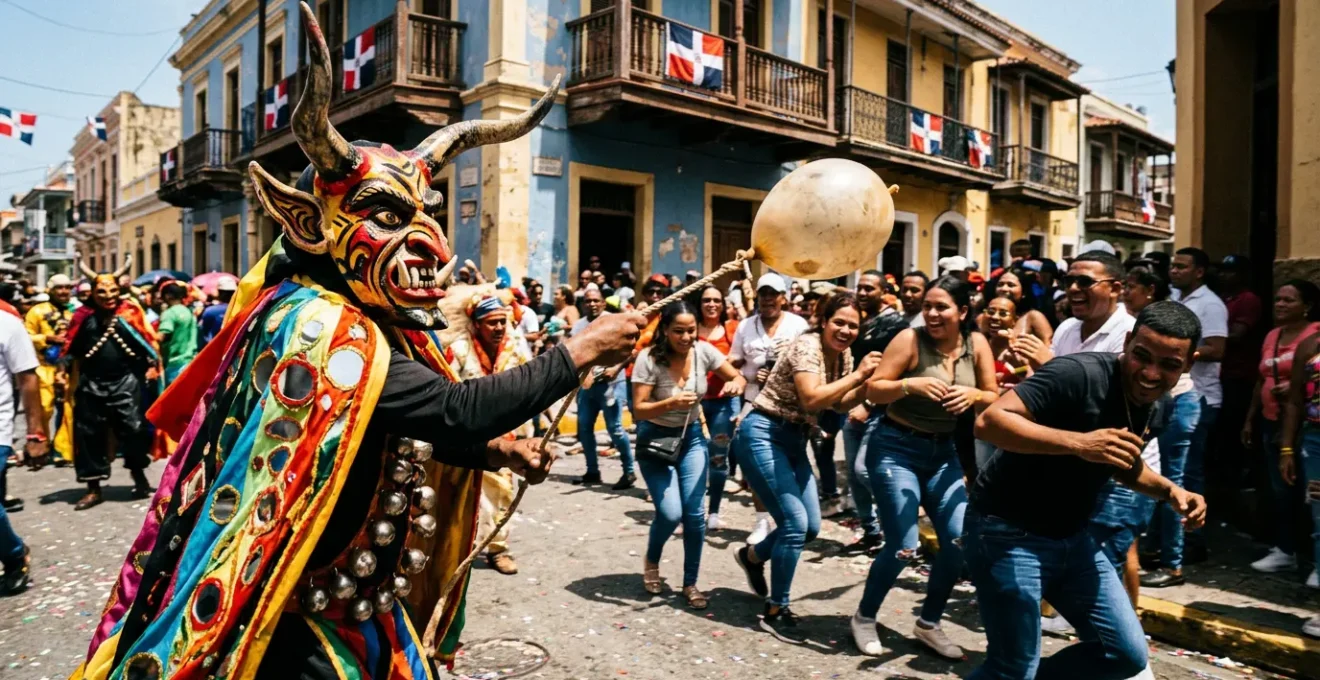
The thrill of the Dominican Carnival isn’t about avoiding the chaos; it’s about understanding its rules. You want the vibrant intensity of La Vega but fear the sting of a Diablo Cojuelo’s whip. This guide moves beyond generic advice, offering a veteran’s playbook on “controlled chaos.” Learn the unwritten social contract of the streets, strategic positioning, and how to participate authentically, ensuring you leave with incredible memories instead of just bruises.
The air crackles with merengue, a whirlwind of color and demonic masks rushes past, and then you hear it: the sharp *thwack* of an inflated animal bladder—a vejiga—connecting with someone’s backside. This is the heart-pounding, full-contact reality of the Dominican Republic’s La Vega Carnival. Many guides will tell you to watch for pickpockets and stay hydrated, but they miss the fundamental question on every first-timer’s mind: how do I soak in this incredible cultural explosion without getting relentlessly whipped?
The secret isn’t to hide or to run. The true key to mastering the carnival lies in moving from a fearful spectator to an informed participant. It’s about understanding the invisible lines and unwritten rules that govern the street-level chaos. This isn’t random violence; it’s a centuries-old ritual with its own logic. Forget simply avoiding the devils; this guide will teach you how to read their movements, signal your intentions, and control your level of immersion.
We’ll decode the “why” behind the whip, compare the major carnival parades, and equip you with a concrete safety strategy. From there, we’ll dive into the culture, showing you how to participate in local traditions respectfully, learn authentic dance steps, and even bring home a piece of the magic without being just another tourist. This is your playbook for controlled chaos.
This guide breaks down everything you need to know to navigate the beautiful chaos of the Dominican Carnival. Below is a summary of the key areas we will cover, from the traditions of the Diablos Cojuelos to the practicalities of photography and cultural participation.
Summary: Your Guide to the Dominican Carnival Experience
- Why Do the “Limping Devils” Hit Spectators with Inflated Bladders?
- La Vega or Santo Domingo: Which Carnival Parade Is More Visual?
- The Safety Strategy for Navigating Carnival Crowds with Valuables
- How Are the Elaborate Papier-Mâché Masks Created by Local Artisans?
- Which Sunday of February Is the Grand Finale of Carnival?
- How to Learn Authentic Bachata Steps Without Looking Like a Tourist?
- How to Participate in Local Traditions Without Being an Intruder?
- How to Photograph the White Sands Without Overexposing Your Shots?
Why Do the “Limping Devils” Hit Spectators with Inflated Bladders?
The hit from a Diablo Cojuelo’s vejiga (an inflated, dried, and cured cow bladder) isn’t an act of aggression but one of ritual purification. As local artisans explain, the tradition has deep roots in a story of a demon cast from heaven. This perspective is beautifully captured by a seasoned mask maker. In an interview during a CIEE workshop, carnival mask artisan Juan Pascual explains, “The whip is not an attack, but as a form of purification – when he hit the earth he hurt his leg, causing him to limp, and the vejiga represents his playful punishment for humanity’s sins.” This re-frames the entire experience from an assault to a shared, symbolic cleansing.
Understanding this is the first step; the second is learning the “social contract” of the street. The chaos is governed by unwritten rules. The center of the street is the “active zone” where participation is assumed and vejigazos are frequent. Sidewalks, vendor areas, and especially elevated porches are considered safer “observation zones.” To signal you’re not a target, stand on a curb, position yourself near Dominican families with small children (devils often avoid hitting near them), or use the “photographer’s immunity” by visibly holding up a camera. If a Diablo does approach, turning your back and playfully covering your rear shows you understand the game without inviting a harder hit.
La Vega or Santo Domingo: Which Carnival Parade Is More Visual?
Choosing between the Dominican Republic’s two premier carnivals depends entirely on the experience you seek. La Vega offers a gritty, immersive, and full-contact cultural dive, while Santo Domingo presents a grand, polished national showcase. Think of it as the difference between being in the middle of a mosh pit versus having front-row seats at an arena rock show. One is for thrill-seeking participants, the other for appreciative spectators.
To make the right choice, consider this breakdown of the two distinct carnival experiences. A recent comparative analysis provides a clear guide for travelers:
| Aspect | La Vega Carnival | Santo Domingo Carnival |
|---|---|---|
| Vibe | Immersive chaos, full-contact experience | Grand national showcase, spectator sport |
| Best For | Thrill-seekers and cultural immersion | Families and photographers |
| Photo Opportunities | Gritty close-ups, character portraits | Wide-angle floats, Malecon backdrop |
| Schedule | Every Sunday in February | Last Sunday of February |
| Crowd Density | Intense street-level interaction | Organized viewing areas |
As you can see in the image, the Santo Domingo parade along the oceanfront Malecón is a photographer’s dream, with massive floats, coordinated troupes, and an organized layout. This visual spectacle is designed for consumption from a distance, offering sweeping views and epic scale, perfectly aligning with its role as the national parade and grand finale for the country’s carnival season.
The Safety Strategy for Navigating Carnival Crowds with Valuables
A veteran’s safety strategy for La Vega goes beyond “watch for pickpockets.” It’s about proactive “Dominican Gearing” and “Defensive Positioning.” This means preparing your gear and choosing your spot wisely to minimize risk and maximize enjoyment. The first rule is to make yourself a less appealing target. Leave the expensive smartphone, jewelry, and credit cards in the hotel safe. Your on-the-street kit should be minimalist and secure.
A core part of this strategy is physical positioning. The main flow of the parade is for the brave and the prepared. By staying near permanent structures like walls or established vendor stalls, you create a buffer against unpredictable crowd surges and the main path of the vejigazos. Furthermore, a crucial update to the carnival experience reflects a growing awareness of different comfort levels. The organizers of Carnaval Vegano have now introduced a designated ‘no vejiga area’ on the avenue, a safe haven for families and observers who want to see the action without being part of it.
Your Pre-Carnival Gear & Safety Checklist
- Dominican Gearing: Wear a ‘cangurera’ (fanny pack) on your front, containing only essential cash in small bills.
- Phone Strategy: Carry a cheap prepaid ‘burner’ phone for emergencies; your primary phone stays in the hotel safe.
- Document Prep: Carry photocopies of your ID/passport in different pockets. The originals remain secured at your hotel.
- Footwear: Wear sturdy, closed-toe shoes with good grip. The streets will be slippery with spilled drinks and debris.
- Offline Prep: Pre-download offline maps of La Vega and screenshot emergency contact numbers before leaving your Wi-Fi zone.
How Are the Elaborate Papier-Mâché Masks Created by Local Artisans?
The soul of the Diablo Cojuelo lies in its careta, the elaborate and often terrifying papier-mâché mask. These are not mass-produced trinkets but pieces of folk art, born from generations of tradition in local workshops, or ‘talleres’. The creation process is a painstaking labor of love, starting with a clay mold that is then layered with strips of paper and glue. Once dried, the mask is sanded, painted, and adorned with horns, mirrors, and bells, each detail imbued with symbolism.
This legacy is embodied by artisans like Juan Pascual, who has been a central figure in the carnival world for decades. An account of a workshop with him details how Juan Pascual, an artisan with over 40 years of experience, demonstrates the traditional papier-mâché molding techniques passed down through his family. Seeing the works-in-progress, from bare molds to intricately painted final products, offers a profound appreciation for the craft.
For travelers wanting to bring a piece of this art home, ethical souvenir hunting is key. Avoid cheap plastic imitations sold on the street. Instead, seek out the ‘talleres’ in La Vega’s artisan districts. An authentic mask will have the hollow, resonant sound of real papier-mâché when tapped, not the dead thud of plastic. Look for the subtle imperfections of hand-painting versus the uniformity of machine prints. Reputable artisans are proud of their family legacy and will share it. Expect to pay a fair price—from $50 to over $200 USD—for a genuine piece of Dominican culture, a testament to the skill and heritage behind it.
Which Sunday of February Is the Grand Finale of Carnival?
While carnival celebrations happen every Sunday in February, the intensity and character of the crowd evolve each week, culminating in a massive celebration that merges with a key national holiday. The “Grand Finale” is effectively a two-part event: the final Sunday of carnival celebrations, followed by the national parade on Dominican Independence Day, February 27th. For tourists seeking the ultimate spectacle, this final week is the time to go.
Each Sunday offers a different “vibe,” allowing you to choose your experience, from a more local feel to the peak tourist-filled pandemonium. A vibe-check guide from a breakdown of the Carnaval Vegano schedule helps clarify the progression:
| Sunday | Date (2025) | Vibe | Best For |
|---|---|---|---|
| First Sunday | February 2 | Soft launch, locals testing costumes | Photographers, authentic experience |
| Second Sunday | February 9 | Building energy, growing crowds | Balance of authenticity and spectacle |
| Third Sunday | February 16 | Peak intensity, maximum participation | Full carnival experience seekers |
| Final Sunday + Feb 27 | February 23 + 27 | Grand finale merging with Independence Day | Tourists wanting the ultimate spectacle |
The scale of this finale is immense, with official projections anticipating as many as 900,000 visitors for the season. This convergence of carnival revelry and national pride on February 27th creates an unparalleled atmosphere of celebration, as depicted by the sea of flags and costumes under twilight fireworks.
How to Learn Authentic Bachata Steps Without Looking Like a Tourist?
Forget the flashy, complicated turns you see in ballroom bachata. Authentic Dominican bachata is all about ‘el sentimiento’—the feeling, the connection with your partner, and the subtle, rhythmic hip movement known as ‘cadencia’. The best place to learn is not a dance class, but a local ‘colmado’ (a neighborhood corner store that doubles as a bar and social hub). This is a form of environmental learning where you absorb the culture naturally.
The strategy is simple. In the evening, find a colmado with music playing. Buy a large Presidente beer or a small bottle of rum to share—this is a social currency that signals you’re here to participate, not just to observe. Start with merengue, which uses a simpler two-step and is easier to pick up. Watch how locals move; notice that the action is in the hips, not the feet. When a local invites you to dance, always accept. They are often patient and encouraging teachers, especially if you show genuine interest and a willingness to laugh at yourself. The goal isn’t to master complex patterns but to catch the rhythm and connect with the music and the people.
How to Participate in Local Traditions Without Being an Intruder?
The line between enthusiastic participant and intrusive tourist is тонкий, but it’s easy to stay on the right side of it by understanding the local “currencies of participation.” This isn’t about money; it’s about showing respect, enthusiasm, and a willingness to engage on their terms. The simplest currency is your voice: cheer loudly, “Que viva el carnaval!” when a ‘comparsa’ (carnival troupe) passes by. This vocal support is always appreciated.
Another currency is sharing. If a local in your immediate ‘coro’ (friendly group hangout) offers you a small cup of rum, accept it graciously. Refusing can be seen as standoffish. In return, sharing your own snacks or buying a round for your immediate neighbors builds instant camaraderie. Photography is another key area. Before taking a close-up portrait of a Diablo, make eye contact, smile, and gesture with your camera. After you take the shot, show them the picture on your screen. They put immense effort into their costumes and love to see themselves in action.
For a deeper level of engagement, learn about the ‘caves’. These are the neighborhood-based organizations that form the carnival groups. According to an overview from insiders on the La Vega culture, these groups prepare year-round and are the heart and soul of the parade. Showing genuine interest in a specific group’s traditions is the ultimate sign of respect and the fastest way to be welcomed into the fold.
Key takeaways
- Carnival safety is about strategic positioning and understanding the “social contract” of the street, not just avoidance.
- La Vega offers an intense, full-contact immersion, while Santo Domingo provides a polished, family-friendly spectacle. Choose based on your tolerance for chaos.
- Your participation is a currency: cheering, sharing drinks, and learning key slang like ‘vejigazo’ and ‘careta’ will earn you respect and a better experience.
How to Photograph the White Sands Without Overexposing Your Shots?
While Dominican beaches are famous, the real photographic challenge is capturing the explosive energy of the carnival under the harsh Caribbean sun. The dazzling costumes, covered in mirrors and sequins, are a nightmare for any camera’s auto-exposure. To get great shots without blowing out the highlights, you need to take manual control and think like a pro.
First, switch your camera’s metering mode to spot metering. Aim the spot at a mid-tone on the costume—a patch of colored fabric, not the shiny mirrors or white elements. Then, intentionally underexpose your shot by 1/3 to 2/3 of a stop; this preserves the crucial detail in the brightest parts of the image. A polarizing filter is a must-have accessory; it will dramatically cut down on the glare from metallic decorations and deepen the colors of the sky and costumes.
To capture the action, use a fast shutter speed (1/500s or faster) to freeze the Diablos in mid-air during a jump or a vejigazo. Alternatively, experiment with a slow shutter speed (like 1/15s) and pan your camera along with a moving parade float to create a dynamic motion blur that conveys the energy of the day. Finally, remember that the best photos often tell a story. Instead of just focusing on the action of the hit, look for the reaction: the laughter, the surprise, and the shared joy that follows. These are the images that truly capture the spirit of carnival.
Now that you have the veteran’s playbook for navigating the beautiful chaos, from safety strategies to cultural etiquette, the next step is to put it into practice. This knowledge transforms the carnival from a potentially intimidating event into an accessible, deeply rewarding cultural adventure.