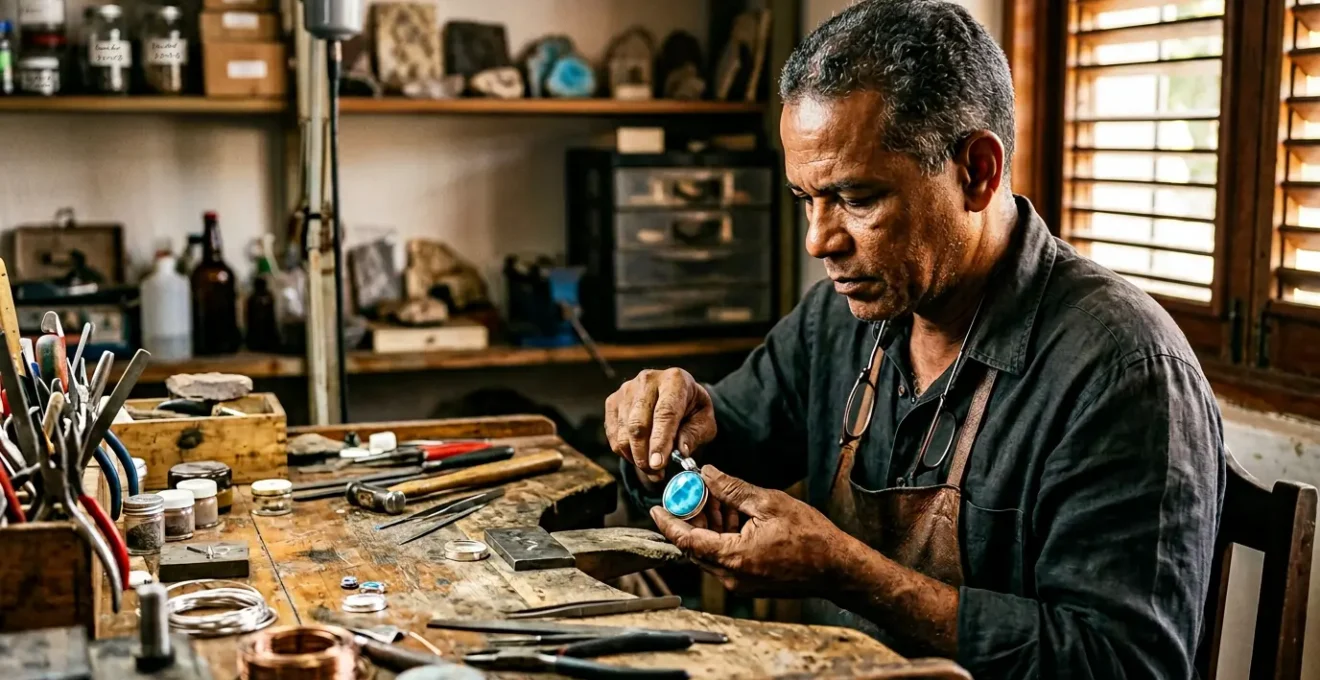
Acquiring a significant piece of jewelry in Santo Domingo is not about shopping; it’s about commissioning wearable art with a story.
- Understand the material’s soul: Distinguish authentic Larimar and Amber and choose the metal that honors the stone’s character.
- Navigate the artisan ecology: Select the right environment—from historic workshops to private studios—to connect with a true creator.
Recommendation: The process begins before your trip. Start by creating a personal design brief that captures the story you want your piece to tell.
The desire for a unique travel memento often leads us down crowded streets lined with glittering trinkets. In Santo Domingo, this path is particularly dazzling. You’re searching for more than a souvenir; you want a piece with a soul, something that captures the island’s essence. The typical advice is predictable: explore the Zona Colonial, look for the iconic Larimar and Amber, and haggle. But for the fashion-forward traveler, this approach barely scratches the surface. This isn’t surprising in a country whose passion for adornment is palpable; in fact, the Dominican Republic is a major player, with a high rate of jewelry consumption.
But what if the true art of acquiring a masterpiece lies not in finding a finished piece, but in co-creating one? What if you shifted your mindset from buyer to patron? This guide reframes the journey. It’s not about what to buy, but how to commission. We will move beyond the simple certificate of authenticity and toward building a complete “provenance dossier” for your piece—a collection of its story, its materials, and its maker. This is your personal stylist’s brief for curating, not just collecting.
Together, we will explore the three fundamental pillars of this creative process. First, we’ll develop a deep appreciation for the island’s geological treasures. Then, we’ll identify the ideal environment to find a master artisan. Finally, we’ll outline the precise steps to commission a piece of wearable art that is unequivocally yours, a true narrative woven in metal and stone.
This article provides a complete roadmap for the discerning traveler. Follow these sections to transform your quest for a souvenir into a sophisticated act of artistic patronage.
Summary: Your Guide to Commissioning Jewelry in Santo Domingo
- Silver or Gold: Which Metal Best Compliments Larimar?
- The Certificate You Must Ask For When Buying Expensive Stones
- Zona Colonial vs Shopping Malls: Where Are the High-End Jewelers?
- How to Commission a Piece from a Local Goldsmith?
- The Sunscreen Mistake That Ruins Silver Jewelry at the Beach
- How to Distinguish Real Amber from Plastic Fakes in Gift Shops?
- Why Is Larimar Found Only in One Mountain in the Dominican Republic?
- How to Explore Santo Domingo’s Modern and Ancient Sides in 48 Hours?
Silver or Gold: Which Metal Best Compliments Larimar?
The first decision in your design brief is choosing the metal that will house your gemstone. This isn’t merely a preference; it’s a stylistic choice that profoundly impacts the stone’s expression. Larimar, with its palette of Caribbean blues, offers a fascinating canvas. While gold brings warmth and a classic, high-value feel, .925 sterling silver is the metal of choice for most artisans and connoisseurs. Silver’s cool, crisp tone acts as a perfect frame, enhancing the icy blues and cloud-like white patterns within the pectolite stone without competing with them.
From a practical standpoint, silver also offers superior durability in the Caribbean’s humid climate. It resists tarnish better than lower-grade alloys and provides a strong setting for the stone. Furthermore, your budget goes further with silver, allowing you to commission a larger, more impactful statement piece. The aesthetic synergy is undeniable: think of a clear sky blue Larimar set in polished silver—it’s the epitome of coastal elegance. Gold is traditionally reserved for the rarest, deep “volcanic blue” AAA-grade Larimar, where its richness complements the stone’s intensity.
Ultimately, the choice reflects your personal style and skin tone. Silver beautifully complements cool undertones, making the blue of the Larimar pop. Gold flatters warmer complexions, creating a luxurious, sun-kissed effect. As a stylist, I advise clients to consider not just the stone, but the entire composition. The metal is not just a setting; it’s the supporting actor that helps the star—the Larimar—truly shine.
The Certificate You Must Ask For When Buying Expensive Stones
In the world of fine jewelry, authenticity is paramount. However, a fashion-forward curator thinks beyond a simple certificate. Your goal is to build a “provenance dossier” for your piece. This is more than a receipt; it’s the documented history of your wearable art, and the certificate of authenticity is just the first page. When engaging with a jeweler for a significant purchase, asking for this documentation is non-negotiable. But don’t stop there. A true dossier requires a deeper inquiry.
You must ask the seller or artisan specific questions to build this narrative. Where exactly was the stone mined? Can they tell you about the artisan who cut the stone and the one who crafted the setting? Reputable Dominican jewelers and workshops are proud of their craft and will gladly share this information. When you commission a piece, this becomes even more critical. Documenting the process is part of the experience. This dossier should include:
- The official certificate of authenticity, verifying the stone’s type and grade.
- The artisan’s name and workshop location.
- Information about the stone’s origin (e.g., the Los Chupaderos mine for Larimar).
- Photographs you take during the creation process, if possible.
This collection of information transforms your jewelry from a beautiful object into a piece with a verifiable history and a personal connection. It’s the difference between buying a product and investing in a story. This hallmarking of both material and maker is what gives the piece its true, lasting value beyond the carat weight or market price.
Zona Colonial vs Shopping Malls: Where Are the High-End Jewelers?
Choosing where to commission your piece is a strategic decision that defines your entire experience. Santo Domingo presents a fascinating spectrum of “artisan ecologies,” each with distinct advantages. You are not just choosing a store; you are choosing your creative partner and the environment in which your piece will be born. The two primary hubs are the historic Zona Colonial and modern, climate-controlled shopping malls, with private workshops offering a third, more intimate option.
The Zona Colonial is the heart of the artisan scene. Here, you’ll find independent workshops where you can often meet the jewelers themselves. The atmosphere is steeped in history, and the pieces often reflect unique, one-of-a-kind designs. This is the ideal environment for a traveler seeking character and a direct connection to the creator. To deepen your understanding before you buy, a visit to the Larimar Museum in this district is essential. It provides invaluable context on the stone’s history and helps you recognize quality. In contrast, high-end shopping malls like Blue Mall or Ágora Mall host established, reputable retailers. They offer brand consistency, certified stones, and a comfortable, air-conditioned experience, but often at a premium price and with less direct access to the artisans.
The following table breaks down the key differences, helping you select the environment that best aligns with your “design brief” and curatorial goals. As an analysis from a recent comparative guide shows, the best choice depends on your priorities: uniqueness, price, or brand assurance.
| Location Type | Advantages | Price Range | Authenticity Level |
|---|---|---|---|
| Zona Colonial | Historical setting, artisan workshops, unique pieces | Mid to High | High – direct from creators |
| Shopping Malls | Brand consistency, certified stones, climate-controlled | High to Premium | High – established retailers |
| Private Workshops | Custom work, direct artist relationship, best prices | Variable | Highest – witness creation process |
For the true curator, the ultimate experience often lies in a private workshop, which you typically find through research and referrals. This is where you can achieve the highest level of customization and build a genuine relationship with the goldsmith, making the creation process itself part of your piece’s story.
How to Commission a Piece from a Local Goldsmith?
Commissioning a custom piece of jewelry is the ultimate act of personal expression and the pinnacle of the curatorial travel experience. It elevates you from a consumer to a collaborator. This process requires preparation, communication, and a clear vision. You are creating a “design brief” to guide the artisan. This brief should be a mix of visual inspiration (mood boards, sketches) and technical specifications, including your preferred metal, stone grade (aim for AAA-grade Larimar for the deepest blues), and precise measurements.
The journey begins at home, with research. Identify reputable jewelers or artisan workshops known for custom work before you even pack your bags. Once in Santo Domingo, visit several of your shortlisted artisans. This is not just for price comparison; it’s to find a stylistic match and build a rapport. Does their aesthetic resonate with yours? Do you feel a creative connection? Once you’ve chosen your artisan, you’ll present your design brief, agree on a timeline, and typically pay a standard 50% deposit, known locally as “el avance,” to begin the work. This is a crucial step in formalizing the collaboration.
To ensure a successful and memorable commission, following a structured approach is key. The following plan will guide you from initial concept to the final creation, ensuring your vision is realized beautifully.
Your Action Plan: Commissioning a Custom Piece
- Research reputable artisan workshops and jewelers known for custom work before your trip.
- Prepare your design brief with mood boards, preferred stone grades (AAA for deepest blue), and measurements.
- Visit multiple workshops to compare styles and build relationships with artisans.
- Agree on a timeline and pay the standard 50% deposit (‘el avance’) to begin work.
- Document the creation process with photos and artisan details for your provenance dossier.
The Sunscreen Mistake That Ruins Silver Jewelry at the Beach
Once you’ve commissioned or acquired your perfect piece of wearable art, protecting it becomes paramount, especially in a tropical environment. The biggest threat to your jewelry’s longevity is often found in your beach bag. The cardinal rule is to avoid all contact with sunscreen. Larimar is a porous stone, meaning it can absorb chemicals. The oils and chemicals in sunscreen can cause permanent discoloration, turning its beautiful blue hues a murky, dull shade. The same applies to chlorine from pools and even the salt in the ocean air and water. Always apply sunscreen first, let it dry completely, and then put on your jewelry, or better yet, save your finest pieces for evening wear.
This sensitivity to environmental factors is a key characteristic of the stone. As experts from a Dominican gemstone guide note, this extends even to light itself.
Larimar’s photosensitivity means its color can fade with prolonged sunlight exposure.
– Larimar Creations, Dominican Republic Gemstone Guide 2025
This underscores the need for mindful care. The high humidity and salty air of the Caribbean also accelerate the oxidation process on sterling silver, causing it to tarnish faster. This is why high-quality .925 sterling silver is the minimum standard; it offers the best resistance. To care for your piece, cleaning should be gentle. A simple bath in mild soap and warm water, followed by a soft cloth to dry, is all that’s needed to maintain its luster. Harsh chemicals and ultrasonic cleaners should be avoided at all costs, as they can damage both the stone and the silver’s patina.
How to Distinguish Real Amber from Plastic Fakes in Gift Shops?
Alongside Larimar, Dominican Amber is one of the island’s most sought-after treasures. Its rarity and unique properties, especially the coveted blue variety, make it a prime target for imitation. In fact, due to its scarcity and unique fluorescent qualities, high-quality Dominican Blue Amber has become more expensive than gold. This high value means that tourist-focused gift shops can be rife with plastic or copal (young, immature resin) fakes. As a discerning curator, you must be able to perform a few simple, non-destructive field tests to verify authenticity before you even consider a purchase.
Authentic Dominican amber has several tell-tale characteristics that imitations cannot replicate. Real amber feels surprisingly light for its size and warm to the touch, whereas plastic feels dense, heavy, and cold. Visually, look for natural imperfections under magnification. Real amber often contains tiny air bubbles, stress fractures, and sometimes even ancient inclusions like insects or plant matter—the very story of its prehistoric past. Fakes are often too perfect, too uniform in color.
To arm yourself against counterfeit pieces, familiarize yourself with these professional authentication methods. They can be performed discreetly and will quickly reveal a fake.
- Visual Test: Look for natural color variations and ancient inclusions (insects, plant matter) visible under magnification.
- Weight Test: Real amber feels surprisingly light and warm to the touch, while plastic feels heavy and cold.
- UV Light Test: Dominican blue amber glows a brilliant blue under ultraviolet light due to its natural aromatic hydrocarbons. Most fakes will not react.
- Friction Test: Rub the piece vigorously on a soft cloth. Real amber will emit a faint, pine-like resin scent and become statically charged, able to pick up small pieces of paper.
- Saltwater Test: In a cup with a solution of one part salt to two parts water, real amber will float, while most plastic and glass imitations will sink.
Why Is Larimar Found Only in One Mountain in the Dominican Republic?
The extraordinary rarity of Larimar is central to its allure. It is not just scarce; it is geographically unique. This sky-blue stone is found in only one place on Earth: a single, jungle-covered mountainside in the Bahoruco mountain range, near the city of Barahona. This incredible geological anomaly is the result of a perfect storm of volcanic activity that occurred millions of years ago. Hot volcanic gases pushed crystallized minerals, including this unique blue variety of pectolite, up through volcanic tubes or “pipes.” Over millennia, erosion washed these stones down the mountainside and into the Bahoruco River, which carried them to the Caribbean Sea.
This single-source origin is what makes Larimar so special. The mining process is difficult and laborious, confined to a small, specific area, as detailed by geological sources.
The most important outcrop of blue pectolite is located at Los Chupaderos, about 10 km southwest of Barahona, a single mountainside now perforated with approximately 2,000 vertical shafts.
– Wikipedia Contributors, Larimar Geological Information
The story of its modern discovery adds a layer of romance to its geological tale. Although it was first noted by a priest in 1916, it was officially “rediscovered” in 1974 by a local artisan, Miguel Méndez, and a visiting Peace Corps volunteer, Norman Rilling. Méndez, in a stroke of poetic inspiration, named the stone after his young daughter, Larissa, combined with the Spanish word for sea, “mar,” thus creating “Larimar.”
Understanding this story—the violent volcanic birth, the journey down the river, the single mountain source, and the loving name—is to understand the soul of the stone. It’s not just a blue mineral; it is a piece of the Dominican Republic’s unique geological and cultural history, a true treasure born from fire and water.
Key takeaways
- True value lies in commissioning a piece with a story, not just buying an object off a shelf.
- Build a “provenance dossier” by documenting the stone’s origin, the artisan’s name, and the creation process.
- The choice of metal and artisan environment (workshop vs. mall) are key stylistic decisions in your design brief.
How to Explore Santo Domingo’s Modern and Ancient Sides in 48 Hours?
Now that you are armed with the knowledge of a seasoned curator, you can strategically explore Santo Domingo to bring your vision to life. A 48-hour immersion is the perfect amount of time to gather inspiration, connect with the city’s creative pulse, and meet the artisan who will craft your piece. This itinerary is designed for the “jewelry hunter,” blending historical context with contemporary design discovery, culminating in the commissioning of your wearable art.
Day 1: Historical Immersion and Market Analysis. Your first day is dedicated to understanding the roots of Dominican design. Start your morning at the Amber Museum or Larimar Museum in the Zona Colonial. This is not just a tourist stop; it’s essential research to train your eye for quality and authenticity. In the afternoon, wander the colonial streets, not as a tourist, but as a designer. Look for architectural details, Taino motifs in art galleries, and the colors of the city. This visual library will inform your design brief. In the evening, browse the established jewelers in the Zona Colonial. Your goal is not to buy, but to analyze: compare styles, settings, stone grades, and price points. This is your market research.
Day 2: Contemporary Vision and Artisan Connection. Your second day shifts from the past to the present and future of your piece. Spend the morning visiting contemporary art galleries in more modern neighborhoods. Observe how today’s Dominican artists interpret their heritage. This will infuse your design with a modern sensibility. The afternoon is the culmination of your journey. With your design brief refined and your research complete, you will visit the private workshop of an artisan you pre-researched and arranged to meet. This is where the magic happens. You’ll discuss your vision, build a creative partnership, and formally commission your piece. This act transforms your trip into a legacy, a story you will wear for years to come.
Your journey from traveler to curator begins now. Start by sketching the story you want your piece to tell, and use this guide to bring that narrative to life in the heart of the Caribbean, creating a piece of wearable art that is profoundly and uniquely yours.