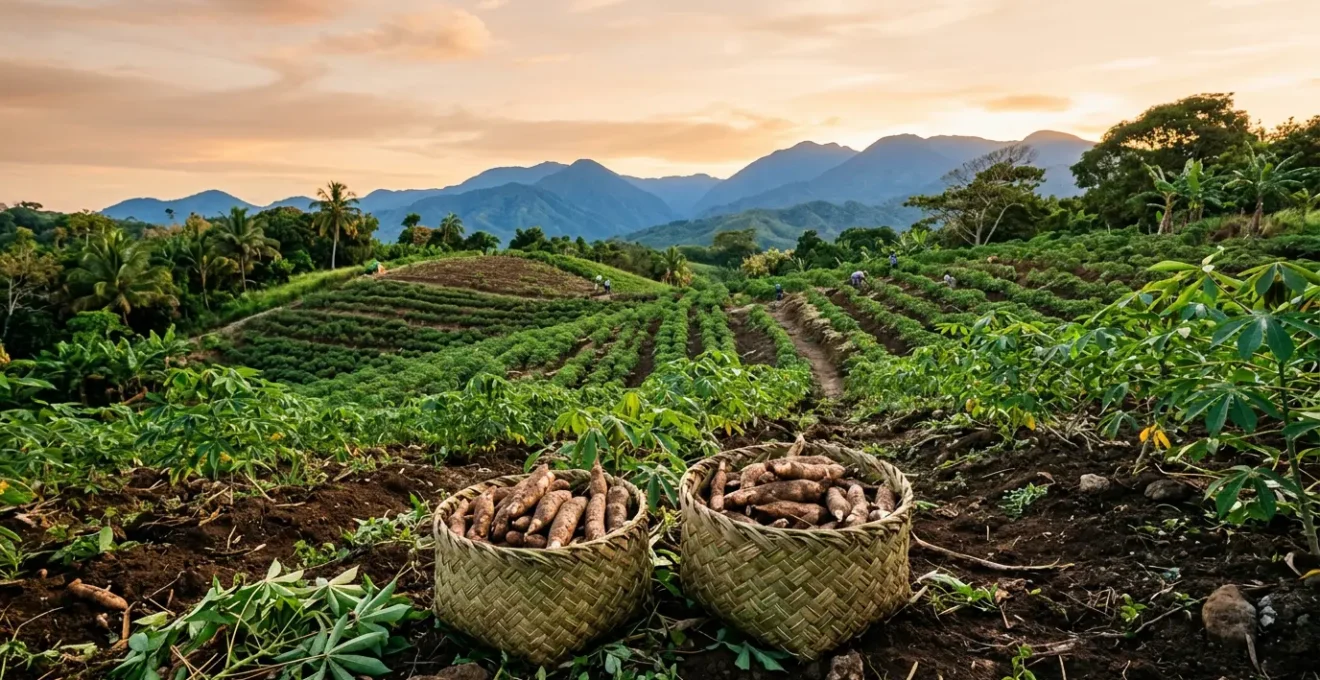
Taino culture is not extinct; its sophisticated ecological wisdom is still edible and can be experienced directly through the food on your plate today.
- The survival of Taino heritage is best understood through living systems like casabe bread making and conuco farming, not just as historical relics in a museum.
- The foundational ‘flavor DNA’ of Taino spices and ancient cooking methods like the fogón forms the very base of modern Dominican cuisine, waiting to be decoded.
Recommendation: To truly connect, approach your travels as a culinary anthropologist—engage critically with museums, artisans, and farms to find authentic continuity, not just a rehearsed historical narrative.
As a traveler with a taste for authenticity, you’ve arrived in the Caribbean craving more than a resort buffet. You’re searching for a connection, a story, a flavor that speaks of the island’s soul. The common narrative presents Taino culture as a relic of the past, a fascinating history confined to museums and archaeological sites. We’re told to look for their legacy behind glass, in the form of pottery shards and zemí figures.
But what if the most profound connection isn’t found in an exhibit, but on your plate? What if the Taino worldview wasn’t vanquished, but simply went underground, surviving in the culinary grammar of the island? This is the central thesis of a culinary anthropologist: culture is a living, breathing system, and nowhere is it more alive than in the food people grow, cook, and share. The Taino legacy isn’t a lost chapter; it’s the foundational syntax of the Caribbean’s edible language.
This guide will teach you to read that language. We will move beyond simple lists of ingredients to understand the systems, philosophies, and techniques that keep Taino traditions vibrant. From the elemental resilience of casabe bread to the spiritual significance of cacao and the smoky whisper of the fogón, you will learn to taste history and experience a culture that is very much alive.
The following sections will deconstruct the edible heritage of the Taino people, providing you with the tools to transform your next meal into a genuine cultural encounter. Prepare to embark on a journey of edible archaeology.
Summary: How to Experience Taino Traditions Through Food and Agriculture?
- Why Casabe Bread Is the Ultimate Taino Survivor in Cuisine?
- The Herbal Remedies from Taino Roots Used in Rural Areas Today
- Altos de Chavón Museum vs Museum of Dominican Man: Which Tells the Story Better?
- How to Distinguish Taino-Inspired Art from Cheap Souvenirs?
- When Is the Yucca Harvest That Celebrates Indigenous Roots?
- How to Tour a Cacao Plantation and Make Your Own Chocolate?
- What Are the “Holy Trinity” Spices of Dominican Cooking?
- How Does Cooking on a “Fogón” (Wood Fire) Change the Flavor?
Why Casabe Bread Is the Ultimate Taino Survivor in Cuisine?
Casabe is not merely a type of bread; it is an edible artifact, a direct link to the pre-Columbian Caribbean. This crisp, circular flatbread made from a single ingredient—bitter yuca (cassava)—represents an extraordinary feat of culinary engineering and cultural resilience. Its production involves a sophisticated, multi-step process to detoxify the poisonous yuca, transforming it into a durable, nutritious food source that could be stored for months. This technology was crucial for Taino sustenance, travel, and trade, making it a cornerstone of their society.
The cultural importance of casabe continues to resonate. Its enduring presence is so significant that it has garnered international attention, a fact underscored by the 2024 joint nomination by five Caribbean nations for UNESCO Intangible Cultural Heritage status. This recognition elevates casabe from a simple food item to a living tradition, a symbol of indigenous identity that has weathered centuries of change. For the traveler, tasting casabe is tasting history itself.
To truly appreciate this tradition, one must learn to distinguish artisanal casabe from its mass-produced counterparts. The authentic experience lies in the texture, aroma, and even the sound of the bread. Here’s what a culinary anthropologist looks for:
- Texture and Flexibility: Authentic casabe should be perfectly crisp yet possess a slight flexibility when fresh, unlike industrial versions which can be hard and brittle.
- Color Variation: A traditional casabe, cooked on a clay griddle or ‘burén’, will show a range of colors from pure white to a toasted golden brown, reflecting the artisan’s control of the heat.
- Visible Grain: Look closely. An artisanal bread will reveal the visible texture of cassava fibers, a rustic quality lost in the uniform smoothness of industrial production.
- The Snap: A well-made casabe produces a clean, distinctive crisp sound when broken—a testament to its perfect dehydration.
- Aroma: The most elusive quality is the subtle, smoky note imparted by a traditional wood-fired preparation, an aroma completely absent in factory-made products.
By learning to recognize these qualities, the traveler ceases to be a mere consumer and becomes a participant in the act of cultural preservation, appreciating casabe not just for its taste, but for the story it tells.
The Herbal Remedies from Taino Roots Used in Rural Areas Today
The Taino relationship with the natural world extended far beyond food. For the Taino, the forest was a living pharmacy, and health was a state of balance and harmony with the environment. This holistic worldview, where plants possess both nutritional and spiritual properties, has deeply influenced the healing traditions of the Caribbean. While often labeled as “folk medicine,” these practices represent a sophisticated system of ethnobotanical knowledge passed down through generations.
Today, this ancient wisdom is not confined to remote villages. It is experiencing a renaissance, recognized for its profound connection to well-being. Modern wellness centers are now looking to this heritage, integrating Taino principles into their therapies. This demonstrates a powerful continuity, where ancestral knowledge is not just preserved but actively applied in contemporary contexts.
Case Study: Cayo Levantado Resort’s Yubarta Wellness Experience
A prime example of this integration is the Cayo Levantado Resort. Their wellness program explicitly incorporates traditional Taino medicinal plants, such as guava leaves for their anti-inflammatory properties, anamú for its immune-boosting effects, and even references to the sacred cohoba tree in their spiritual therapies. This approach is guided by the Taino worldview of living in harmony with the earth’s natural cycles, proving how these ancient principles continue to inspire and inform modern, high-end wellness treatments in the region. This is not appropriation, but a respectful continuation of a living philosophy.
For the spiritual traveler, this means the path to connecting with Taino traditions may lead through a spa or a wellness retreat. It’s an opportunity to experience firsthand how the Taino understanding of plants as allies for the body and spirit remains a potent force in the quest for health and balance in the Caribbean today.
This fusion of ancient and modern highlights a crucial aspect of Taino survival: adaptation. The remedies persist because they are effective, and their underlying philosophy of harmony with nature resonates more strongly than ever in our modern world.
Altos de Chavón Museum vs Museum of Dominican Man: Which Tells the Story Better?
For any traveler seeking to understand Taino heritage, a museum visit seems like a logical first step. However, a culinary anthropologist knows that a museum is not a neutral container of facts, but a narrator with a point of view. The way a story is told—what is included, what is excluded, and whose voice is centered—is as important as the artifacts on display. In the Dominican Republic, the two foremost institutions, the Museo Arqueológico Regional Altos de Chavón and the Museo del Hombre Dominicano, offer vastly different narratives of the Taino past.
To go beyond the glass cases, one must ask critical questions about the stories being told. The following analysis compares the narrative focus and experience offered by these formal institutions against the “living museums” of contemporary Taino communities and farm-to-table projects where the culture is practiced daily.
| Aspect | Altos de Chavón | Museum of Dominican Man | Living Museums (Conucos) |
|---|---|---|---|
| Narrative Focus | Pre-contact archaeological story | Nation-building & ‘Indio’ identity | Contemporary practice & continuity |
| Experience Type | Artifacts behind glass | Historical documentation | Hands-on participation |
| Voice Represented | Archaeological interpretation | National narrative | Living Taino descendants |
| Cultural Authenticity | Frozen in time | Institutional perspective | Evolving tradition |
This comparison reveals that while traditional museums are invaluable for their collections, they often portray Taino culture as a finished historical chapter. To experience the Taino tradition as a living, evolving entity, the traveler must seek out the “living museums”—the conucos (traditional farms), the artisan workshops, and the community projects where the heritage is not just remembered, but lived. To aid in this critical engagement, here is a checklist for your visit.
Your Action Plan: Visiting with an Anthropologist’s Eye
- Identify the Voice: As you observe the exhibits, ask yourself: Whose voice is telling this story? Is it the archaeologist, the state, or the Taino people themselves? Whose voice is missing?
- Assess the Timeline: Does the museum’s narrative end in 1492, or does it acknowledge the survival, adaptation, and revival of Taino traditions into the present day?
- Look for Connections: How does the exhibit connect the artifacts to contemporary life? Are there links made to modern language, food, agriculture, or spiritual practices?
- Question the Portrayal: Are the Taino presented as passive historical subjects, or as an active, resilient culture? Does the narrative acknowledge and respect modern Taino descendants?
- Seek the Living Culture: After your visit, make a plan to find a “living museum.” Seek out a farm-to-table experience, an artisan co-op, or a cultural center that highlights the continuity of these traditions.
Ultimately, a complete understanding requires embracing all three narratives: the archaeological, the national, and the living. One tells you what was, the other tells you what it became, and the last tells you what it *is*.
How to Distinguish Taino-Inspired Art from Cheap Souvenirs?
The traveler’s quest for an authentic memento often ends at a market stall filled with generic souvenirs. But for the discerning eye, there is a world of difference between a mass-produced trinket and a piece of Taino-inspired art that carries cultural weight. The key lies in understanding that for the Taino, symbols were not mere decoration; they were a language used to express their cosmology, social structure, and connection to the spiritual world.
A cheap souvenir simply mimics a shape, while an authentic piece of art, created by an artisan who understands the tradition, respects the symbol’s original meaning or ‘voz’ (voice). Recognizing this difference transforms the act of shopping from a commercial transaction into an act of cultural appreciation. The first step is to learn the basic grammar of Taino symbolism.
This image captures the essence of living heritage—an artisan’s hands, guided by ancestral memory, carving sacred patterns into guayacan wood. To engage with this art form respectfully, familiarize yourself with some of its core symbols:
- Spiral Motifs: Far from being a simple swirl, the spiral represents cosmic energy, the eternal cycle of life, death, and rebirth, and the power of hurricanes.
- The Sacred Tree (Cohoba): Depictions of this tree reference the powerful hallucinogen used in cohoba ceremonies by caciques (chiefs) to communicate with the spirits (zemís).
- The Frog (Coquí): A ubiquitous symbol of Puerto Rico, the coquí frog is a powerful Taino emblem of fertility, rainfall, and life-giving water.
- Dujo Stool Patterns: The intricate geometric designs on a dujo, a ceremonial stool, were not just aesthetic. They indicated the social status and power of the cacique who sat upon it.
- Zemí Figures: These are not “gods” in the Western sense, but representations of spiritual beings, ancestors, or natural forces. Their depiction requires reverence and understanding.
When you encounter these symbols, ask the artisan about their meaning. An artist connected to the tradition will be able to share the story behind the symbol, while a mere vendor will only be able to tell you the price. In that conversation, you will find the true value of the piece.
When Is the Yucca Harvest That Celebrates Indigenous Roots?
One of the first things a culinary anthropologist learns is to question assumptions, especially those that seem to package culture into a neat, tourist-friendly event. The idea of a single, annual “yucca harvest festival” is a prime example. While it sounds like an authentic way to connect with indigenous roots, it’s a modern fiction based on a misunderstanding of Taino agricultural genius. The real story is far more interesting and reveals a profound ecological wisdom.
The Taino did not have a single harvest season for yuca (cassava) because they didn’t need one. They developed a revolutionary agricultural system that rendered such concepts obsolete. This system is the true celebration of their indigenous roots.
The Year-Round Abundance of the Conuco System
The heart of Taino agriculture was the conuco. These were not flat fields, but large, carefully constructed mounds of earth packed with leaves and organic matter. This design was a brilliant, sustainable innovation. The mounds provided excellent drainage in the tropical climate, protected the soil from erosion during heavy rains, and created a rich, self-fertilizing compost. This environmentally-friendly and nearly maintenance-free system allowed for the year-round cultivation and harvesting of cassava and other essential crops. The conuco was a living pantry, not a seasonal field, ensuring a constant food supply.
Therefore, the authentic way to celebrate the yuca harvest is not to look for a specific date on a calendar, but to understand and appreciate the continuous, sustainable cycle of the conuco. It’s about recognizing that the true “festival” is the system itself—a testament to an agricultural philosophy that worked in harmony with the land, rather than trying to dominate it.
For the traveler, this means shifting focus from finding a festival to finding a farm. Look for eco-lodges or agricultural projects that still practice conuco-style farming. Participating in the planting or harvesting of yuca, no matter the time of year, is the most genuine way to connect with this fundamental aspect of Taino heritage.
How to Tour a Cacao Plantation and Make Your Own Chocolate?
The story of chocolate is often told starting with the Aztecs and Maya, but cacao has deep roots in the Caribbean as well. While not as central as in Mesoamerica, cacao was part of the Taino’s agricultural and spiritual landscape. As the Journal of Agriculture, Food Systems, and Community Development confirms, “At the moment of conquest, the Taíno cuisines were rather simple, yet they included cacao as part of their agricultural and ceremonial practices.” Today, touring a cacao plantation offers a sensory-rich opportunity to connect with this aspect of the island’s heritage.
However, not all tours are created equal. A culinary anthropologist seeks more than just a tasting and a photo-op. The goal is to find plantations that honor the ecological principles inherent in Taino agriculture. This means looking for operations that practice agroforestry, where cacao trees are grown in a diverse ecosystem alongside other fruit and hardwood trees, mimicking the biodiversity of the natural forest and the Taino conuco.
To guide your choice, here are the critical questions to ask before booking a tour, moving you from a passive tourist to an engaged, conscious traveler:
- Farming Practices: Is this plantation practicing agroforestry that resembles the traditional Taino conuco system, or is it a monoculture crop?
- Economic Fairness: What percentage of the profits from this tour and the products sold goes directly to the local farmers and community? Is the operation Fair Trade certified?
- Ecological Impact: How does the cultivation of cacao here impact the local ecosystem, water sources, and wildlife? Do they actively work to enhance biodiversity?
- Cultural Authenticity: Beyond modern chocolate-making, do they offer insights into the traditional, ceremonial preparation of cacao, honoring its indigenous roots?
Choosing a tour that aligns with these values transforms the experience. Making your own chocolate becomes more than a fun activity; it becomes a participation in a sustainable, ethical system that has its roots in the ancient wisdom of the island’s first peoples.
What Are the “Holy Trinity” Spices of Dominican Cooking?
To understand the soul of a cuisine, you must understand its foundational flavors. In Dominican cooking, and across the Caribbean, this foundation is often a fragrant, complex blend of aromatics known as sofrito. But to call it a single “Holy Trinity” is to oversimplify a rich, layered history. The sofrito is more like a culinary text, with each ingredient representing a different chapter of the island’s past. From an anthropological perspective, the sofrito is a microcosm of Caribbean identity: indigenous roots, European colonization, and African diaspora, all blended into a singular, delicious whole.
Historical Layers in the Caribbean Sofrito
The “Holy Trinity” of Caribbean cooking is, in fact, a story told in three parts, each layer adding a new dimension of flavor and history. The base layer is Taino, built on indigenous ingredients like yautía, maize, and most importantly, ají peppers and recao (culantro). Upon this foundation, the Spanish added their Mediterranean sofrito elements: garlic, onions, oregano, and cilantro. Finally, the tragic history of the slave trade brought the African layer, introducing new ingredients and techniques that further enriched the blend. This makes the modern sofrito a powerful symbol of cultural fusion and resilience.
This layering of history is beautifully illustrated by tracing the evolution of the key aromatics. What began with indigenous peppers and herbs was transformed by colonial additions and later enriched by the African diaspora, creating the complex flavor profile we know today.
| Period | Key Ingredients | Cultural Origin | Modern Use |
|---|---|---|---|
| Pre-1492 (Taino) | Ají cachucha, annatto/bija, wild oregano | Indigenous Caribbean | Base flavor, color |
| Spanish Colonial | Garlic, cultivated oregano, cilantro | Mediterranean | Aromatic depth |
| African Influence | Additional peppers, culantro varieties | West African diaspora | Heat and complexity |
So, the next time you savor a dish seasoned with sofrito, remember that you are not just tasting garlic and peppers. You are tasting centuries of history, a complex and sometimes painful, but ultimately delicious, story of cultural convergence in a single bite.
Key Takeaways
- Taino culture is a living system best experienced through its foodways, not as a static museum piece.
- True authenticity lies in understanding the systems (like the conuco and sofrito) and the philosophies behind them, not just in tasting individual ingredients.
- Conscious travel involves asking critical questions of museums, artisans, and farms to find genuine cultural continuity and support sustainable practices.
How Does Cooking on a “Fogón” (Wood Fire) Change the Flavor?
If ingredients are the words and sofrito is the grammar, then the cooking method is the voice that tells the story. In the context of Taino culinary heritage, no voice is more resonant than that of the fogón, the traditional wood-fired hearth. To cook on a fogón is not simply to apply heat; it is to engage in a dialogue with fire, smoke, and time. This method fundamentally transforms the flavor of food, imparting a depth and complexity that cannot be replicated by a modern gas or electric stove.
The magic of the fogón lies in the slow, indirect heat and, most importantly, the smoke. The type of wood used—often from native trees like guava or jobo—infuses the food with aromatic compounds, adding a signature smokiness that becomes an ingredient in itself. This process is the living ancestor of a globally beloved cooking style.
From Barbacoa to Global BBQ: A Taino Legacy
The very word ‘barbecue’ is a gift from the Taino language. It derives from their word ‘barbacoa,’ which described not a sauce, but a technique: a wooden framework placed over a pit of coals. This method was used for the slow-cooking of meat and fish over low, indirect heat. The process had a dual purpose: the gentle heat cooked the food to tender perfection, while the continuous exposure to smoke both imparted a delicious, savory flavor and acted as a preservative. This technique, born of Taino ingenuity, is the direct ancestor of modern barbecue, a testament to the enduring power of their culinary innovations.
Cooking on a fogón is the final, unifying step in experiencing Taino culinary traditions. It is here that the yuca harvested from a conuco, seasoned with a historically layered sofrito, is kissed by the smoke of native wood. The resulting flavor is not just delicious; it is a taste of heritage, a sensory connection to the island’s most ancient past. It is the culmination of the entire system, a flavor that speaks of resilience, ingenuity, and a deep harmony with the land.
Your journey as a culinary anthropologist starts now. Use these tools not just to taste, but to understand. Your next meal is not just food; it is an opportunity to connect, to question, and to participate in the living, breathing history of the Caribbean.
Frequently Asked Questions about Taino Culinary Traditions
Is there a single yuca harvest festival date?
No, yuca is a tuber that can be harvested year-round thanks to the Taino’s conuco system, so there’s no single unifying harvest date. The idea of one is a modern interpretation, and the true “celebration” is the sustainable, continuous nature of the agricultural system itself.
How can travelers participate in authentic yuca harvesting?
Look for farm-to-table projects, community-based tourism initiatives, or eco-lodges that offer hands-on agricultural experiences. These venues allow you to learn to plant, harvest, and prepare yuca alongside local practitioners, offering a much more authentic connection than a staged festival.
What’s the difference between government folklore events and grassroots celebrations?
Grassroots gatherings, often rooted in the modern Taino revival movement, tend to offer more authentic and personal cultural exchange. Government-sponsored folklore events can be beautiful spectacles but are sometimes more focused on performance for tourists than on genuine community practice. For a deeper connection, seek out the smaller, community-led initiatives.