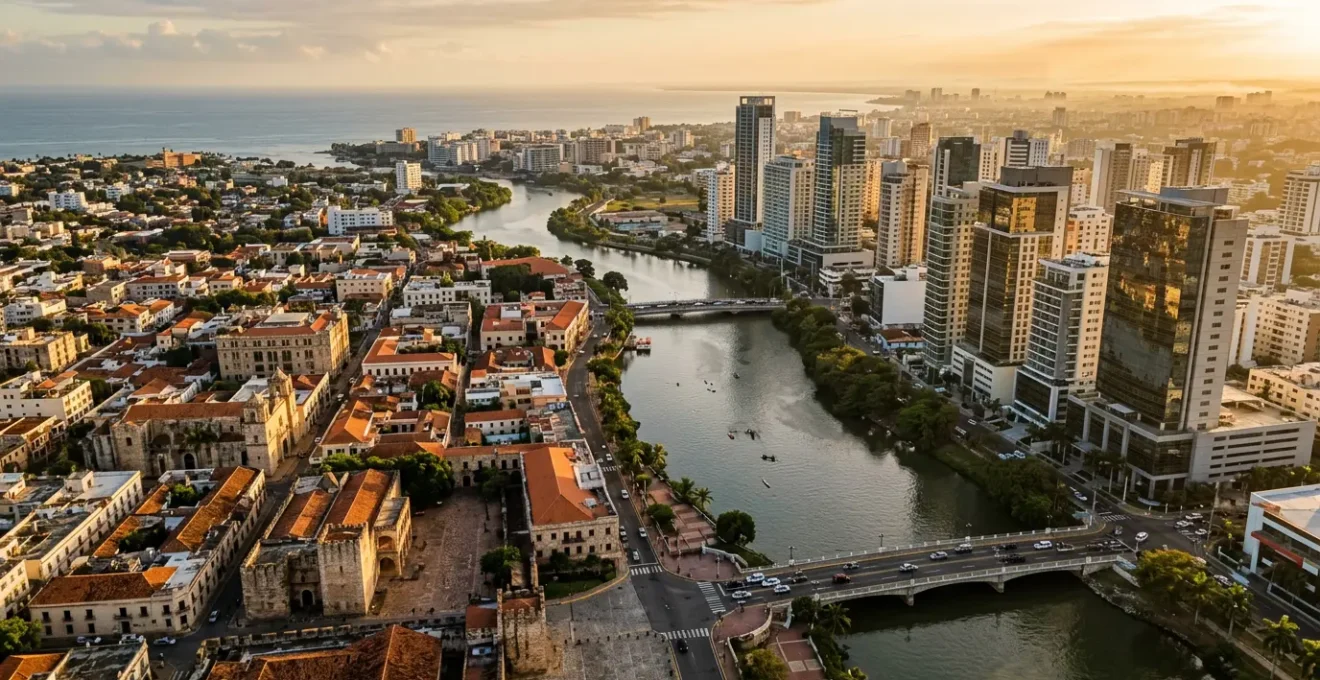
Most guides get Santo Domingo wrong, treating it as a city of two separate halves. The key is to see it as a single, living urban palimpsest where centuries collide.
- The city’s modern infrastructure, like the Metro, is your secret weapon to unlock both the gritty and glamorous sides beyond the tourist core.
- The ‘New Dominican Kitchen’ isn’t just a food trend; it’s a narrative of the nation’s history, from Taíno roots to global diaspora influences.
Recommendation: Approach your 48 hours not as a tourist ticking off a list, but as a modern historian deciphering the clues of this vibrant, chaotic, and utterly captivating capital.
Santo Domingo lures you in with a postcard promise: cobblestone streets, the echo of 16th-century conquistadors, and the warm embrace of Caribbean sun on colonial facades. The default travel plan is simple, almost instinctual: book a boutique hotel in the Zona Colonial and spend 48 hours wandering its historic grid. This approach delivers charm, but it only tells a fraction of the story. It conveniently ignores the sprawling, energetic, and complex metropolis of the 21st century that throbs just beyond the old city walls.
The real Santo Domingo isn’t a neatly divided museum piece. It’s a city of thrilling contradictions, a place of grit and glamour where a sleek, modern metro system runs beneath the routes of pirate raids, and world-class chefs are rediscovering ingredients first used by the Taíno people. But what if the key to truly experiencing Santo Domingo wasn’t to choose between its ancient past and its dynamic present, but to understand the thrilling friction between them? This guide is for the city-break traveler who sees the value in that friction, the modern historian who wants to read the layers of the city’s story. We will move beyond the obvious to build an itinerary that embraces the capital’s beautiful, chaotic, and delicious temporal collision.
This article provides a strategic framework for your two days in the capital. It will guide you through the city’s contrasting neighborhoods, its overlooked cultural gems, and its revolutionary culinary scene, showing you how to read the city like a local.
Summary: A 48-Hour Guide to Santo Domingo’s Contrasts
- Piantini or Zona Colonial: Where Should You Base Yourself?
- How to Use the Santo Domingo Metro to Skip Traffic Jams?
- 3 Small Museums in Santo Domingo That Most Guidebooks Ignore
- The Specific Streets You Should Avoid Walking After 10 PM
- Why Santo Domingo Is Becoming the Gastronomic Capital of the Caribbean?
- How to Trace the Steps of Columbus and Drake in the First City?
- Who Are the Chefs Leading the “New Dominican Kitchen” Movement?
- How to Walk the Defensive Walls of Santo Domingo and Understand the Pirate Attacks?
Piantini or Zona Colonial: Where Should You Base Yourself?
The first decision of your trip is the most strategic: where to sleep. This choice defines your entire 48-hour experience. Do you immerse yourself in the 16th-century ‘living museum’ of the Zona Colonial, or do you opt for the 21st-century pulse of Piantini? The Zona Colonial offers historic boutique hotels in restored mansions, walkable access to foundational sites, and romantic, plaza-side dining. However, it can feel like a tourist bubble, detached from the city’s modern heartbeat. Piantini, the city’s upscale business and residential district, offers international hotel chains, sophisticated nightlife, and a glimpse into the life of the modern Dominican elite. The trade-off is a reliance on taxis or rideshares to reach any historical attractions. Choosing your base is choosing your narrative: the historian or the modernist. But there are ways to blend both.
Your Santo Domingo Base: 5-Step Decision Guide
- Define Your Travel Persona: Identify your primary motive. Are you The Historian (drawn to colonial architecture), The Modernist (preferring contemporary amenities), or The Cultural Insider (seeking authentic local experiences)? Your answer is your north star.
- Consider Your Transport Needs: Inventory your likely destinations. If they are all in the old city, the Zona Colonial’s walkability is a major plus. If you have business meetings or want to explore modern malls, Piantini’s location is better.
- Evaluate Your Evening Preferences: Confront your nightlife style. Do you prefer the historic ambiance and live music of the Zona Colonial’s plazas, or the upscale bars and clubs of Piantini?
- Check Hotel Availability & Style: Look at the specific hotels available. Do you dream of sleeping in a 16th-century building, or do you need the reliability and amenities of a global hotel brand?
- Factor in Safety & Convenience: Assess your comfort level. All areas are generally safe, but the Zona Colonial is the most tourist-friendly at night, with better lighting and a consistent security presence for evening strolls.
Ultimately, the “right” choice depends on your priorities. For a first-time visitor seeking a balance, staying in the Zona Colonial but dedicating a full day to exploring modern districts via the metro or taxi offers the best of both worlds.
How to Use the Santo Domingo Metro to Skip Traffic Jams?
For a city founded in 1496, one of its most revolutionary features is decidedly modern: the Metro de Santo Domingo. While tourists remain tethered to the colonial grid, locals know the city’s notorious traffic, or ‘tapones’, can grind any itinerary to a halt. The metro is your secret weapon, a clean, efficient, and shockingly affordable system that acts as a wormhole between the city’s ancient core and its contemporary extensions. It is not just transportation; it’s a statement of modernity and a vital tool for the savvy traveler. Using it is a declaration that you are here to see the *real* city, not just its curated historical theme park. The gleaming, air-conditioned stations stand in stark architectural contrast to the weathered stone of the colonial city, a perfect example of the temporal collision that defines Santo Domingo.
For the visitor, the metro’s primary value is connecting the past to the present. You can spend your morning walking in the footsteps of Diego Columbus and then, for less than fifty cents, be transported to the Plaza de la Cultura to see modern Dominican art in under 20 minutes—a journey that could take an hour by car. To make your first ride seamless, follow this simple plan.
Your First Santo Domingo Metro Ride in 5 Steps
- Purchase your rechargeable ‘tarjeta’ card at any metro station booth (RD$30 for the card plus a minimum RD$20 credit).
- Load your card at the automated machines; each ride costs RD$20, so load enough for your planned round trips.
- Navigate using color-coded lines: Line 1 (blue) runs North-South, Line 2 (red) runs East-West. The key interchange is Juan Pablo Duarte station.
- Board during off-peak hours (avoiding 7-9 AM and 5-7 PM) for a more comfortable ride and remember to stand on the right on escalators.
- Exit at strategic stations like Eduardo Brito for the Zona Colonial (a 10-minute walk) or Casandra Damirón for the cluster of museums at the Plaza de la Cultura.
3 Small Museums in Santo Domingo That Most Guidebooks Ignore
While the grand museums of the Zona Colonial—the Alcázar de Colón, the Museo de las Casas Reales—are essential visits, they primarily tell the story of the Spanish victors. To truly understand the city’s complex soul, you must venture beyond the main attractions. Local tourism patterns show that less than 15% of Santo Domingo’s visitors explore museums outside this core circuit. This is a missed opportunity, as the city’s smaller, more intimate museums offer a rawer, more personal, and often more poignant look into the Dominican identity. They are the keepers of the city’s modern memory and its deep geological past. For the modern historian, these are not optional side-trips; they are the main event.
The first, and perhaps most crucial, is the Museo Memorial de la Resistencia Dominicana. This powerful museum chronicles the brutal 31-year dictatorship of Rafael Trujillo, a period that shaped modern Dominican society more than any other. It is an emotionally heavy but indispensable visit to grasp the country’s fierce attachment to its chaotic democracy.
Museo de la Resistencia: Understanding Modern Dominican Identity
This museum serves as a bridge between Santo Domingo’s dictatorial past under Trujillo (1930-1961) and its current democratic identity. Located in a former torture house, it documents the 31-year dictatorship through personal artifacts, testimonies, and resistance stories. The museum excels at filtering truth from propaganda about Trujillo’s regime, offering audio guides that contextualize the Dominican Republic’s complex relationship with democracy and its neighbor Haiti. Visitors report it as essential for understanding why certain streets are named as they are and how the city’s modern chaotic democracy emerged from authoritarian rule.
Second, for a dive into the island’s geological treasures, the Museo del Ámbar Mundo offers a fascinating look at the world of Dominican amber, famous for its clarity and the prehistoric inclusions often found within. Finally, the ChocoMuseo provides a hands-on history of chocolate in the New World, from its use by the Taíno people to its role as a key Dominican export today. These three institutions offer a more complete triptych of the Dominican story: its political struggle, its natural wealth, and its agricultural heritage.
The Specific Streets You Should Avoid Walking After 10 PM
Generic travel advice often includes vague safety warnings: “don’t walk alone at night” or “be aware of your surroundings.” This is unhelpful. For the savvy traveler in Santo Domingo, safety isn’t about avoiding entire districts; it’s about understanding the city’s rhythm and learning to “read the street” like a local. The security of a street is not a fixed attribute but a fluid state that changes dramatically with the time of day and the flow of commerce. The key insight is that a street’s safety is directly correlated with its level of local commercial and social activity. Empty streets, even in “good” neighborhoods, are less safe than busy ones.
For example, the main pedestrian thoroughfare, Calle El Conde, is bustling and safe during the day and early evening. After 10 PM, as shops close and the tourist footfall dissipates, it becomes quiet. While police presence keeps it relatively secure, its emptiness can feel unsettling. In contrast, Avenida Mella, a chaotic commercial artery by day, transforms more drastically. Once the countless vendor stalls pack up and the streetlights prove sporadic, its character shifts, and it is best avoided by visitors on foot. The rule is simple: commercial retreat signals a decrease in ambient safety. Instead of memorizing a list of “bad streets,” learn to spot the cues that Dominicans use to gauge their environment.
Pay attention to the colmados (corner stores); when they start pulling down their metal shutters, it’s a signal the neighborhood is winding down for the night. Notice the presence or absence of moto-conchos (motorcycle taxis); these drivers are the lifeblood of the city and their availability is a strong indicator of a street’s viability. If they are plentiful, the area is considered safe to traverse. When you see local families with children heading indoors around 8 or 9 PM, it’s a wise cue to follow their lead and transition from walking to taking a registered taxi or Uber for your late-night movements.
Why Santo Domingo Is Becoming the Gastronomic Capital of the Caribbean?
For decades, Caribbean fine dining was associated with other islands. But a quiet revolution has been simmering in Santo Domingo, and it has now reached a boiling point. The city’s high-end restaurant scene is not just growing; it’s exploding. Indeed, local tourism and hospitality data report that Santo Domingo’s high-end restaurant scene has grown 300% since 2020, with events like Taste Santo Domingo attracting global culinary attention. This isn’t just about more restaurants; it’s about a fundamental shift in how Dominican food is perceived, prepared, and celebrated. The city is rapidly and rightfully claiming its title as the gastronomic capital of the Caribbean.
The driving force behind this transformation is what can be called the “Diaspora Effect.” A new generation of Dominican chefs, after honing their craft in the world’s top kitchens in New York, Miami, and Spain, is returning home. They are armed with global techniques—sous-vide, deconstruction, modern plating—but possess a deep, personal connection to the island’s native ingredients. They are not importing foreign food; they are elevating local treasures. Humble staples like tayota (chayote), yautía coco (a creamy tuber), and leren (a crisp, ancient root) are being transformed from countryside fare into stars of fine-dining tasting menus.
This movement is a conscious act of cultural rediscovery. Chefs like Savero Stassi at Ajualá are leading the charge, applying modernist techniques to ingredients sourced exclusively from Dominican fields and coasts. This creates a dining experience that is both globally sophisticated and profoundly local. It’s a culinary expression of the city’s own identity: a deep respect for roots, seamlessly blended with a modern, outward-looking perspective. To eat in Santo Domingo today is to taste the story of the nation’s past, present, and future on a single plate.
How to Trace the Steps of Columbus and Drake in the First City?
Walking through the Zona Colonial is an exercise in time travel. This was the first permanent European settlement in the Americas, a fact palpable in the very stones under your feet. For the modern historian, the goal is not just to see the sights but to overlay the narratives of the city’s founders and its most infamous attackers. The two key figures that define this early era are Christopher Columbus, whose family established the city as the seat of their power, and Sir Francis Drake, the English privateer who ransacked it in 1586. Tracing their steps offers a compelling “then vs. now” journey through the heart of the first city.
Begin at the Fortaleza Ozama, the 1502 fortress that stands as the oldest military structure in the Americas. Stand on its ramparts overlooking the river and imagine Drake’s ships approaching, a scene that has barely changed in 500 years. Then, walk down Calle Las Damas, the first paved street of the New World. This is where the noble Spanish ladies, including the wife of Diego Columbus, would promenade. Notice the defensive architecture—thick walls, high windows—a clear indication that this colonial outpost was built with security in mind from day one.
Your walk should lead you to the Alcázar de Colón, the palace built for Diego Columbus, Christopher’s son. From its upper balconies, the strategic view of the harbor becomes clear; this was a command center, not just a residence. Finally, make your way to the Plaza de España. Today it’s a wide-open square lined with restaurants, but this was the original waterfront where Spanish galleons docked, unloading supplies and loading gold. It was from this vantage point that the Spanish empire expanded into the New World, and it was this same prize that drew the attention of pirates and privateers like Drake. The city was a base for exploration and a target for plunder, two forces that shaped its very existence.
Who Are the Chefs Leading the “New Dominican Kitchen” Movement?
The “New Dominican Kitchen” isn’t a monolithic movement led by a single figure. It’s a dynamic ecosystem of talented chefs, each contributing a unique perspective. Understanding these different approaches is key to navigating the city’s exciting culinary landscape. We can identify three main archetypes of chefs who are collectively reshaping Dominican cuisine and putting Santo Domingo on the global gastronomic map. Each type represents a different strategy for innovating while honoring tradition.
First is ‘The Culinary Archaeologist.’ This chef delves into historical texts and forgotten rural traditions to resurrect lost ingredients and recipes. They might work with biologists to revive pre-Columbian Taíno crops or pore over colonial-era manuscripts to recreate dishes from the 16th century. Their restaurants are like culinary museums, offering a taste of the island’s deepest history. They are fighting to ensure that the authentic flavors of the past are not lost to modernization.
Next is ‘The Alchemist.’ This chef is a master of modern technique, often trained in the labs of molecular gastronomy. They take iconic Dominican dishes, like the hearty seven-meat stew Sancocho, and deconstruct them. They might turn the broth into a clear consommé, transform the meats into delicate terrines, and present the root vegetables as foams or gels. The goal is not to erase the original dish but to present its essential flavors in a novel, thought-provoking form. They challenge diners to reconsider what a traditional dish can be.
Finally, and perhaps most importantly for the city’s fabric, is ‘The Barrio Champion.’ This chef focuses on elevating street food. They take the humble chimichurri burger or the beloved yaroa (a layered dish of french fries, meat, and cheese) and apply rigorous technique and high-quality ingredients. They might create their own artisanal bread for the chimi or use aged cheeses for the yaroa, transforming everyday food into a restaurant-worthy experience without losing its soulful essence. Together, these three archetypes create a vibrant and diverse culinary scene where tradition and innovation are in constant, delicious conversation.
Key takeaways
- Your choice of neighborhood—historic Zona Colonial or modern Piantini—is the single most important decision that will shape your 48-hour experience.
- Embracing modern infrastructure like the Metro is not just for convenience; it’s the key to unlocking the city’s authentic contemporary culture beyond the tourist bubble.
- Santo Domingo’s culinary scene is the most dynamic narrative of its identity, telling a story from Taíno roots to the global ‘Diaspora Effect’ on a single plate.
How to Walk the Defensive Walls of Santo Domingo and Understand the Pirate Attacks?
The remnants of Santo Domingo’s defensive walls are not just piles of old stone; they are the city’s very DNA, physical evidence of its birth in an age of constant threat. Built to protect the Spanish crown’s first foothold in the Americas from rival empires and opportunistic pirates, these fortifications tell a story of strategy, technology, and fear. To walk them is to understand the precariousness of colonial life and the engineering genius it inspired. The centerpiece of this system, Fortaleza Ozama, was not merely a castle but a sophisticated machine for 16th-century warfare, designed specifically to counter the threat of maritime assaults from figures like Sir Francis Drake.
The fortress’s design was a direct response to pirate tactics. Its 21-meter central tower provided unparalleled surveillance over the Ozama River, the city’s main artery. Its cannons were positioned not just to fire, but to create overlapping fields of fire in a “kill zone” at the river’s mouth. This strategic design was complemented by cutting-edge military architecture for its time, directly countering the evolving technology of naval cannons and siege warfare.
The following table breaks down how the city’s defensive technology was tailored to meet specific pirate threats, showcasing a deliberate and intelligent defensive strategy that you can still observe today.
| Defensive Element | Technology Used | Pirate Threat Countered |
|---|---|---|
| Stone Walls (3 meters thick) | Limestone blocks, mortar | Cannon bombardment from ships |
| Angled Bastions | Star fort design | Direct cannon fire, siege positioning |
| Firing Steps | Arquebuses, muskets | Scaling attempts, close combat |
| River Position | Natural barrier, controlled access | Surprise attacks, rapid retreat |
| Underground Storage | Vaulted tunnels | Fire attacks, gunpowder sabotage |
With this new lens for reading the city’s past and present, you are now equipped to go beyond the surface. Your 48 hours in Santo Domingo can be more than a vacation; they can be an investigation, a conversation between centuries. Use this guide to craft an itinerary that is uniquely yours, one that embraces the city’s glorious, complicated, and delicious whole.