The greatest misconception about the Dominican Republic is that its indigenous Taino people are extinct; the reality is their culture is a living heritage woven into the nation’s DNA, language, and landscape.
- Genetic studies confirm that a significant percentage of the Dominican population carries Taino mitochondrial DNA, a direct maternal link to the island’s first peoples.
- Everyday Dominican Spanish is filled with Taino words, and foundational agricultural practices like the conuco system are still in use.
Recommendation: Shift your perspective from looking for ruins to identifying the living Taino cultural substrate in the food you eat, the words you hear, and the sacred geography of the island.
For the curious traveler or cultural anthropologist, the Dominican Republic presents a fascinating paradox. The standard historical narrative, often learned in school, tells a grim story of the Taino people being swiftly wiped out by disease and violence following Columbus’s arrival. This has led to the pervasive and damaging myth of their complete extinction. Many visitors arrive expecting to find Taino culture only behind the glass of a museum display case, a relic of a lost world.
But what if this narrative is not just incomplete, but fundamentally wrong? What if the key to understanding the Dominican soul is not to mourn a vanished people but to learn how to recognize their living presence? The Taino were not erased; they adapted, intermarried, and integrated, creating a cultural substrate that underpins much of modern Dominican identity. Their influence is not a ghost but a genetic echo, a linguistic footprint, and a spiritual worldview that continues to shape the island today.
This guide is an act of active deconstruction. It moves beyond the platitudes of extinction to provide a practical framework for identifying the vibrant, living Taino heritage. We will explore the cosmological vocabulary hidden in plain sight, decode the genetic evidence of their survival, and learn to read the landscape not as a colonial map, but as a sacred Taino geography. This is your invitation to see the Dominican Republic through a new lens, one that honors the resilience and enduring legacy of its first people.
Summary: A Guide to Recognizing the Living Taino Heritage
- 5 Common Words You Use That Are Actually Taino Origin
- Why DNA Studies Reveal Taino Ancestry in 15% of Dominicans?
- Corral de los Indios: Is It Worth the Drive for History Buffs?
- The Zemi Mystery: What Do These Taino Idols Actually Represent?
- The Error of Calling Tainos “Extinct” When Speaking to Locals
- Where to Find the Best Preserved Taino Cave Art Accessible to Tourists?
- How to Experience Taino Traditions Through Food and Agriculture?
- How to Trace the Steps of Columbus and Drake in the First City?
5 Common Words You Use That Are Actually Taino Origin
The most immediate and accessible evidence of the living Taino heritage is in the language spoken every day. Long before Spanish arrived, the Taino language named the flora, fauna, and phenomena of the Caribbean. Many of these words were so perfectly descriptive that they were absorbed into Spanish and, subsequently, into English and other languages. Recognizing them is the first step in understanding that Taino culture was not replaced, but became a foundational layer of what is now Dominican.
These are not just loanwords; they are a form of cosmological vocabulary that carries a piece of the Taino worldview. For instance, the word huracán is more than just a storm. As Taino Culture Studies notes, “Huracán was not just a word for a storm but the name of a powerful deity, Jurakán, linking language directly to Taino cosmology and spirituality.” Similarly, when you relax in a hamaca (hammock) or enjoy barbacoa (barbecue), you are participating in a cultural continuum stretching back over 500 years. The words persist because the concepts and technologies they represent were indigenous innovations integral to life in the Caribbean.
Other essential words include bohío, a traditional hut, which is still used to describe rural dwellings, and staples of the Dominican diet like maíz (corn) and yuca (cassava). Even the geography of the island retains its Taino names, such as the Cibao region, meaning ‘stony land’. Listening for these words trains your ear to hear the island’s deeper history beneath the surface of modern Spanish.
Why DNA Studies Reveal Taino Ancestry in 15% of Dominicans?
The argument against the extinction myth finds its most powerful scientific backing in the field of genetics. While the number varies between studies, the evidence is unequivocal: a significant portion of the modern Dominican population carries a direct, unbroken genetic link to the island’s first inhabitants. This is not folklore or wishful thinking; it is a genetic echo resonating in the DNA of the living.
So why does this ancestry often appear as a specific percentage, like the commonly cited 15%? The answer lies in how the DNA is passed down. Much of the surviving indigenous genetic evidence is found in mitochondrial DNA (mtDNA). According to a foundational study on the topic, Taino maternal DNA is prominent in former Spanish colonies. This is because mtDNA is passed exclusively from mother to child. This pattern strongly suggests that during the early colonial period, Spanish men took Taino women as partners, and these women passed their indigenous ancestry down through subsequent generations of daughters. The most common Native American mtDNA haplogroups found in the Greater Antilles are A2, B2, and C1, confirming this pattern of matrilineal survival.
This genetic evidence fundamentally refutes the narrative of a complete demographic collapse. While the Taino population suffered immensely, it did not vanish. It contributed fundamentally to the formation of the Dominican people. Some studies show that up to 30% of Dominicans have Indigenous mitochondrial DNA, contradicting the extinction narrative with hard data. This biological persistence is a powerful testament to the resilience of the Taino people and a cornerstone of modern Dominican identity, proving that the Taino are not just ancestors in a historical sense, but in a very real, biological one.
Corral de los Indios: Is It Worth the Drive for History Buffs?
For the history buff willing to venture beyond the beaches, the Corral de los Indios in San Juan de la Maguana offers a profound connection to the Taino’s ceremonial life. But to answer whether it’s “worth the drive,” one must abandon the idea of finding a monumental stone structure like Stonehenge. Its value lies not in its grandeur, but in its preserved authenticity as a major ceremonial site. It is one of the most important indigenous plazas in the Caribbean, a place where Taino chiefs organized areítos (ceremonial dances) and played batú (a ritual ball game).
The site consists of a large, circular stone-paved area. What makes it compelling is its subtle power and the knowledge of the events that took place here. Visiting is an exercise in historical imagination. To truly appreciate it, you must become a Taino investigator, looking for clues that reveal the site’s purpose and significance. The central monolith is believed to represent a behique (shaman), the spiritual leader who would have presided over ceremonies.
To make the most of a visit to this or any other Taino archaeological site, applying a systematic approach can transform a pile of old rocks into a rich historical text. This requires looking beyond the obvious and engaging with the landscape as the Taino would have: as a space encoded with spiritual and astronomical significance.
Your Taino Investigator’s Field Checklist
- Identify Key Petroglyphs: At ceremonial sites, look for the central petroglyph, often representing the ‘behique’ (shaman) or other important figures.
- Check Astronomical Alignments: Note the site’s orientation. Many plazas and caves were positioned to align with solstices, equinoxes, or important celestial bodies.
- Test the Acoustics: Stand in the center of a plaza like the Corral de los Indios and speak. These ceremonial spaces were often designed with natural sound amplification in mind.
- Distinguish Plazas: Learn to tell the difference between an areíto (dance plaza) and a batú (ball game court) by their shape, size, and associated features.
- Observe Modern Connections: As you explore, observe how the site might connect to modern Dominican folk religion or local legends, which often preserve fragments of Taino beliefs.
The Zemi Mystery: What Do These Taino Idols Actually Represent?
To move deeper into the Taino worldview, one must grapple with the concept of the zemí. Often mistakenly labeled as “idols” or “gods,” zemís are one of the most misunderstood aspects of Taino spirituality. Seeing them simply as carved objects is to miss their profound meaning. As archaeologist Jose Oliver clarifies, “A Zemi is not the object itself, but a spiritual force or entity that can inhabit an object, a person, or a feature of the landscape.” A zemí could be a carved figure, but it could also be a distinctive mountain, a powerful storm, or a respected ancestor.
These forces could act at will to influence human life and the environment. The physical objects we see in museums, typically made of wood, stone, or shell, are not the zemí itself but rather a vessel or container for that spiritual energy. They are a point of contact between the physical and spiritual worlds. The Taino believed these objects could cohabit with people and even influence fertility.
Perhaps the most iconic and enigmatic of these are the three-pointed stones, or trigonal zemís. Scholars have proposed several interpretations for their unique shape. One theory is that they are a personification of the yuca spirit, Yucahú, the principal male deity of fertility from which the staple crop grows. Another theory suggests they represent the three-peaked mountains of the island, which were themselves considered sacred. A third interpretation views them as a symbol of a cosmic trinity: sun, earth, and water. The mystery itself highlights the complexity of Taino thought. Understanding the zemí concept is crucial: it shows a belief system where the spiritual is not separate from the material world but is infused within it.
The Error of Calling Tainos “Extinct” When Speaking to Locals
A curious traveler, armed with the knowledge of Taino words and sacred sites, may be tempted to discuss the “extinction” of the Taino people with Dominicans. This would be a profound cultural and historical error. For many Dominicans, the Taino are not an extinct people from a history book; they are the ancestors. The term “indio” is a common identity marker on official documents, and while its history is complex, it points to a public acknowledgment of indigenous roots.
To declare the Taino “extinct” in the face of someone who identifies with this heritage is not just insensitive; it is to participate in a form of cultural erasure that began in the colonial era. It dismisses the lived reality of millions whose genetic makeup, cultural practices, and self-identity are tied to this indigenous heritage. The narrative of extinction served the political purposes of colonizers, but it is not the full story. As historian Ranald Woodaman argues, the survival of the Taino is supported by “‘the enduring (though not unchanged) presence of Native genes, culture, knowledge and identity among the descendants of the Taíno peoples of the region.'”
This “enduring presence” is the key. The Taino culture of 2024 is not the same as the Taino culture of 1491, just as no culture on earth remains static for 500 years. It has evolved, adapted, and blended. But to mistake adaptation for extinction is to miss the very essence of cultural resilience. When you are in the Dominican Republic, the most respectful and accurate approach is to speak of the Taino legacy, the Taino heritage, or the Taino ancestors. This language acknowledges their foundational role in Dominican identity without perpetuating a harmful and inaccurate myth. It opens the door for a more meaningful conversation about how that heritage continues to manifest today.
Where to Find the Best Preserved Taino Cave Art Accessible to Tourists?
While Taino heritage is alive in people, its most sacred artistic expressions are preserved in the silent, dark heart of the island: its limestone caves. For the Taino, caves were portals to the spiritual world, the womb of the earth from which humanity emerged. As Domingo Abréu Collado, a leading Dominican speleologist, states, “Hispaniola is the heart of Taíno culture and the caves are the heart of the Taíno.” These subterranean galleries are adorned with hundreds of petroglyphs (carved) and pictographs (painted) depicting human-like figures, animals, and geometric symbols that offer a glimpse into their cosmology.
For a visitor, choosing the right cave depends on your appetite for adventure versus accessibility. The Dominican Republic offers a range of options, from highly developed sites to remote, off-the-beaten-path experiences. Each provides a different but equally valid window into the Taino’s sacred underground world.
The following table provides a comparison of the most significant and accessible Taino cave art sites. This allows you to choose based on your interest in interpretation, adventure, or sheer volume of art. Remember, visiting these sites is a privilege, and ethical tourism is paramount. Never touch the art and always hire certified local guides whose work supports conservation.
| Site | Best For | Key Features | Accessibility |
|---|---|---|---|
| Cueva de las Maravillas | Accessibility & Interpretation | 500+ petroglyphs/pictographs, modern lighting, elevator access | Excellent – paved paths, handrails |
| Los Haitises National Park | Adventure & Pictographs | Multiple caves, boat access required, pristine art | Moderate – requires boat and hiking |
| El Pomier Caves | Largest Collection | 50+ caves, largest pre-Columbian art collection in Caribbean | Moderate – guided tours only |
| Cueva de Berna | Off-the-beaten-path | Less touristy, authentic experience | Challenging – remote location |
To ensure these treasures last for future generations, it is vital to follow ethical guidelines. A visit to the Cueva de las Maravillas, for example, is managed to prevent damage. Always avoid flash photography, which degrades ancient pigments, and stay on marked paths to protect fragile archaeological deposits.
How to Experience Taino Traditions Through Food and Agriculture?
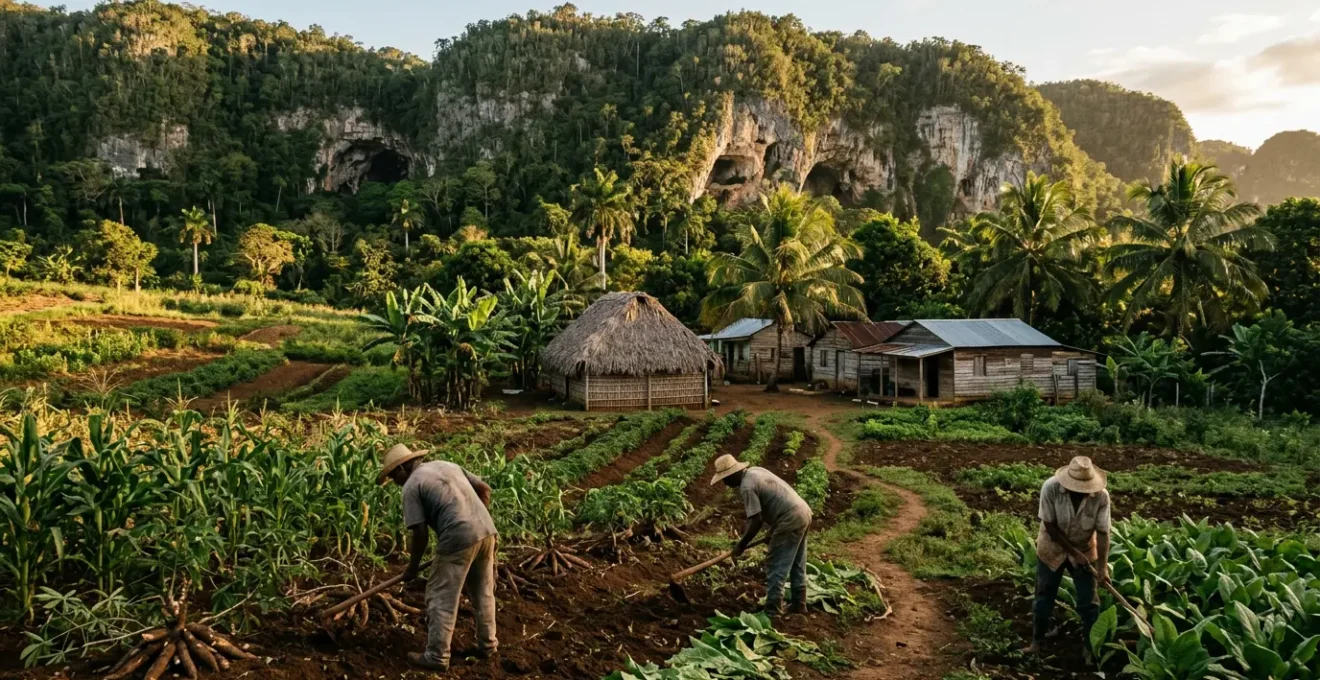
Perhaps the most intimate way to connect with the living Taino heritage is through taste and the land itself. The Dominican foodscape is profoundly shaped by Taino ingredients and agricultural techniques. The Taino were expert farmers, and their system of cultivation, the conuco, is a brilliant innovation that remains a cornerstone of rural agriculture today. This is not a historical footnote; it’s a living practice.
The conuco system involves creating large mounds of earth for planting. This sustainable technique prevents soil erosion on hillsides, conserves soil moisture, and improves drainage. It’s a form of permaculture that allows for the companion planting of multiple crops, a sophisticated agricultural strategy that modern farmers still use throughout the Dominican countryside. When you see these mounded fields, you are looking at a landscape shaped by centuries of indigenous knowledge.
The crops grown in these conucos are the building blocks of the Dominican diet. A trip to any local market is a Taino pantry scavenger hunt. You will find yuca (cassava) in its raw root form and as casabe, the dry, flat “bread of the conquest” that is one of the most direct culinary links to the past. You will also see batata (sweet potato), yautía (a taro-like root vegetable), and maíz (corn). These are not just ingredients; they are the Taino staples that have nourished the people of this island for millennia. Seeking out and trying these foods is a tangible way to experience this cultural continuity.
- Yuca (cassava): The most important Taino crop. Look for the fresh roots and the large, cracker-like discs of casabe bread.
- Batata: The Taino sweet potato, found in a variety of colors and used in both savory and sweet dishes.
- Yautía: A starchy root vegetable, often white or purple, used in stews and as a side dish.
- Maíz: Corn was a key Taino crop, ground into flour and used in various preparations.
- Jagua: A fruit used not for food but for its dark blue dye, which the Taino used for temporary body art.
Key Takeaways
- The “extinction” of the Taino is a colonial myth; their heritage is a living, breathing part of modern Dominican identity.
- Evidence of Taino survival is found in modern Dominican DNA (matrilineal ancestry), everyday language (e.g., hamaca, barbacoa), and food (casabe, conuco farming).
- Engaging with this heritage requires shifting perspective from looking for ruins to identifying the Taino cultural substrate in spiritual concepts (zemí), sacred sites (caves), and acts of resistance.
How to Trace the Steps of Columbus and Drake in the First City?
The Zona Colonial of Santo Domingo is marketed as the “First City of the Americas,” a place to trace the steps of figures like Columbus and Sir Francis Drake. But for a heritage researcher, this is an incomplete and colonialist framing. The more profound journey is to trace the Taino presence and resistance that occurred on this same ground. Instead of following the conquerors, we can follow the story of the conquered and their allies who defied the colonial system.
This “counter-itinerary” transforms the city from a monument to conquest into a testament to resilience. Start at the Fortaleza Ozama. It was built by the Spanish to dominate the Taino people and control the mouth of the Ozama River, but its stones were quarried and laid by forced Taino labor. It is a monument to both oppression and the unseen indigenous hands that built it. From there, find the powerful statue of Fray Antón de Montesinos on the Malecón. In 1511, from a simple hut in this city, this Dominican friar delivered a blistering sermon denouncing the enslavement and abuse of the Taino people, becoming one of the first European voices for indigenous rights in the Americas. His statue is not just a monument to him, but to the Taino lives he fought to defend.
This approach requires reading between the lines of the official history. Every colonial building stands on land that was once Taino. The stones of the cathedral were shaped by indigenous labor. Even the city’s layout was designed to supplant a pre-existing Taino village. By searching for these hidden histories—the story of the rebel Taino chief Enriquillo who fought for his people’s freedom in the Bahoruco mountains, the public denouncement of the encomienda system, the archaeological evidence of Taino life beneath colonial structures—you trace a much more powerful and truthful story of the “First City.” You trace the story of survival.
By learning to see these signs—in language, genetics, food, and the landscape—you move beyond the role of a passive tourist. You become an active participant in recognizing and honoring a resilient cultural heritage that refuses to be forgotten. The next step is to carry this knowledge with you, not just in the Dominican Republic, but wherever you travel, and to always question the narratives of extinction.