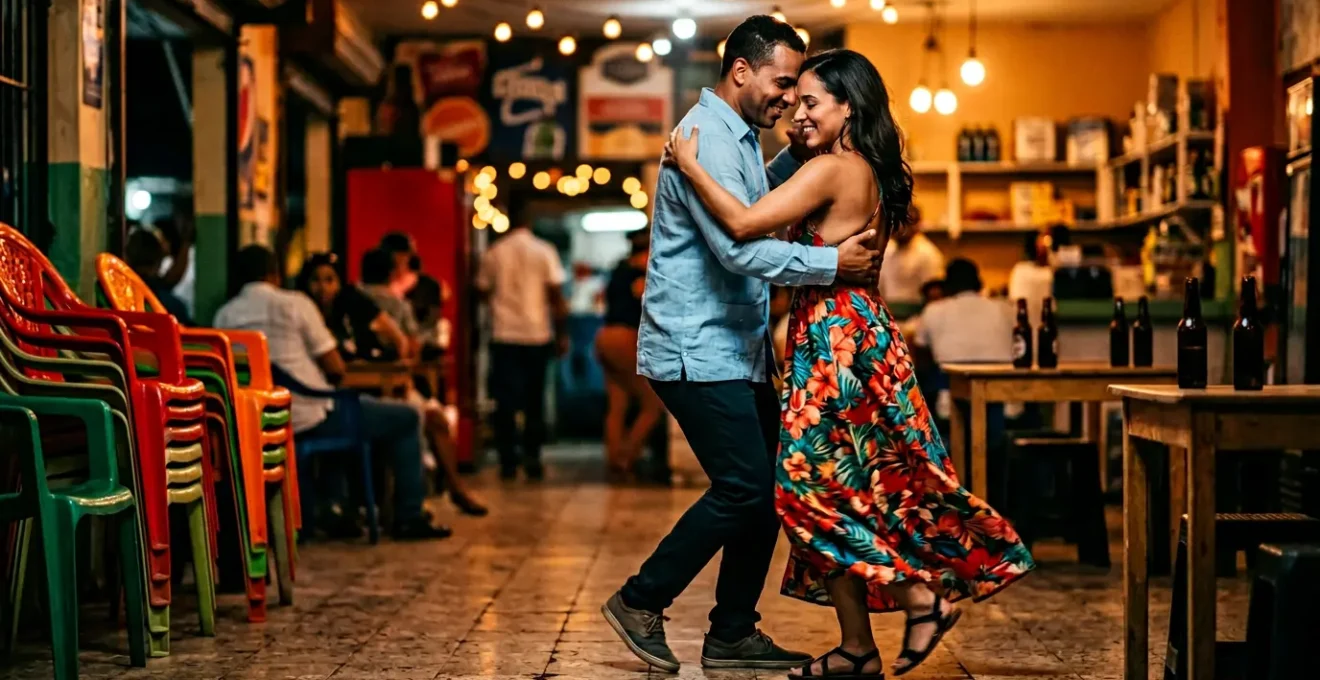
Authentic Dominican bachata is less about complex steps and more about understanding a cultural conversation.
- Confidence is built not with bachata, but with the simpler, collective energy of merengue first.
- The dance physically expresses the stories of “musica de amargue” (music of bitterness)—it’s about feeling, not just footwork.
- The most crucial move is non-verbal: the respectful, silent dance invitation known as the ‘cabeceo’.
Recommendation: To truly blend in, start as an observer. Master the social rhythm of merengue before embracing the soulful connection of bachata.
You’ve seen it in the resort disco or on a YouTube tutorial: the familiar 1-2-3-tap of the bachata basic step. You practice it, you feel you’ve got it, but when you step onto a real Dominican dance floor, something feels off. You feel like an outsider, a tourist performing a routine rather than a participant in a conversation. The energy, the connection, the unspoken rules seem just out of reach. This is a common frustration for dancers and music lovers who genuinely want to connect with Dominican culture beyond the surface.
The internet is filled with advice on footwork, turns, and “sensual” moves. But what if the secret to not looking like a tourist has very little to do with the complexity of your steps? What if the real key lies in understanding the social fabric, the history, and the subtle language of the dance floor? True authenticity isn’t about flawless technique; it’s about cultural fluency. It’s knowing why you should start with merengue, what the lyrics are truly saying, and how to ask for a dance without saying a single word.
This guide is your cultural translator. As a local dance instructor and historian, I’ll take you beyond the footwork. We will decode the unwritten rules of the Dominican dance experience. We’ll explore the emotional heart of bachata, navigate the social etiquette of a “colmadón,” and give you the tools to move with confidence and respect. You will learn not just how to dance, but how to belong on the dance floor.
To guide you on this journey from observer to participant, this article is structured to build your understanding step by step. Here is what we will cover:
Summary: Your Guide to Dancing Like a Local
- Merengue vs Bachata: Which Rhythm Should Beginners Tackle First?
- Where to Find Authentic “Colmadón” Dancing in Santo Domingo?
- Why Bachata Lyrics Are Known as “Musica de Amargue” (Bitterness)?
- The Invitation Mistake That Offends Local Dance Partners
- When Is the Merengue Festival to Experience the Genre at Its Peak?
- How to Participate in Local Traditions Without Being an Intruder?
- How to Attend the La Vega Carnival Without Getting Whipped by a Diablo Cojuelo?
- How to Navigate Dominican City Centers Safely as a Solo Traveler?
Merengue vs Bachata: Which Rhythm Should Beginners Tackle First?
The first mistake many aspiring dancers make is jumping directly into bachata. While it’s the dance you came to learn, it’s not the place to start. The true foundation for any dancer in the Dominican Republic is merengue. Why? Because merengue is about collective joy and simple, foundational rhythm, while bachata is about intimate connection and emotional expression. Trying to achieve intimacy without first understanding the basic rhythm is like trying to write poetry without knowing the alphabet.
Merengue’s basic step is essentially a two-step march, making it the most accessible Latin dance. This simplicity lowers the barrier to entry and allows you to build rhythmic confidence in a high-energy, low-pressure group setting. In a sea of merengue dancers at a party, individual mistakes vanish into the collective energy. Bachata, with its closer embrace and focus on the partnership, puts a spotlight on you. The following table breaks down the crucial differences for a beginner.
| Aspect | Merengue | Bachata |
|---|---|---|
| Social Setting | High-energy group festivities, parties | Intimate one-on-one connection |
| Basic Step Complexity | 2-step march (simplest Latin dance) | 8-count with tap on 4 & 8 |
| Musical Tempo | 120-160 BPM (faster) | 120-140 BPM (moderate) |
| Space Required | Stationary, minimal movement | Side-to-side box pattern |
| Partner Distance | Open or semi-close hold | Close embrace typical |
| Social Confidence Needed | Low – blend into group energy | Higher – sustained partner eye contact |
The path to authentic bachata, therefore, begins with its older sibling. By mastering the simple joy of merengue, you train your ear, build your confidence, and earn your place on the dance floor before tackling the deeper emotional currents of bachata. This visual of a festive Dominican party captures the exact group energy that makes merengue the perfect starting point.
Follow this progression to build your skills organically. This isn’t just about steps; it’s about building the social and musical confidence to truly connect when you finally ask someone for that first bachata.
Your 5-Step Confidence-Building Pathway
- Master the Merengue 2-step march in place – it’s literally walking to the beat, building your rhythm confidence without complex footwork.
- Practice Merengue in group settings at parties to lower social pressure – the energy is collective, mistakes disappear in the crowd.
- Train your ear to distinguish the güira scrape in Merengue from the syncopated requinto guitar in Bachata – feeling the right rhythm is the foundation.
- Transition to Bachata’s 3-step + tap pattern solo at home first, getting comfortable with the more complex 8-count structure.
- Graduate to partner Bachata only after mastering steps 1-4, bringing both musical confidence and basic footwork muscle memory.
Where to Find Authentic “Colmadón” Dancing in Santo Domingo?
Forget the polished tourist clubs. The soul of Dominican neighborhood life and authentic dancing is the colmadón. These are corner stores that, by night, transform into bustling social hubs. Plastic tables and chairs spill onto the sidewalk, a powerful sound system blasts music, and locals gather to drink Presidente beer, play dominoes, and dance. For a traveler, stepping into this world can be intimidating, but it’s where the real magic happens. It’s here that dancing is not a performance, but a part of everyday social interaction.
However, there’s an unwritten script to a night at a colmadón. Arriving at the wrong time or behaving in the wrong way can immediately mark you as an outsider. The key is to understand the natural flow of the evening, which is less about a schedule and more about a social rhythm. It’s about showing up, finding a space, contributing to the local economy by buying your drinks there, and patiently waiting for the right moment.
A Night in the Life of an Authentic Santo Domingo Colmadón
Research from bachata cultural immersion programs shows the unwritten timeline of authentic colmadón nights: Arrive 9-10 PM (not too early), order a ‘servicio’ of Presidente beer with ice to establish presence. Claim space by placing chairs but don’t be territorial. 10-11 PM is warm-up time with merengue and salsa. Real bachata dancing begins after 11 PM when locals finish dinner. The DJ’s music selection acts as code – traditional bachata (guitar-heavy, no synthesizers) signals grounded, close-embrace style perfect for beginners. Urban/modern bachata with electronic elements means expect younger crowd doing complex turns. Peak authentic dancing happens 12-2 AM when only serious dancers remain.
Understanding this timeline is crucial. It allows you to ease into the environment, observe, and participate when the energy is right. The music itself will guide you: when you hear the raw, acoustic sounds of traditional bachata, you know you are in the heart of an authentic experience. This is the moment you’ve been waiting for—the opportunity to dance bachata as it’s lived and breathed, far from the tourist trail.
Why Bachata Lyrics Are Known as “Musica de Amargue” (Bitterness)?
To dance bachata without understanding its emotional core is to miss the point entirely. The genre’s nickname, “musica de amargue” (music of bitterness), is not just a quaint historical footnote; it is the living soul of the dance. Born in the rural, impoverished communities of the Dominican Republic, bachata has always been the voice of the common person, singing stories of heartbreak, longing, betrayal, and the hardships of daily life. The dance, therefore, is not just a set of steps—it’s a physical expression of these deeply felt emotions.
Bachata can look very different even within the Dominican Republic depending on a dancer’s individual style, age, region where they are from
– Adam Taub, Bachata Class – Dominican Dance Research
This emotional weight is coded directly into the music. It’s in the sorrowful cry of the lead guitar (requinto) and the distinct rhythmic pulse. In fact, musical analysis reveals how the bass tends to play on the 3rd, 4th, and 1st beats, creating a syncopated “pull and release” feeling that musically embodies the tension of heartbreak and desire. When you dance, you are moving to this very specific, emotionally charged rhythm.
The movements themselves are a direct translation of this “amargue.” The grounded, earthy steps represent the weight of life’s struggles. The close embrace isn’t just for sensuality; it’s about seeking comfort and connection in the face of hardship. The characteristic hip movement on the “tap” (the 4th and 8th beats) creates a physical sensation of pull and release, a moment of punctuation that mirrors the emotional narrative. Dominican dancers often describe this as transforming personal pain into shared beauty. The dance becomes a form of collective catharsis—a way to process sorrow while celebrating resilience. It’s not about sadness; it’s about transforming sadness into connection.
The Invitation Mistake That Offends Local Dance Partners
You’ve mastered the merengue, you’ve found a colmadón, and the DJ is playing a classic bachata. Now comes the most nerve-wracking moment: the invitation. This is where most foreigners make their biggest cultural mistake. In many Western cultures, a direct verbal approach is standard. Walking up to someone and asking, “Would you like to dance?” is normal. In the Dominican Republic, this can be seen as overly aggressive, even rude, especially in a traditional setting.
The authentic Dominican invitation is a subtle, non-verbal art form known as the “cabeceo.” It is a silent conversation that happens from across the room. It’s a dance before the dance, a system built on mutual respect and the ability to accept or decline an offer without causing public embarrassment. Mastering the cabeceo is perhaps the single most important skill to learn to show you are a respectful and knowledgeable guest, not an oblivious tourist.
The process is a delicate exchange of glances and gestures. Here are the unwritten rules you must follow:
- DO make eye contact with the person you wish to dance with from across the room.
- DO offer a slight, subtle head nod towards the dance floor. This is the ‘cabeceo’.
- DO wait for a response. If they return the nod, that is your “yes.” You may then approach them.
- DON’T approach someone directly with a verbal invitation without first establishing this non-verbal consent.
- DO learn to recognize polite rejections: a hand to the chest might mean “I’m resting,” a slight head shake means “not this song,” and looking away is a clear “no.”
- DON’T persist after any form of “no.” Simply offer a smile and a nod, preserving social harmony (and your own reputation for future dances).
Finally, the dance doesn’t end when the music stops. Walking away immediately is a major faux pas. The correct protocol is to say a genuine “gracias,” maintain eye contact for a moment, and escort your partner back to their seat or their friends. This small act of courtesy is what separates a welcomed guest from a fleeting tourist.
When Is the Merengue Festival to Experience the Genre at Its Peak?
To experience Dominican dance culture at its most vibrant and explosive, there is no better time than the Festival del Merengue in Santo Domingo. This massive, free, multi-day event transforms the city’s Malecón (seafront boulevard) into a sprawling dance party. It is an unparalleled opportunity to see the country’s biggest musical acts live and to witness merengue in its purest, most celebratory form. However, like any large-scale cultural event, navigating it effectively requires some insider knowledge.
The official stages with famous bands are an incredible spectacle, but they are often packed with spectators. The most authentic dancing doesn’t always happen in front of the main stage. As a dancer, your goal is to find space and a community rhythm. The Merengue Festival happens annually in July, with the real magic, the spontaneous ‘barrio’ parties, often kicking off after 11 PM. These smaller street gatherings can offer three times more authentic dancing opportunities than the crowded main venues.
Surviving and thriving in the festival crowds on the Malecón is an art. Instead of being overwhelmed, use these strategies to find your dancing pocket:
- Seek Natural Clearings: Look for dance pockets near food vendors. The space people create while eating and waiting for food offers temporary but valuable room to dance.
- Join a ‘Coro’: Don’t be shy of the informal dance circles, or ‘coros.’ Stand at the edge, clap to the rhythm to show your enthusiasm, and wait for a welcoming gesture before joining in.
- Flow with the Crowd: Stay in the general flow of foot traffic rather than hugging a wall. The constant movement naturally creates pockets of space perfect for a few dance steps.
– Be a Participant: Bring small bills for water or a ‘fría’ (cold beer) to share with street musicians or fellow dancers. This simple act of reciprocity instantly changes your status from a mere spectator to an active participant. – Explore After Midnight: Once the main stage shows wind down, head towards nearby neighborhoods like San Carlos or Ciudad Nueva. Here you’ll find spontaneous street parties where the crowd is often 80% locals, and the dancing is raw and genuine.
How to Participate in Local Traditions Without Being an Intruder?
Whether you are at a colmadón, a family gathering, or a domino game in the park, the line between being a welcomed guest and an awkward intruder is a fine one. The desire to participate is good, but true respect is shown not by jumping in, but by understanding how to enter a social space gracefully. The key is a gradual, respectful progression. You are not a performer; you are a guest learning a new culture. This requires patience and observation.
A powerful framework for this is the “Observer-Apprentice-Participant” model. It’s a three-phase approach that ensures you earn your place in a social setting rather than just taking it. This isn’t a formula to be rushed; it’s a mindset of humility and genuine interest. In most Dominican social settings, this entire process could take anywhere from 30 minutes to an hour, and the patience you show is a direct signal of your respect.
The Observer-Apprentice-Participant Cultural Engagement Model
Teaching artist Andre Avila’s cultural engagement methodology demonstrates the three-phase approach for respectful participation: Phase 1 (Observer) – Stand at a respectful distance, show genuine interest through body language, make brief eye contact acknowledging presence. Phase 2 (Apprentice) – Ask specific questions using key phrases like ‘¿Me permite mirar?’ (May I watch?) or ‘¿Le molesta si me siento aquí?’ (Do you mind if I sit here?), showing you’ve learned basic courtesy. Phase 3 (Participant) – Only after receiving a clear non-verbal ‘yes’ (a smile, a gesture to join, someone making space for you) do you actively participate.
Another critical concept is reciprocity. To avoid being seen as a “taker” who is only there for the experience, you must find ways to contribute. This doesn’t have to be monetary, but it should be a gesture of goodwill that shows you understand the social exchange. This is The Reciprocity Rule:
- At Domino Games: Don’t just watch. Offer to buy the next round of coffee or beer for the players.
- At a Colmadón: Always purchase your drinks from the establishment. Bringing your own is a major sign of disrespect.
- With Street Musicians: If you enjoy their music, show appreciation by buying them a cold beer or leaving a tip.
- At a Family Gathering: Never arrive empty-handed. Bring a shareable item like a dessert, a bottle of rum, or a large bottle of soda.
How to Attend the La Vega Carnival Without Getting Whipped by a Diablo Cojuelo?
The Carnival of La Vega is one of the oldest and most vibrant traditions in the Americas. At its heart are the Diablos Cojuelos (Limping Devils), elaborately costumed characters who roam the streets with inflated vejigas (traditionally, dried cow bladders) and playfully whip the legs and backsides of onlookers. For the uninitiated, this can be an intimidating, even frightening prospect. The fear of getting “whipped” causes many tourists to hide or react with fear, which is precisely the wrong approach.
What outsiders often miss is that this is not an act of aggression; it is a playful cultural game with its own set of unwritten rules. The Diablos are performers, and their “attacks” are part of the carnival’s interactive theater. They are not looking to cause genuine harm, but to elicit a reaction and engage the crowd. Understanding the nature of this “game” is the key to enjoying the experience without fear.
Cultural research and local accounts reveal that the Diablos target those who show fear, who try too hard to run away, or who seem completely disengaged. Conversely, they respond positively to those who “play the game” correctly. This involves showing that you are a good sport and that you respect the tradition. You can do this by maintaining eye contact with a smile, offering a playful taunt back, or even doing a little dance move as they approach. This engagement transforms the interaction. A person who plays along is more likely to receive a theatrical, gentle tap rather than a painful smack. It’s a sign of mutual respect within the carnival’s chaos. By participating with confidence and humor, you move from being a potential “victim” to a co-creator of the carnival celebration.
Key Takeaways
- Merengue is your rhythmic foundation for building confidence; Bachata is the emotional expression you graduate to.
- True participation follows an “Observer-Apprentice-Participant” model, showing respect through patience and humility.
- The most important “moves” are non-verbal: the ‘cabeceo’ invitation, the reciprocity of buying a drink, and the ‘social camouflage’ that ensures safety.
How to Navigate Dominican City Centers Safely as a Solo Traveler?
All the cultural knowledge in the world is useless if you don’t feel safe enough to explore. For a solo traveler, especially after dark on the way to or from a dance venue, safety is paramount. The key to navigating Dominican city centers with confidence is an art I call “social camouflage.” It’s about blending in by adopting the posture, awareness, and small social rituals of a local. It’s not about being paranoid; it’s about being smart, projecting confidence, and reducing your visibility as a target.
This starts with how you carry yourself. Walk with a deliberate purpose, even when you’re lost. A confident stride makes you look like you belong. Avoid standing on street corners staring at your phone’s map; instead, duck into a shop or a colmadón to check your bearings discreetly. Mastering a few local greetings—a simple ‘Saludos’ or a casual ‘¿Todo bien?’—can also signal a level of familiarity that sets you apart from a fresh-off-the-bus tourist.
When it comes to nightlife, your safety strategy is even more critical. Here’s how to apply social camouflage to your dancing adventures:
- Use Colmados as Safe Havens: These corner stores are well-lit and always have staff. They are great places to buy a small item, get your bearings, and ask for directions from the staff (who are more reliable than random customers).
- Verify Your Ride: ‘Motoconchos’ (motorcycle taxis) are a common way to get around, but not all are trustworthy. Before leaving a dance venue, ask the staff to recommend or call a trusted driver for you.
- Safety in Numbers: This is the golden rule of nightlife. Make friends on the dance floor. When it’s time to leave, especially after midnight, try to walk out with a group or a couple you’ve interacted with. Data backs this up: safety statistics from Dominican dance venues show that 90% fewer incidents occur when travelers leave in groups between 1-2 AM compared to leaving alone after 3 AM.
- Offline Maps are Your Friend: Download maps for offline use. This allows you to navigate without having your expensive smartphone out on the street, which can attract unwanted attention.
Ultimately, safety is the foundation of a good experience. By learning to blend in, you not only protect yourself but also open the door to more authentic and relaxed interactions.
You now have the cultural map and the safety tools. The next step is yours to take. Step onto the floor, listen with more than just your ears, observe with respect, and join the conversation. Start with that first merengue, and let your journey into the heart of Dominican dance truly begin.