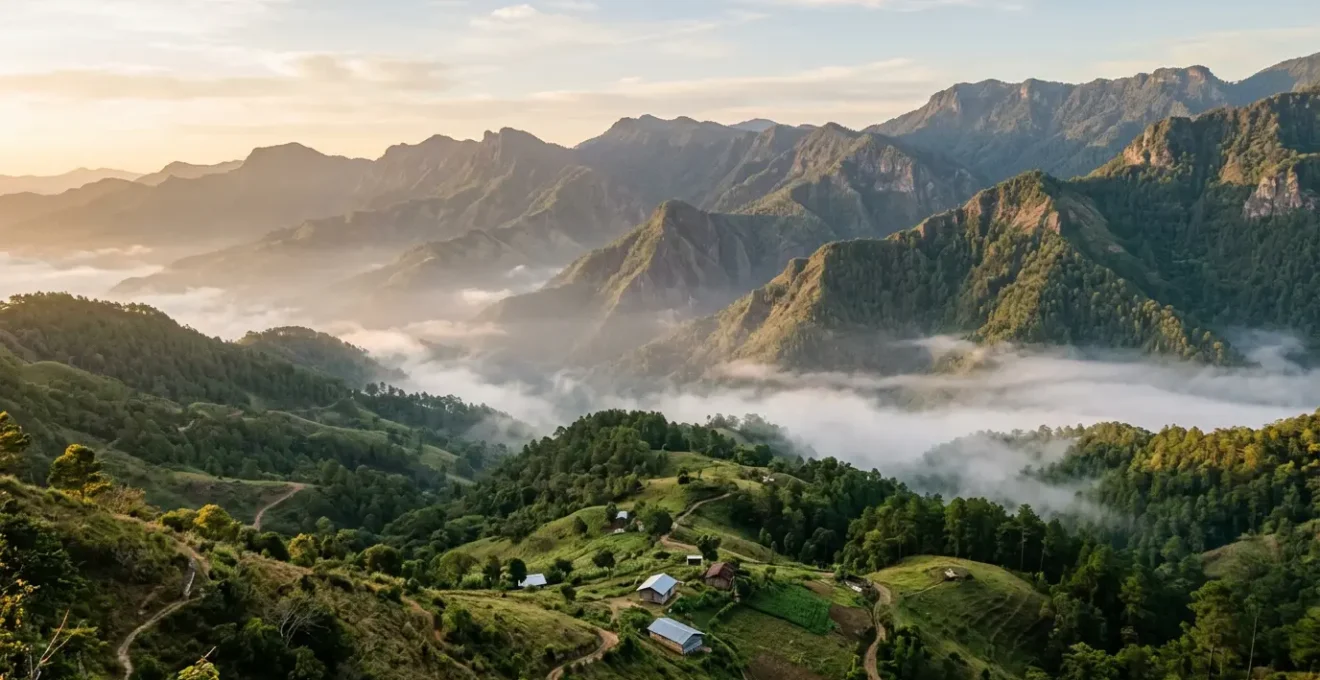
A successful Dominican mountain retreat hinges not on choosing a town, but on mastering its unique micro-climates and on-the-ground logistics.
- Learn why temperate crops like strawberries and apples thrive at high Caribbean altitudes.
- Prepare for a real phenomenon: seeing frost and sub-zero temperatures in a tropical nation.
Recommendation: Shift from a tourist mindset to an explorer’s; pack for four seasons, learn basic mountain driving techniques, and pre-check your vehicle’s brakes before any descent.
When you picture the Dominican Republic, you likely imagine swaying palm trees and turquoise water. The common refrain is that the country is “more than just beaches.” While true, this statement barely scratches the surface. The Central Cordillera isn’t just a hilly alternative to the coast; it’s a completely different ecosystem, a world of pine forests, chilly nights, and unique agricultural science. Most guides offer a simple choice—Jarabacoa for adventure, Constanza for farms—but this binary view is a disservice to the region’s complexity.
Planning a truly rewarding mountain retreat here requires a different mindset. It’s less about which town to book and more about understanding the principles of this temperate anomaly in the heart of the Caribbean. The key isn’t just knowing it gets cool, but grasping the concept of micro-climate mastery, where temperatures can plummet 20 degrees Celsius after sunset. It’s about appreciating not just the taste of fresh strawberries, but the story of agricultural innovation that allows them to grow here.
This guide moves beyond the clichés. We will explore the specific logistical and sensory details you need for a successful trip. From the critical brake-check you must perform before descending steep grades to the training required for a Pico Duarte expedition, we’ll provide the strategic knowledge needed to transform a simple vacation into a genuine exploration of the Dominican Republic’s alpine soul.
This article provides a complete roadmap for your mountain adventure. To help you navigate, the summary below links directly to each key section, from choosing your base to preparing for high-altitude treks.
Summary: Planning Your Central Cordillera Mountain Retreat
- Constanza or Jarabacoa: Which Mountain Town Is Better for Relaxation?
- Why Are Strawberries and Apples Grown in the Caribbean Alps?
- The Brake-Check You Must Do Before Descending the Cordillera
- How Cold Does It Really Get in Valle Nuevo at Night?
- 3 Hidden Lookouts That Offer the Best Valley Views
- How to Train and Prepare for the Pico Duarte Expedition?
- How to Tour a Cacao Plantation and Make Your Own Chocolate?
- How to Explore the Rainforest Canopy Without Getting Lost?
Constanza or Jarabacoa: Which Mountain Town Is Better for Relaxation?
The common wisdom pits Jarabacoa as the “adventure capital” against Constanza, the “vegetable garden.” While there’s truth to this, the best approach to relaxation is not to choose one, but to embrace a slow-travel itinerary that savors the unique character of both. True relaxation here comes from understanding and experiencing their complementary energies.
Imagine starting your day at a quiet café in Jarabacoa, overlooking the misty Yaque del Norte river, then spending the afternoon exploring Constanza’s vibrant flower nurseries. The 90-minute scenic drive between the towns is an experience in itself, a journey through shifting landscapes and roadside stands laden with fresh produce. Rather than rushing, consider this route part of the destination. This “both/and” approach replaces a hurried decision with a richer, more immersive journey.
Constanza’s unique identity was profoundly shaped by the arrival of Japanese immigrants in the mid-20th century. They applied their agricultural expertise to the valley’s unique climate, transforming it into a hub for temperate crops. This history is palpable when you visit a farm like Fresas Ariyama, where you can see the techniques that made strawberry cultivation possible in the Caribbean. Jarabacoa offers a different serenity, found in riverside hotels like Gran Jimenoa, where the sound of the water provides a constant, calming soundtrack. Ultimately, relaxation isn’t a location, but a pace.
Why Are Strawberries and Apples Grown in the Caribbean Alps?
The sight of apple orchards and strawberry fields in the Caribbean is a delightful puzzle. The answer lies in a powerful combination of altitude and climate, creating a “temperate anomaly” unique to this region. The town of Constanza, in particular, is the epicenter of this phenomenon. It’s not just slightly cooler; it is a fundamentally different agricultural zone.
The science is straightforward: high altitude creates temperate conditions. Constanza’s valley floor sits at an elevation of 1,250 meters (over 4,000 feet), allowing for cold nights that are essential for many fruits and vegetables to flourish. During winter months, temperatures can dip below freezing, with recorded lows reaching -5°C. This predictable chill is what allows crops like strawberries, apples, peaches, and even garlic to be cultivated on a commercial scale, supplying the entire country.
This unique climate dictates the rhythm of life and the visitor experience. Depending on the season, you can participate in different harvests and festivals, making the timing of your trip a key planning consideration. Visiting during the right season can transform your trip from simple sightseeing to a hands-on sensory experience.
| Season | Constanza Produce | Jarabacoa Produce | Best For Visitors |
|---|---|---|---|
| Dec-Feb | Strawberries, Garlic | Coffee harvest | Pick-your-own strawberries |
| Mar-May | Potatoes, Flowers | Avocados | Flower Festival (June) |
| Jun-Aug | Apples, Peaches | Passion fruit | Fruit wine tasting |
| Sep-Nov | Giant cabbages, Pears | Citrus fruits | Harvest festivals |
Understanding this calendar allows you to plan a trip centered around picking your own strawberries in January, enjoying the vibrant flower festival in June, or tasting freshly pressed fruit wines in August. The agricultural landscape is not just a backdrop; it’s an interactive calendar of events.
The Brake-Check You Must Do Before Descending the Cordillera
Driving in the Central Cordillera is breathtaking, but the steep, winding roads demand absolute respect for your vehicle and local driving etiquette. While general caution is advised everywhere, the descents here present a specific mechanical challenge that can lead to brake failure if not managed correctly. This is not a suggestion; it is a critical safety protocol for the region, underscored by sobering national statistics.
The fundamental principle is to let your engine do the work, not your brakes. On long, steep downhill sections, relying solely on your brake pedal will cause the brake pads and fluid to overheat, a condition known as “brake fade,” where your brakes temporarily lose all stopping power. The correct technique, known as engine braking, is to shift into a lower gear (2nd or 3rd in an automatic, or a low manual gear). The engine’s resistance will naturally slow the car, allowing you to use the brakes only for short, firm applications rather than continuous pressure.
The stakes are high. While the Dominican Republic is making efforts to improve road safety, recent data showing 3,114 traffic-related deaths in one year highlights the need for defensive driving. Mastering engine braking and performing a pre-descent check are the most important things you can do to ensure a safe journey.
Your Pre-Descent Safety Checklist: Mountain Driving
- Vehicle Check: Before leaving any mountain town, visually inspect your tires, and confirm your brakes and lights are working. Ensure you have a functional spare.
- Engage Low Gear: At the top of any major descent, shift into a lower gear (2, 3, or L). Do this *before* you start going downhill and build up speed.
- Honk at Blind Corners: A short, light honk before entering a blind curve is standard local practice to alert oncoming traffic, especially larger vehicles.
- Scan for Hazards: Be vigilant for unmarked speed bumps (“policías muertos”), potential landslide debris (especially in rainy season), and animals on the road.
- Emergency Kit: Always carry essential supplies. This includes water, a phone charger or power bank, a reflective triangle, and the local emergency number (911).
This isn’t about being fearful, but about being prepared. Adopting these local driving habits, especially the discipline of engine braking, transforms a potentially hazardous drive into a confident and enjoyable part of your mountain adventure.
How Cold Does It Really Get in Valle Nuevo at Night?
The question of cold in the Dominican mountains is often met with a smile and a light jacket recommendation. This is dangerously inadequate advice for Valle Nuevo National Park, also known as the “Caribbean Alps.” Here, the cold is not a mild chill; it is a dominant, defining feature of the ecosystem, capable of producing frost and sub-zero temperatures.
To be precise, the park experiences some of the most dramatic temperature swings in the Caribbean. It’s a classic example of a high-altitude micro-climate. It’s not uncommon for Valle Nuevo’s daytime temperatures to be a pleasant 20°C (68°F), only to plummet to 0°C (32°F) or below after midnight, especially between December and March. This nightly freeze is what creates “La Escarcha,” the thick morning frost that blankets the landscape, a surreal and beautiful sight of ice crystals on pine needles and tropical ferns.
Planning a trip, especially an overnight stay at the Villa Pajon eco-lodge or the park’s campsite, requires micro-climate mastery in your packing. This means layering is not optional; it is essential. You will need a base layer, a fleece or mid-layer, and a windproof/waterproof outer jacket. A warm hat, gloves, and wool socks are non-negotiable for the evenings and early mornings. Think of it as packing for a North American autumn camping trip, not a Caribbean getaway. Ignoring this advice can lead to a miserable, dangerously cold night.
The cold is the very reason Valle Nuevo is so special. It has shaped a unique ecosystem of Hispaniolan pine forests and hardy grasslands found nowhere else on the island. Embracing and preparing for the cold is the key to unlocking the magic of this incredible alpine environment.
3 Hidden Lookouts That Offer the Best Valley Views
While the title suggests a simple list, the true secret to finding the best views in the Central Cordillera isn’t a map to three specific spots. It’s about adopting an explorer’s mindset and learning *how* to spot the unmarked pull-offs and hidden vistas that line the mountain roads, particularly the stunning route between Jarabacoa and Constanza.
Instead of seeking out named tourist spots, the best strategy is to become a “view hunter.” The scenic drive itself, a 1.5 to 2-hour journey through the “eternal spring” climate, is the destination. Along this road, you’ll find numerous opportunities for breathtaking panoramas. The key is knowing what to look for. One such view, which locals might point you to, is the “Agricultural Quilt” lookout, which offers a stunning top-down perspective of Constanza’s neatly gridded, multi-colored farms. Another is the “Birth of a River” viewpoint, where you can trace the nascent Yaque del Norte as it winds through the high valleys.
To find your own “hidden” lookouts, use modern tools with an old-school sense of adventure. Before you go, use the terrain layer on Google Maps or download offline maps on an app like Maps.me to identify sharp bends in the road that face out over a valley—these are often prime locations for unofficial viewpoints. For capturing the best photos, remember that timing and technique are everything. The “golden hours,” roughly an hour after sunrise (6-7 am) and an hour before sunset (4-5 pm), provide the soft, angled light that makes the valleys come alive. A polarizing filter for your camera can also be a game-changer, cutting through the tropical haze to reveal crisp details and vibrant colors.
The most important rule, however, is safety. Only pull over in designated areas or spots with a wide, stable shoulder, well away from blind corners. The goal is to capture the view, not to become a hazard. By shifting your focus from a checklist of spots to a strategy of discovery, every turn in the road becomes a potential photo opportunity.
How to Train and Prepare for the Pico Duarte Expedition?
Climbing Pico Duarte, the highest peak in the Caribbean at 10,174 feet (3,098 meters), is a serious undertaking. It’s a bucket-list achievement that requires significant logistical preparedness, not just physical fitness. Success on the trail depends as much on your training and mental fortitude as it does on your leg strength.
A typical guided trek is a 3-day, 2-night affair covering approximately 28 miles (46 km). The first day is an 11-mile, mostly uphill push to the Compartición base camp at 8,000 feet. This is where most hikers are challenged. Your training should simulate this specific effort. This means practicing by hiking long distances (around 11 miles) with a loaded pack of 20-30 lbs. Incorporating stair climbing or stadium steps into your routine is crucial for building the specific muscle groups needed for the relentless ascent.
Furthermore, this is a tropical altitude trek, which presents a unique challenge: heat and humidity at lower elevations. To prepare your body, consider training in the heat of the day or even using sauna sessions to acclimate to heat stress. Mental preparation is just as vital. The trail is long, the “refugios” (shelters) are basic, and the meals are communal. You must be ready for a 48-hour commitment with minimal comforts. Learning a few essential Spanish phrases like “¿Cuánto falta?” (How much further?) and “Necesito descansar” (I need to rest) can go a long way in communicating with your local guides.
The expedition is logistically managed by certified tour operators. You cannot hike it independently. Booking a tour is required and handles guides, mules (to carry gear), food, and park fees. To budget, you should know that current tour packages start around US$255 per person for the standard 3-day trek. This investment ensures a safe, supported journey to the roof of the Caribbean.
How to Tour a Cacao Plantation and Make Your Own Chocolate?
The Dominican Republic is a world-class producer of organic cacao, and a tour of a plantation is a must-do sensory experience. It’s a journey from the raw, fruity pulp of the cacao pod to the rich, complex flavor of a finished chocolate bar. However, not all tours are created equal. To ensure an authentic and ethical experience, it’s wise to move beyond passive tourism and ask the right questions.
The best cacao experiences are concentrated in the Cibao Valley, the agricultural heartland near Santiago. Here, you can find family-run farms that offer a truly immersive look at the entire process. A quality tour should engage all your senses: you’ll taste the surprisingly sweet and sour tang of the fresh pulp surrounding the beans, smell the distinct fermented, vinegary aroma of the beans as they dry, and hear the satisfying “snap” that indicates a bar of chocolate has been properly tempered.
To choose a tour that is both educational and supportive of the local community, consider asking these three key questions before you book:
- What percentage of the tour fees goes directly to the farming families? This helps determine if the tour is a genuine partnership or simply using the farm as a backdrop.
- Do you source cacao exclusively from this plantation, or do you support multiple local farms? This shows a commitment to the broader community.
- Can we meet the farmers and learn about their traditional cultivation methods? This ensures the experience is centered on the people and their craft, not just a commercial product.
A great tour often concludes with a hands-on workshop where you get to grind the roasted cacao nibs and make your own rustic chocolate. For a complete Dominican tasting experience, try pairing your dark chocolate with a locally produced añejo rum or a cup of high-altitude coffee from the Barahona region. This elevates the tour from a simple activity to a deep dive into the island’s rich gastronomic culture.
Key Takeaways
- The Central Cordillera is a region of micro-climates; pack for four seasons, as Caribbean frost is a real possibility.
- Logistical preparedness is paramount: master engine braking for mountain descents and train specifically for high-altitude humidity if tackling Pico Duarte.
- The best experiences are sensory and immersive, from tasting fresh cacao pulp to using digital tools to identify endemic birds in the canopy.
How to Explore the Rainforest Canopy Without Getting Lost?
While the question of “not getting lost” is about safety, the deeper question for the modern explorer is “how to get truly immersed.” In the cloud forests of the Central Cordillera, this means trading the adrenaline rush of a commercial zipline for the focused observation of a naturalist. The goal is to see the canopy not as a blur, but as a thriving, multi-layered habitat.
The key to this deeper exploration is choosing the right location and equipping yourself with the right tools. A prime example is the Ebano Verde Scientific Reserve. Unlike crowded zipline parks, its primary focus is conservation and education. The reserve features hanging bridges and observation towers that are designed for slow, quiet observation. This allows you to truly appreciate the transition from Hispaniolan pine forests to the lush, epiphyte-draped cloud forest, and increases your chances of spotting the area’s unique wildlife.
To elevate your experience, assemble a “Digital Naturalist’s Toolkit” on your smartphone before you go. These powerful apps work offline and can transform your hike into an interactive discovery:
- Merlin Bird ID: Download the Dominican Republic pack to get real-time suggestions for birds you hear or see. It’s your best chance to identify the spectacular, endemic Hispaniolan Trogon.
- iNaturalist: Use your phone’s camera to snap photos of plants and insects. The app’s community and AI will help you identify the countless unique orchids, bromeliads, and other species you encounter.
- Maps.me: This offline map application is essential for navigating trails within reserves where cell service is non-existent, ensuring you can explore confidently without getting lost.
Bringing a good pair of binoculars is also non-negotiable for any canopy exploration. By combining the right location with these tools, you shift from a passive tourist to an active participant in the discovery of one of the Caribbean’s most unique ecosystems.
You now possess the strategic knowledge to plan a mountain retreat that goes far beyond a typical vacation. Armed with an understanding of the region’s micro-climates, agricultural wonders, and logistical demands, you are ready to explore the alpine heart of the Dominican Republic. Start planning your expedition today.
Frequently Asked Questions about How to Plan a Mountain Retreat in the Central Cordillera?
What sensory experiences should I expect during the cacao process?
You’ll taste the sweet-sour tang of fresh cacao fruit pulp, smell the fermented aroma of drying beans, and feel the satisfying snap of properly tempered chocolate.
Where are the best cacao experiences located?
The Cibao Valley region near Santiago offers authentic plantation tours where you can see the entire process from tree to chocolate bar.
What local pairings work best with Dominican chocolate?
Pair dark Dominican chocolate with local añejo rum or high-altitude Barahona coffee for a complete tasting experience.