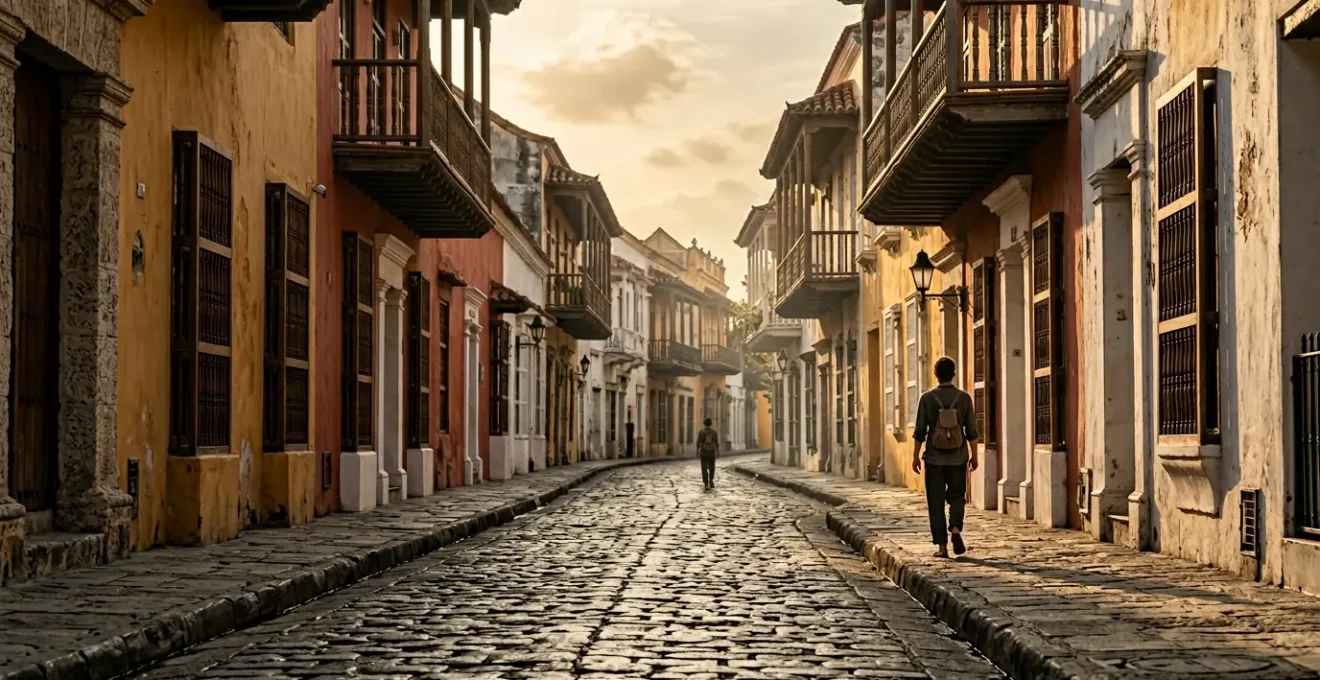
Planning a self-guided tour is not about listing sights, but learning the architectural language of the streets.
- Materials like cobblestones and coral limestone narrate tales of trade, technology, and climate adaptation.
- Timing your walk can unlock entirely different historical atmospheres, from pre-electric dawn to the quiet of siesta.
Recommendation: Begin by observing the ground beneath your feet; the story of a city starts with its very foundation.
For the history enthusiast who prefers the solitary rhythm of their own footsteps to the chatter of a guided group, the self-guided walking tour is a perfect vessel for discovery. Yet, the greatest challenge isn’t navigating from point A to point B; it’s ensuring you don’t miss the rich, silent context embedded in the stones and structures all around. Most planning guides focus on logistics—using digital maps, listing famous landmarks, and checking opening times. While practical, this approach often results in a tour that is merely a collection of photo opportunities, lacking the deep narrative that makes a place truly come alive.
But what if the true key to an unforgettable tour wasn’t in the route you follow, but in learning *how* to see? A heritage architect doesn’t just look at a building; they read it. They understand the architectural grammar that governs its form, the material narratives told by its surfaces, and the unseen infrastructure that dictates its function. This guide is designed to equip you with that architect’s eye. We will move beyond simple itineraries to explore the principles of reading a historic city as a text, allowing you to uncover the stories that most tourists walk right past.
This article provides a framework for planning your walk, not as a checklist of sights, but as an exercise in urban archaeology. You will learn to decode the very fabric of the streets, understand the interplay of light and shadow, and appreciate the genius of historical design. The following sections will guide you through this process.
Table of Contents: A Guide to Reading Historic Streets
- Why Do Some Streets Have Cobblestones While Others Are Paved?
- Calle Las Damas or Calle El Conde: Which Is More Photogenic at Sunset?
- How to Dress for a Day of Walking on Hot Stone Streets?
- When Is the Best Time to Walk the Colonial Zone for Silence?
- The Hidden Symbols in Colonial Facades That tourists Overlook
- Where to Find the Best Examples of Victorian “Gingerbread” Houses in Puerto Plata?
- How to Explore Santo Domingo’s Modern and Ancient Sides in 48 Hours?
- Why the Dominican Baroque Style Is Unique in the Americas?
Why Do Some Streets Have Cobblestones While Others Are Paved?
The story of any historic street begins from the ground up. The choice between cobblestone and modern pavement is not merely aesthetic; it’s a foundational chapter in a city’s biography, revealing its history of trade, technology, and environmental management. Early colonial towns were often built on mud and dirt, which became impassable during heavy rains. Cobblestones were an ingenious, if laborious, solution. Rather than being wasted, the rounded river stones and angular quarried rocks used as ballast in European trade ships were repurposed as a sturdy, reliable paving material. As Charleston’s 1817 campaign to pave streets with cobblestones demonstrates, this was a significant municipal undertaking.
These stones were a symbol of practicality. Their uneven surface, while challenging for modern footwear, provided excellent traction for horses and carts. Furthermore, the gaps between the stones created a naturally permeable surface, a crucial element of superior water management during tropical storms that modern asphalt cannot replicate. The transition zones where cobblestone ends and asphalt begins often mark the original boundaries of a colonial settlement, a physical line between the old world and its later expansion. To walk from one surface to the other is to literally cross a historical timeline.
To start reading this material narrative, pay attention to the stones themselves:
- Origin: Are they rounded river rocks or more angular, quarried stones? Rounded stones often indicate they arrived as ship ballast from distant ports.
- Color and Composition: Different colors can point to different origins—Scottish granite, English brick, or local limestone each tell a unique story of trade routes and available resources.
- Sound: Listen to the sound your footsteps make. The distinct clatter on cobblestones was once an integral part of the city’s soundscape, announcing arrivals and the movement of commerce.
Calle Las Damas or Calle El Conde: Which Is More Photogenic at Sunset?
Once you understand the ground, the next step is to look at how light interacts with the city’s form. The question of which street is “more photogenic” is subjective, but an architect would reframe it: which street’s design best captures and dramatizes the light of the setting sun? The answer lies in orientation and materials. A street running east-to-west, like parts of Calle El Conde, might be bathed in a direct, head-on golden light, creating a flat but brilliantly illuminated scene. In contrast, a north-south street like Calle Las Damas will experience the “golden hour” as sidelight, a far more dramatic effect.
This sidelight rakes across the facades, picking out the texture of weathered coral limestone, tracing the intricate patterns of iron window grills (rejas), and casting long, evocative shadows that stretch across the cobblestones. This interplay of light and shadow is not just pretty; it’s a visual metaphor for the passage of time. The building facades are no longer flat surfaces but become three-dimensional sculptures, their history and craftsmanship revealed in high relief. The solitary walker’s shadow becomes part of this moving tableau, a transient presence against a centuries-old backdrop. For the photographer and the historian alike, the drama of sidelight on textured surfaces almost always offers a richer, more layered story than direct, flat illumination.
How to Dress for a Day of Walking on Hot Stone Streets?
Engaging with a historic city is a physical act, and your comfort is paramount to your ability to observe and appreciate. Dressing for a day of walking on hot stone streets requires more thought than simply “wearing comfortable shoes.” It involves a dialogue with the environment the city’s founders knew well. The dark, dense cobblestones and paving stones are excellent thermal masses; they absorb the intense Caribbean sun and radiate it back, creating a microclimate just above the street surface. Your choice of footwear and clothing is your primary interface with this historic, and often harsh, environment.
Footwear is the most critical element. The uneven surfaces of historic streets, designed for horse-drawn carts, place unique stress on the modern foot. You need shoes with supportive, cushioned soles to absorb the impact and combat fatigue. Good ankle support is also crucial to prevent twists and sprains on irregular stones. Think of your shoes as modern technology designed to bridge the gap between your 21st-century body and a 16th-century surface.
Clothing choices should be guided by historical wisdom. Long before synthetic sportswear, inhabitants of the tropics relied on lightweight, breathable natural fabrics. Linen and cotton are your best allies. They allow air to circulate and help manage moisture. Crucially, many of the most significant historic sites are active places of worship, such as the grand cathedrals along your route. Modest dress that covers the shoulders and knees is often required for entry. By choosing loose-fitting linen trousers or a long skirt and a light top with sleeves, you are not only showing respect but are also adopting a historically proven strategy for staying cool and comfortable.
When Is the Best Time to Walk the Colonial Zone for Silence?
A city’s character changes dramatically with the rhythm of the day. For the solo explorer seeking context, “silence” is not just the absence of noise but the presence of atmosphere. The modern hum of traffic and crowds can obscure the subtle historical whispers of a place. To find the Colonial Zone’s more contemplative moods, you must plan your walk to coincide with the lulls in 21st-century life, allowing the city’s older voices to emerge. True silence is rare; instead, the goal is to practice strategic “sound-scaping”—timing your walk to tune into the historical sounds of church bells, echoing footsteps, and the wind in hidden plazas, rather than the clamor of tourism.
Early morning, in the hour just after dawn, offers a “pre-electric light” ambiance. The soft, angular light is similar to what the city’s founders would have experienced, and the streets are often at their quietest, shared only with residents starting their day. Another powerful moment is the traditional “siesta hour,” typically from 1-3 PM. As tourist traffic wanes and shops close, the city takes on a suspended-in-time quality, the heat shimmering over empty squares. Perhaps most magically, the moments immediately following a brief tropical rain shower offer a unique sensory window. The air is cleansed, the stones are dark and reflective, and the streets are briefly, blissfully empty, creating a perfect opportunity for reflection.
Your Action Plan for Crafting the Perfect Tour
- Points of Contact: List all the architectural elements you want to “read”—facades, doorways, paving, rooflines, and public squares.
- Collect: Inventory existing information. Download an offline map and save key locations, but also gather notes on specific architectural styles or historical events.
- Coherence: Confront your plan with your core interest. If you’re fascinated by military history, prioritize fortifications over civic buildings. Align the route with your passion.
- Memorability/Emotion: Identify what emotional experience you are seeking—solitude, grandeur, decay? Plan your timing (dawn, siesta, dusk) to match this mood.
- Plan Integration: Create a flexible timeline, not a rigid schedule. Group sights by proximity but leave room for spontaneous detours to follow a compelling detail or a quiet alleyway.
The Hidden Symbols in Colonial Facades That tourists Overlook
The facade of a colonial building is not a blank wall; it is a dense tapestry of symbols, a public declaration of wealth, status, faith, and cultural identity. To the untrained eye, it is merely decorative. To the architect’s eye, it is a text rich with meaning. Tourists may walk by, but the curious explorer stops to read the stories hidden in plain sight within the ironwork, stonework, and woodwork. These details are the vocabulary of a city’s architectural grammar, and learning to spot them is key to understanding the social fabric of the past.
The intricate iron window grills, or rejas, are a prime example. While serving a practical security function, their complexity and craftsmanship were a direct reflection of the owner’s wealth. Simpler, geometric patterns might belong to a merchant’s house, while elaborate, scrolling floral motifs could signify the home of a high-ranking official. Likewise, the carvings around a doorway or the materials used for the facade itself—humble plaster versus expensive, hand-cut stone—speak volumes about the original inhabitant’s place in the social hierarchy.
Even the thickness of the walls tells a story of climate and technology. The most powerful colonial families lived in grand mansions designed to project authority and provide comfort in a tropical climate. These structures were fortresses of both power and practicality.
Case Study: The Walls of the Alcázar de Colón
The castle of Don Diego Colón in Santo Domingo, built in 1517, served as the home for generations of the Christopher Columbus family. It is a masterclass in material narrative. Its imposing Renaissance style is blended with Moorish, Gothic, and Isabelline influences, reflecting the complex cultural heritage of the Spanish Empire. But its most telling feature might be its walls. The mansion’s 40-inch-thick coral-limestone walls were not just for defense; they were a form of pre-modern air conditioning, their immense thermal mass keeping the 22 opulent rooms naturally cool in the Caribbean heat.
Where to Find the Best Examples of Victorian “Gingerbread” Houses in Puerto Plata?
While Santo Domingo is famed for its stone-built colonial core, a trip to Puerto Plata on the north coast reveals a completely different, yet equally fascinating, chapter of Dominican architectural history: the wooden Victorian “Gingerbread” house. This style, which flourished in the late 19th and early 20th centuries, is a testament to a new era of prosperity driven by agriculture and trade. It represents a different architectural grammar—one that is lighter, more ornate, and exquisitely adapted to the tropical climate in a way that differs from the earlier stone structures.
The defining feature of this style is the intricate decorative fretwork, known locally as calado. This is not mere ornamentation; it is a critical element of passive cooling, allowing breezes to flow freely through the upper portions of walls and gables while maintaining privacy. The entire structure is a beautifully complex system of climate control. Wide, wrap-around verandas provide shade and create semi-outdoor living spaces, high ceilings allow hot air to rise, and louvered windows offer precise control over airflow and light. To find the best examples, one should wander the streets of Puerto Plata’s historic center, particularly around the Parque Central, looking for these key features.
The following table breaks down the vocabulary of this unique architectural style. A recent analysis shows key features of this architectural style, which are essential for understanding its function and beauty.
| Feature | Function | Visual Characteristic |
|---|---|---|
| Fretwork (Calado) | Essential ventilation for tropical climate | Intricate decorative patterns cut into wood |
| Wide Verandas | Shade provision and outdoor living space | Wrap-around porches with ornate railings |
| High Ceilings | Allow hot air to rise naturally | Creates grand interior spaces |
| Louvered Windows | Airflow control while maintaining privacy | Adjustable wooden slats |
| Finials | Decorative status symbols | Ornate roof-line decorations |
How to Explore Santo Domingo’s Modern and Ancient Sides in 48 Hours?
A historic city is not a museum; it is a living organism where centuries coexist, often in the same block or even the same building. The true art of a self-guided tour lies in appreciating this temporal layering, seeking out the “seams” where past and present meet. In Santo Domingo, this means structuring your exploration not just by location, but by theme. A 48-hour itinerary can become a powerful narrative tool, allowing you to contrast the city’s history of conquest with its story of resilience and creativity.
A thematic approach could look like this:
- Day 1 – Power & Conquest: Start at the imposing Fortaleza Ozama, the oldest military fortress in the Americas. Move to the Catedral Primada de América, the seat of religious authority. Conclude at the Museo de las Casas Reales, the former center of political administration. This route traces the spine of colonial power.
- Day 2 – Resilience & Creativity: Begin at the Museo Memorial de la Resistencia, which documents a more recent, turbulent history. Then, deliberately seek out the modern art galleries housed within 16th-century colonial buildings. Finish by discovering vibrant street art that uses ancient walls as its canvas. This route reveals the enduring spirit of the city.
The most profound moments often occur at the intersection of these two narratives. A rooftop bar overlooking a 500-year-old plaza, a contemporary sculpture in a centuries-old courtyard—these are the places where the city’s full story is most palpable. While walking, practice a mental exercise: as you stand on Calle El Conde, try to imagine the sounds, smells, and sights of 1520 versus those of today. This “Then vs. Now” approach transforms a simple walk into a dynamic form of urban archaeology. While it’s wise to save historic hotspots on a digital map before you start, don’t be afraid to get intentionally lost in the grid; the city’s secrets are often found in the quiet side streets between major landmarks.
Key Takeaways
- A city’s story begins with its materials; cobblestones and limestone narrate tales of trade, technology, and climate adaptation.
- The timing of your walk—whether at dawn, siesta, or after rain—is a powerful tool for curating the atmosphere and avoiding crowds.
- Architectural details like ironwork and fretwork are not just decoration but a symbolic language of wealth, status, and practical design.
Why the Dominican Baroque Style Is Unique in the Americas?
The final layer of understanding comes from synthesizing your observations into an appreciation for a region’s unique architectural syntax. The Dominican Baroque style is a perfect case study. While Baroque architecture is found throughout the Americas, the version that developed in Hispaniola is distinct, shaped profoundly by two key factors: its early timeline and its primary building material. As the first major European settlement, Santo Domingo was a laboratory for colonial architecture. The construction from 1514 to 1540 of the Santa María la Menor Cathedral makes it the oldest in the Americas, built at a time when the Gothic style was transitioning into the Renaissance and early Baroque.
This early start meant its influences were different from the later, more flamboyant Baroque styles of Mexico or Peru, which had centuries of accumulated colonial wealth and established craft traditions to draw upon. The second, and perhaps more defining, factor was the local geology. The predominant building material was not easily carved volcanic stone or fine-grained limestone, but a porous, golden-hued coral limestone. This material, full of fossilized shells and inconsistencies, was difficult to carve into the kind of hyper-detailed ornamentation seen elsewhere.
This material constraint became a creative catalyst. Dominican architects were forced to express the drama and grandeur of the Baroque style not through intricate surface decoration, but through powerful, simpler forms, bold massing, and a profound sense of solidity. The beauty of Dominican Baroque lies in its restraint and its powerful connection to its specific place. The golden color of the stone, the massive, fortress-like walls, and the relatively simple, strong lines create an aesthetic that is both monumental and deeply rooted in the island’s natural environment. It is a style defined by what it is made of, a perfect and final lesson in reading the material narrative of a city.
Your self-guided tour is now more than a route; it is a framework for inquiry. By learning to read the architectural grammar of a place, you empower yourself to uncover endless stories, transforming every walk into a profound act of discovery.
Frequently Asked Questions about Walking Historic Streets
What type of footwear is best for cobblestone streets?
Supportive shoes with cushioned soles and good ankle support are essential. The uneven surfaces and radiant heat from dark stones require modern cushioned technology to combat fatigue from surfaces originally designed for horse-drawn carts.
Are cobblestone streets safe to walk on?
Yes, with mindful preparation. Wearing supportive, non-slip shoes and taking a slower pace helps prevent tripping on the uneven surfaces. Staying aware of your surroundings and any posted signs further enhances safety, allowing you to focus on the history around you.
Should I dress differently for visiting historic churches along the route?
Yes, absolutely. Many historic sites are active churches requiring modest dress. Choose lightweight, breathable fabrics like linen and cotton that cover shoulders and knees. These natural materials were historically used in Caribbean climates long before synthetics and are both respectful and practical for staying cool.