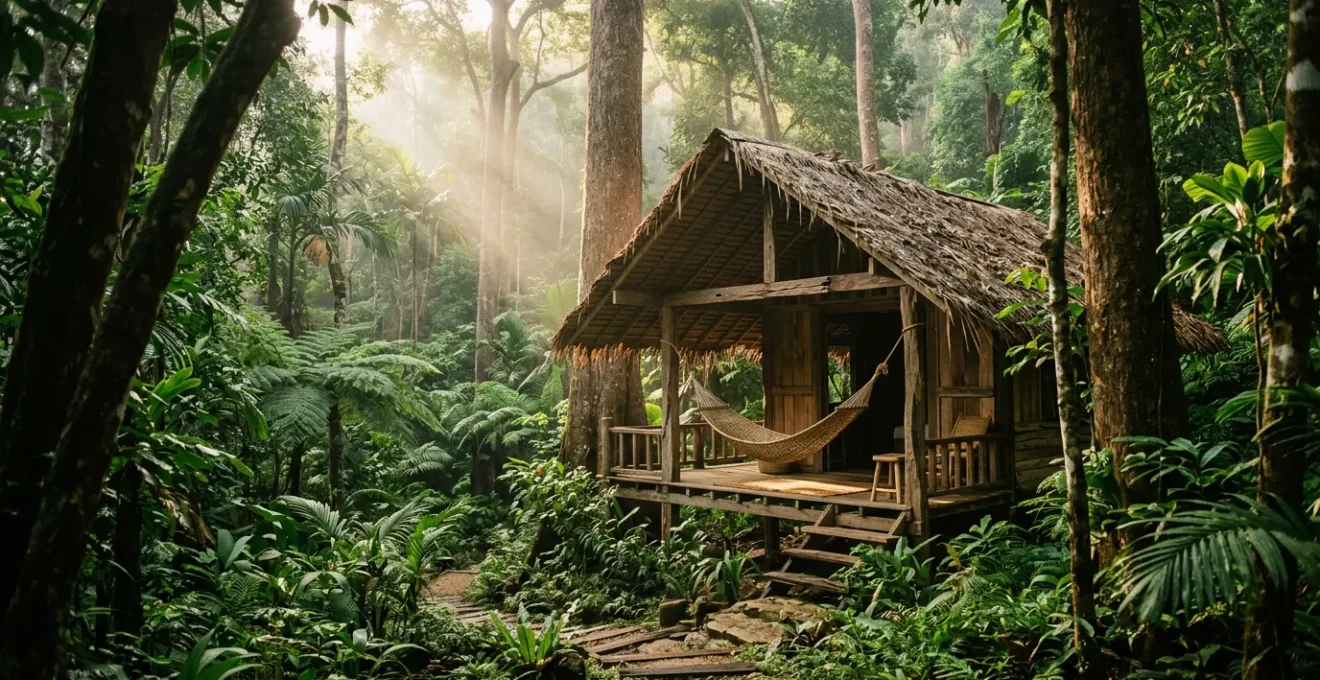
Most guides focus on what to pack for a jungle trip, but true preparation goes deeper. The key to a transformative off-grid experience isn’t about bringing the right gear; it’s about intentionally recalibrating your internal operating system. This means adapting your body to the climate, synchronizing your schedule with nature’s rhythm, and shifting your mindset from one of consumption to one of conscious participation.
The dream of escaping to an off-grid jungle lodge often conjures images of serene disconnection: waking to the sound of exotic birds, surrounded by a sea of green, far from the relentless hum of city life. For the urban dweller, it represents the ultimate digital detox. Yet, the transition from a world of instant convenience to one of self-reliance in nature can be jarring. The common advice revolves around packing lists—bug spray, long sleeves, a good book. While practical, this approach barely scratches the surface and treats the experience like a rustic camping trip.
But what if the most crucial preparation isn’t about what’s in your suitcase, but what’s in your head? The real challenge and reward of an off-grid stay lie in a fundamental mindset shift. It’s about moving from a life managed by clocks and notifications to one guided by the sun and the seasons. It’s about unlearning our dependency on air conditioning, endless hot water, and invisible waste disposal. The true art of preparing for the jungle is learning to synchronize with its rhythm, not just endure its conditions.
This guide moves beyond the packing list. We will explore how to re-calibrate your body to the tropical climate, master the art of sleeping peacefully in open-air rooms, and understand your role within the lodge’s ecosystem. We will also equip you with the critical thinking skills to distinguish genuine eco-lodges from “greenwashed” tourist traps and build an itinerary that fosters genuine wellness, not just a temporary escape.
This article is structured to guide you through each stage of this mental and physical preparation. The following summary outlines the key areas we will explore to ensure your off-grid adventure is not just a vacation, but a truly transformative experience.
Summary: A City Dweller’s Roadmap to Jungle Immersion
- No A/C in the Jungle: How to Stay Cool Naturally at Night?
- The Mosquito Net Strategy: How to Sleep Bite-Free in Open Rooms?
- Do You Have to Work on the Farm at an Eco-Lodge?
- 4×4 or Taxi: How to Get to Remote Lodges in the Mountains?
- How to Spot if an Eco-Lodge Is Truly Green or Just ‘Greenwashed’?
- How to Distinguish Real Ecotourism from ‘Greenwashing’ in the DR?
- How to Explore the Rainforest Canopy Without Getting Lost?
- How to Build a Wellness Itinerary That Actually Reduces Stress?
No A/C in the Jungle: How to Stay Cool Naturally at Night?
For a city dweller, the absence of air conditioning in a hot, humid climate can seem like the biggest hurdle. The key isn’t to fight the heat, but to help your body adapt to it. This process, known as heat acclimatization, is a physiological recalibration. Instead of relying on an external machine, you are training your internal thermostat. Your body becomes more efficient at sweating and regulating its core temperature. While research shows that full heat acclimatization typically takes 10-14 days, you can kickstart the process.
Arrive well-hydrated and continue to drink plenty of water, even when you don’t feel thirsty. Embrace the local rhythm: be active during the cooler mornings and evenings, and adopt the habit of a midday siesta during the peak heat. Indigenous populations in tropical climates demonstrate a natural advantage in this area. A 2022 study on heat adaptation found that tropical indigenes have a blunted thermal sensitivity and superior convective heat transfer, allowing them to tolerate heat more effectively. You can mimic this by choosing lightweight, loose-fitting clothing made from natural fibers like cotton or linen, which allow for better airflow and moisture wicking.
At night, focus on maximizing airflow. Choose a room with good cross-ventilation. A simple, low-energy fan can make a significant difference by moving air across your skin. Take a cool shower just before bed to lower your body temperature. By working with your body and the environment, you’ll discover a surprising resilience and find that sleeping in the ambient warmth of the jungle becomes a comfortable, natural state.
The Mosquito Net Strategy: How to Sleep Bite-Free in Open Rooms?
Sleeping in an open-air bungalow with only a mosquito net between you and the jungle can be intimidating. However, it’s crucial to reframe your perspective. The mosquito net is not a flimsy barrier; it is your personal sanctuary, a secure and tranquil space that allows you to be fully immersed in the sounds of the night without the worry of insects. The effectiveness of this simple technology is profound. Beyond comfort, insecticide-treated nets (ITNs) are a cornerstone of public health in tropical regions.
To make your sanctuary impenetrable, the technique is everything. Before dusk, do a thorough check of the net for any holes. Tuck the edges securely under the mattress on all sides, ensuring there are no gaps. If the net is suspended from a single point, make sure it drapes widely enough that you won’t press against the mesh while you sleep. Think of it as creating a sealed bubble. This meticulous setup is your most important evening ritual. The psychological benefit is immense; once inside your sealed net, you can relax completely and listen to the symphony of the rainforest.
The technology behind these nets is constantly improving. For instance, next-generation nets with dual insecticides have shown remarkable results. A study between 2019 and 2022 found that these advanced nets cut malaria rates in children by half compared to older models. While the lodge will provide a net, knowing its power and how to use it correctly transforms it from a simple object into a key tool for peace of mind. You’re not just avoiding bites; you’re participating in a proven strategy that allows for safe, harmonious living within a vibrant ecosystem.
Do You Have to Work on the Farm at an Eco-Lodge?
The term “eco-lodge” can sometimes conjure images of mandatory farm labor, but this is a common misconception. The reality is about “participatory tourism,” an invitation to connect with the place on a deeper level, not an obligation to work. Many authentic eco-lodges are built around a philosophy of contribution, offering guests a spectrum of opportunities to engage. This reframes the idea of a vacation from passive consumption to active, meaningful exchange.
As the platform Eco-Volontaire notes, this approach represents a new way of travel:
Solidarity travel and eco-volunteering are innovative facets of participatory tourism. They offer real immersion in projects with a positive impact.
– Eco-Volontaire Platform, Ecovolunteering Overview
This “positive impact” can take many forms, tailored to your interests and skills. It’s about finding a model that resonates with you. Perhaps it’s a skill-sharing model, where you might offer your professional expertise in photography or web design for a few hours. Or it could be light participation in conservation efforts, like wildlife monitoring or trail maintenance. In many cases, it’s a “hybrid guest-volunteer” model, where you might join in on morning activities—like harvesting from the organic garden for that day’s meals—and have the afternoons free for your own exploration. This is not labor; it is a lesson in resource consciousness, seeing firsthand where your food comes from.
The goal is not to extract free labor but to foster a genuine connection and understanding. By participating, you are no longer just an observer. You become part of the lodge’s story and its sustainable mission. The choice to participate, and at what level, is almost always yours.
4×4 or Taxi: How to Get to Remote Lodges in the Mountains?
The journey to a truly remote lodge is often the first part of the adventure. Paved roads give way to dirt tracks, and the final miles can be steep and challenging. Choosing how to navigate this last leg is a significant decision that balances cost, autonomy, and local impact. Renting a 4×4 offers flexibility but comes with high self-reliance requirements and often has insurance that excludes off-road damage. A local taxi, on the other hand, puts you in the hands of an expert with deep local knowledge.
Often, the best solution is a hybrid approach that combines a standard rental car with a pre-arranged local transfer for the final, difficult stretch. This method not only minimizes risk but also maximizes the positive economic impact on the community. You are directly supporting a local driver or a micro-enterprise. The following table breaks down the key factors to consider:
| Factor | Rental 4×4 | Local Taxi/Driver | Hybrid Approach |
|---|---|---|---|
| Upfront Cost | $60-120/day + fuel | $40-80 one-way | $30-60 total |
| Self-Reliance Required | High (tire changes, navigation) | Low (driver expertise) | Medium (last-mile only) |
| Local Economic Impact | Low (international rental) | High (direct to driver) | Very High (local moto-taxi) |
| Insurance Coverage | Often excludes off-road | Driver professionally insured | Mixed coverage |
| Cultural Experience | Limited | High (storytelling, insights) | Very High (community connection) |
| Time Efficiency | Flexible schedule | Dependent on driver | Moderate (transfer point) |
| Risk of Getting Lost | High without GPS | Very Low (local knowledge) | Low (guided last-mile) |
A prime example of the hybrid model is the access strategy for Rambala Jungle Lodge in Panama. Guests drive to a designated point on the main road, where they transfer to the lodge’s 4×4 for the steep 3-kilometer journey. The final access is a 15-minute hike, with luggage transported by horse. This staged approach is a core part of the off-grid experience, filtering out casual tourism and ensuring that guests who arrive are truly committed to the immersive environment. It turns a logistical challenge into a memorable part of the narrative.
How to Spot if an Eco-Lodge Is Truly Green or Just ‘Greenwashed’?
In an era of conscious travel, the term “eco” is used liberally. It’s easy to be swayed by a website with lush green branding and a nature-based name. However, true sustainability is a deep operational ethos, not a marketing strategy. To avoid “greenwashing,” you need to become a detective and ask pointed, specific questions before you book. Vague claims like “we are eco-friendly” are red flags; genuine eco-lodges are proud of their systems and transparent with their data.
Instead of general inquiries, focus on the lodge’s core resource loops: water, waste, and energy. A truly sustainable operation is a closed-loop system. The Global Sustainable Tourism Council (GSTC) Certification, considered the gold standard, evaluates lodges across 4 core areas: sustainable management, socioeconomic impacts, cultural impacts, and environmental impacts. While not all small lodges can afford certification, they should be able to answer questions inspired by its principles.
This is not about being confrontational; it’s about showing you are an informed traveler who cares. A lodge that is genuinely committed to its principles will welcome your questions with pride and detail. A lodge that is merely greenwashing will likely respond with vague, defensive, or evasive answers. Your inquiry is a powerful tool to support authentic operators and drive accountability in the industry.
Your Pre-Booking Greenwashing Audit
- Ask about water management: “How do you process your greywater (from showers/sinks) and blackwater (from toilets)?” Look for answers mentioning bio-digesters, constructed wetlands, or septic systems, not just “it goes into the ground.”
- Question waste disposal: “Where does your non-compostable trash physically go?” A real eco-lodge will have a specific plan for transport and partnership with a regional recycling facility.
- Request transparency: “Do you monitor your energy and water usage? Can you share any data?” Authentic operations track their metrics as a point of pride.
- Investigate the supply chain: “What percentage of your food comes from your own garden or neighboring farms within a 50km radius?” Specificity is key.
- Verify circular systems: “How do you close the loop? For example, is food waste composted for the garden? Is rainwater harvested?” Look for evidence of a circular, not linear, resource flow.
How to Distinguish Real Ecotourism from ‘Greenwashing’ in the DR?
The challenge of distinguishing genuine ecotourism from marketing ploys is a global one, and it’s particularly acute in popular destinations like the Dominican Republic. Greenwashing preys on a traveler’s good intentions, using superficial cues—like a leafy logo or the word “eco” in the name—to project an image of environmental responsibility that isn’t backed by practice. The core issue, as researchers have noted, is the gap between claims and reality.
Certification provides a structure to manage, improve, and communicate sustainability performance. However, the two main needs identified early on have not changed: to differentiate between genuine and greenwashing claims of sustainability, and to use certification as a structured approach to developing systems and practices.
– Sustainable Tourism Certification Research Team, Systematic Literature Review on Sustainable Tourism Certification
This highlights the dual role of sustainability initiatives: they are both a shield for the consumer and a roadmap for the operator. For you, the traveler, it means looking beyond the surface. A solar panel is a good start, but it can also be a token gesture. True sustainability is systemic. It’s about closed-loop systems where waste from one process becomes a resource for another. It’s about deep community integration where the lodge is a source of stable, meaningful employment and an engine for local entrepreneurship, not just a resort that happens to be in a beautiful location.
Superficial community benefit might be a one-time donation to a local school. Deep integration, however, means the lodge is managed by locals, sources the vast majority of its food from neighboring farms, and actively fosters local businesses, such as hiring local guides or selling crafts made in the village. This level of commitment is harder to fake and creates a resilient, mutually beneficial relationship between the tourism operation and its host community. Your job as a traveler is to look for evidence of this deep, systemic integration.
How to Explore the Rainforest Canopy Without Getting Lost?
One of the greatest joys of a jungle stay is the freedom to explore. But the dense, disorienting environment can be intimidating. While technology like offline GPS apps is a valuable safety net, this is a unique opportunity to reawaken your innate navigational senses. This is “sensory acclimatization” in action—learning to read the world through sound, touch, and sight rather than relying on a screen.
Start with a guide. On your first few walks, pay close attention to how they navigate. They are not just walking; they are constantly observing and listening. They use “sound-mapping,” noting the direction of a river or the consistent call of a certain bird. They identify “sensory anchors,” like a line of trees with distinctively rough bark or the scent of a particular flowering plant. Your goal is to start building your own mental map using these same techniques. The most powerful and simple technique is ‘Looking Back.’ Every hundred meters or so, turn around. The trail looks completely different on the return journey, and memorizing it from both directions is the single best way to prevent getting disoriented.
Before you venture out alone, even on a short walk, be prepared. Always tell someone your intended route and expected return time. Carry a small “getting lost” kit with a loud whistle (the universal distress signal is three sharp blasts), a small signal mirror, and a brightly colored piece of fabric to increase your visibility. By combining these basic precautions with the practice of natural navigation, you transform a potentially anxious experience into an empowering one. You are not just a visitor walking through the forest; you are a participant, actively reading and interpreting the living landscape around you.
Your Natural Navigation Toolkit
- Use the sun as your compass: Track its general east-to-west movement for a reliable sense of direction.
- Practice ‘sound-mapping’: Identify and remember the direction of constant sounds like a flowing river or distant road.
- Master the ‘Looking Back’ technique: Turn around frequently to memorize the trail from the return perspective.
- Create sensory anchors: Follow a stream by its sound, a line of trees by their texture, or a patch of flowers by their scent.
- Prepare a digital backup: Download an offline map app like Maps.me, which works without cell service using your phone’s GPS.
- Carry a simple safety kit: A loud whistle, a signal mirror, and a high-contrast bandana can be lifesavers.
Key takeaways
- True preparation for a jungle lodge is an internal recalibration of your body, mind, and expectations, not just a packing list.
- Distinguishing authentic eco-lodges from “greenwashed” ones requires asking specific, system-oriented questions about water, waste, and community integration.
- The goal is not to endure the lack of modern conveniences, but to synchronize with the jungle’s natural rhythm, which is the foundation of a truly restorative wellness experience.
How to Build a Wellness Itinerary That Actually Reduces Stress?
The ultimate goal of an off-grid jungle stay is often “wellness,” but true wellness is more than just yoga sessions and green smoothies. It’s a state of being that arises naturally from disconnecting from the pressures of modern life and synchronizing with a healthier, more natural rhythm. The paradox is that the best wellness itinerary is one with almost nothing on it. It’s about creating space for “structured nothingness.”
As author Katja Hollaar reflects on her time living off-grid in the jungle:
Here, enveloped within the untamed jungle, hurry holds little meaning. We’ve adapted our days to the rhythms of the natural world that surrounds us. As we shed the constant pressure to maximize productivity, we’ve discovered a sweetness in unhurried existence.
– Katja Hollaar, Mindfulness on Demand
This “sweetness in unhurried existence” is the essence of jungle wellness. It comes from activities that are inherently mindful because they demand your full attention. The simple act of hand-grinding cacao for breakfast, navigating a muddy trail, or simply watching a line of leaf-cutter ants becomes a grounding ritual. Your itinerary should be built around creating opportunities for these moments, not filling every hour. Dedicate a sensory focus for each day: one day for deep listening, another for observing colors and light, a third for noticing textures. This is a powerful way to pull your mind into the present moment.
Crucially, the wellness journey doesn’t end when you leave. The re-entry into the “real world” can be jarring and undo all the benefits. A structured re-entry protocol is just as important as the digital detox itself. This helps you preserve the state of calm you’ve cultivated.
Your Digital Detox and Re-Entry Protocol
- Implement a ‘Digital Sunset’: Three days before your trip, gradually cut screen time by 30% each day to ease the transition.
- Schedule ‘structured nothingness’: During your stay, block out 2-3 hours daily with no goal other than hammock time or silent observation.
- Assign a sensory focus each day: Dedicate specific days to focusing only on sounds, then textures, then colors to deepen your presence.
- Practice the ‘Digital Sunrise’ upon return: Keep your phone off or in airplane mode for the first 24 hours back home to protect your new baseline of calm.
- Plan your re-entry: Before you leave, decide to unpack slowly, avoid work emails on day one, and schedule a walk in a local park to ease back into your routine.
Frequently Asked Questions About Staying in an Off-Grid Jungle Lodge
What is the most blatant form of greenwashing in eco-lodges?
Using green colors, nature-based names, or eco-slogans without offering any actual green credentials or evidence. Terms like ‘nature-based tourism’ or even ‘ecotourism’ can be misused to promote operations that have serious negative environmental impacts.
How can I verify if a certification is legitimate?
Check if the certification comes from a reputable third-party organization. The GSTC (Global Sustainable Tourism Council) maintains a list of accredited certification bodies. Verify certifications on an operator’s website and cross-reference with the certifying body’s official registry.
What should I look for beyond solar panels to assess true sustainability?
Look for closed-loop systems: Does food waste become compost for gardens? Is rainwater harvested for non-potable uses? Is energy use monitored and minimized, not just generated? True sustainability creates circular resource systems, not just single green features.
How can I distinguish superficial from deep community integration?
Deep integration means the lodge is managed by locals, sources the majority of food from neighboring farms, and fosters local entrepreneurship. Ask what percentage of staff are local, where food is sourced from, and how the lodge supports community development beyond one-off donations.