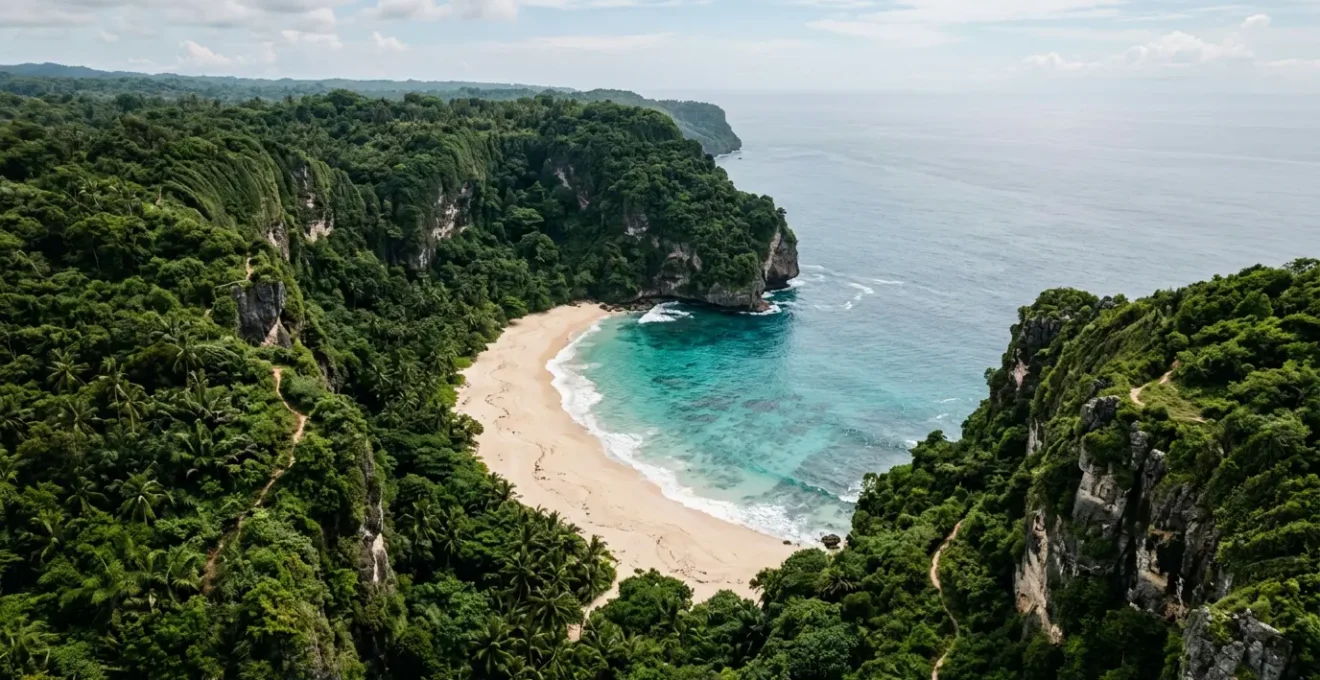
The key to unlocking the North Coast’s hidden beaches isn’t a better guide; it’s learning to think like a cartographer.
- True solitude is earned by mastering “landscape literacy”—reading terrain, tides, and timing, not just following a GPS pin.
- Safety and access are intertwined; understanding survival essentials and tidal patterns transforms a risky gamble into a calculated expedition.
Recommendation: Ditch the tourist mindset. Start by analyzing satellite maps and tide charts for a single target cove; this is the first step to becoming your own expedition leader.
Every intrepid traveler knows the feeling. You see a photo of a perfect, empty stretch of sand, a “secret” beach on the Samaná Peninsula, and the call to adventure is deafening. Yet, the common advice feels like a compromise: hire a boat, join a tour, and share your discovery with dozens of others who followed the same script. This is exploration as a transaction, not a discovery. The standard methods treat the landscape as a destination to be bought, not a puzzle to be solved.
But what if the real map isn’t a GPS track shared in a blog post, but a set of skills? What if accessing these pristine coves wasn’t about following, but about reading the landscape? This guide is built on a counter-intuitive premise: the best way to reach these secret places without a guide is to become your own cartographer. It’s about developing a literacy in the language of the coast—deciphering tides, interpreting terrain, and understanding the hidden rhythms of access that unlock true, earned solitude.
This is not a simple list of locations. It is a manual for the self-reliant explorer, providing the strategic tools needed to plan, execute, and safely return from expeditions to the wild edges of the coast. We will deconstruct the challenges and transform them into a solvable equation of knowledge and preparation.
This article provides a complete cartographic framework for your expedition. The summary below outlines the essential skills you’ll acquire to navigate the North Coast’s hidden gems with confidence and respect.
Summary: A Cartographer’s Manual for the North Coast
- What Survival Essentials Must You Bring to a Virgin Beach?
- Playa Frontón or Playa Madama: Which Hike Is More Rewarding?
- The Tide Mistake That Can Trap You in Secluded Coves
- When to Arrive at Playa Rincón Before the Tour Buses Show Up?
- How to Leave No Trace When Visiting Unmanaged Beaches?
- How to Access the Most Dramatic Landscapes of the Peninsula Safely?
- How to Hike the Baní Dunes Without Heat Exhaustion?
- Where to Find Private Beach Access That Actually Lives Up to the Photos?
What Survival Essentials Must You Bring to a Virgin Beach?
Approaching a virgin beach isn’t packing for a day trip; it’s equipping an expedition. The difference lies in preparing for the unexpected, as help is not a quick phone call away. Your pack is your lifeline, and every item must be chosen with purpose. Forget generic first-aid kits; the tropical coast has specific threats. Potent antihistamines for sandfly bites that can ruin a trip, and vinegar for jellyfish stings are non-negotiable. Technology is a powerful ally, but only with redundancy. A waterproof phone case and a fully charged power bank are critical, but they are useless without pre-downloaded offline maps and GPX tracks for navigation beyond the reach of cell signals.
Signaling becomes your most important skill if things go wrong. A simple, loud whistle is a universal distress signal, and a signal mirror can be seen for miles. For truly remote expeditions, where a twisted ankle can become a life-threatening situation, a personal locator beacon (PLB) is the ultimate insurance policy. This isn’t over-preparation; it’s a professional approach to risk. Even a simple surf session requires foresight; a breakaway leash prevents dangerous entanglement while ensuring your board remains a life-saving flotation device. Acknowledging the risks is the first step to mitigating them. With drowning being a significant danger in coastal areas, every piece of gear that keeps you safe and self-sufficient is essential.
Your Essential Cartographer’s Checklist: Virgin Beach Expedition
- Offline Navigation: Download offline maps and any available GPX tracks for your target area using an app like Maps.me before you lose signal.
- Tropical First-Aid: Pack specific remedies like vinegar for jellyfish stings, strong antihistamines for sandfly bites, and oral rehydration salts for dehydration.
- Emergency Signaling: Carry a loud whistle, a signal mirror, and seriously consider a personal locator beacon (PLB) for truly remote explorations.
- Power Redundancy: Your phone is a tool. Protect it with a waterproof case and ensure it stays charged with a full power bank.
- Board Safety: If surfing or paddleboarding, always use a leash. A breakaway leash is ideal to prevent entanglement while keeping your flotation device near.
Ultimately, the essential gear you bring reflects a mindset: you are not a passive visitor but the active, responsible leader of your own journey.
Playa Frontón or Playa Madama: Which Hike Is More Rewarding?
The choice between Playa Frontón and Playa Madama is a classic Samaná dilemma, but framing it as “which is better” is the wrong approach. A cartographer asks, “Which expedition profile aligns with my capabilities and objectives?” These are two fundamentally different experiences. Playa Madama is an accessible, rewarding introduction to coastal hiking. The 45-minute trek along a well-trodden path offers stunning views without demanding expert-level navigation, leading to an intimate, calm cove perfect for a relaxed swim.
Playa Frontón, however, is a different beast. It is the peninsula’s crown jewel, but it demands tribute in the form of effort and skill. The two-hour hike is a challenging jungle slog on a poorly marked trail where losing your way is a real possibility. The reward for this effort is not just a beach, but a cathedral of nature. The immense, 90-meter metamorphic cliff that dominates the landscape is a humbling sight, offering a profound sense of scale and isolation that is simply impossible to find at more accessible spots. The snorkeling along its vibrant reef is a world-class bonus.
The table below, based on data and hiker reports from platforms like AllTrails’ trail comparisons, breaks down the decision matrix. It’s not about better or worse, but about matching the challenge to your ambition.
| Factor | Playa Frontón | Playa Madama |
|---|---|---|
| Hike Difficulty | 8/10 – Challenging jungle trail | 5/10 – Moderate coastal path |
| Hike Time | 2 hours one-way | 45 minutes one-way |
| Trail Markings | Poor – easy to lose trail | Clear – well-traveled path |
| Beach Size | Large crescent beach | Small intimate cove |
| Snorkeling Quality | Excellent – vibrant coral reef | Good – calm clear waters |
| Solitude Potential | Very high – boat access limited | Moderate – easier access |
Choose Madama for a beautiful day out. Choose Frontón for an accomplishment, a story to tell, and a genuine taste of wild Dominican beauty.
The Tide Mistake That Can Trap You in Secluded Coves
Of all the forces a coastal explorer must respect, the tide is the most relentless and unforgiving. The most beautiful, secluded coves are often flanked by high cliffs, creating what safety experts call “trap coves”: beaches with no overland escape route at high tide. Miscalculating your “tidal window”—the safe period between high tides—is the single most dangerous mistake you can make. The gentle lapping of the waves can transform into a rising wall of water, cutting off your exit and leaving you stranded. A comprehensive 30-year analysis of beach fatalities highlights that while rip currents are a major killer, being trapped by tides often leads to desperate situations where poor decisions are made.
True access cartography involves more than just finding a path; it requires a four-dimensional plan that includes time. Before even setting foot in a cove, your planning must include these critical steps. First, check the tide charts for the exact day and location using an app like Tides Near Me. Second, use satellite imagery on Google Earth to identify potential trap coves—look for those tell-tale sheer cliffs on all sides. Third, and most importantly, establish a “bailout point” before you descend to the beach. This is a pre-identified spot on high ground where you can safely wait out the high tide if you get trapped. Finally, set a hard alarm on your phone for the tide’s turn. Do not rely on visual cues; your attention will be on the beauty around you, not the water creeping up the sand. The tide is a clock; your job is to know how to read it.
Ignoring the tide is gambling with your safety. Respecting it is the mark of a true expeditionary mindset.
When to Arrive at Playa Rincón Before the Tour Buses Show Up?
Playa Rincón is often listed as one of the most beautiful beaches in the world, a fact that has not gone unnoticed by tour operators. Here, the “secret” is not the location, but the timing. Achieving solitude at a world-famous beach is a strategic exercise in what can be called the “solitude equation.” The key variable is the arrival time of the tour boats. Analysis of local operations shows a clear pattern: most boats depart from Las Galeras around 9:00 AM, unloading their passengers onto Rincón’s sands between 10:30 AM and 11:00 AM. This is the moment the beach transforms from a tranquil paradise to a bustling social hub.
Your mission is to operate outside this peak window. To experience the beach as it’s meant to be seen, you have two primary options:
- The Dawn Patrol (Before 9:00 AM): Arriving early, especially via an overland route or a pre-booked early boat transfer, grants you the beach in its purest state. The light is soft, the sand is untouched, and the only sounds are the waves and birds. You are not just beating the crowds; you are experiencing a completely different place.
- The Second Golden Hour (After 3:30 PM): By late afternoon, the tours are packing up to return to base. The light softens again, the beach empties out, and a sense of calm returns. This window offers the same tranquility as the morning, with the added beauty of the approaching sunset.
Even during midday, a strategic approach can yield pockets of peace. The crowds congregate near the main drop-off points. By heading to the far western end, near the cool, freshwater outlet of Caño Frío, you can find relative quiet even during the busiest hours. Visiting on a weekday will always offer a higher chance of solitude than a weekend.
At Playa Rincón, the ultimate luxury isn’t a comfortable chair, but a well-timed arrival that lets you have a world-class beach all to yourself.
How to Leave No Trace When Visiting Unmanaged Beaches?
For the cartographer-explorer, the prime directive is to map and experience the world without altering it. On unmanaged beaches—those without services, bins, or caretakers—the standard “Leave No Trace” principles are not just a suggestion, but a strict ethical code. The goal is not just to pack out what you pack in, but to achieve a state of trace-free exploration, leaving the landscape as wild and pristine as you found it. This philosophy extends beyond just litter.
One of the most significant unseen impacts is chemical. The vibrant coral reef at Playa Frontón, for instance, is a fragile ecosystem. Using conventional sunscreen containing oxybenzone or octinoxate is akin to poisoning the very attraction you came to see. The only acceptable option is a reef-safe sunscreen based on mineral blockers like zinc oxide or titanium dioxide. This single choice can help preserve the underwater beauty for years to come. Similarly, human waste must be managed responsibly. The “cathole method” is the standard for backcountry ethics: dig a hole 6-8 inches deep at least 200 feet (about 70 steps) away from any water source and cover it thoroughly when you’re done.
True stewardship, however, goes beyond minimizing your own impact; it involves actively leaving the place better than you found it. Pack an extra bag and dedicate five minutes before you leave to a mini beach cleanup. It’s a small act that, compounded by conscious travelers, has a massive positive effect. This means packing out everything—including organic waste like fruit peels, which can take a long time to decompose in a sandy environment and disrupt the local ecosystem. Walk on durable surfaces like wet sand, and never trample the fragile dune grasses that hold the coastline together. Your presence should be as ephemeral as a footprint on wet sand, washed away by the next tide.
The greatest compliment an explorer can receive is for no one to have known they were ever there.
How to Access the Most Dramatic Landscapes of the Peninsula Safely?
The Samaná Peninsula’s allure lies in its raw, untamed drama. Beyond the serene beaches, the landscape offers geological marvels that speak to the power of nature. Accessing these places safely requires a shift in perspective: you are not visiting a park, you are entering a dynamic, powerful environment. A prime example is Boca del Diablo (“Devil’s Mouth”) near Las Galeras. This is not a gentle viewpoint; it’s a natural blowhole where the ocean, forced through a fissure in the cliffside, erupts in powerful jets of water that can soar meters into the air. The spectacle occurs atop a 30-meter-high cliff, and the experience is both thrilling and intimidating.
Safely accessing such a feature is a case study in landscape literacy. The “wow” factor of the water jet is the end result of immense geological pressure. There are no guardrails here. Safety is entirely your responsibility and is based on a few key principles of observation. You must watch the wave patterns before approaching the edge, understand that the ground can be slippery from the constant spray, and respect the raw power on display by maintaining a safe distance. The thrill comes from witnessing the power, not from testing its limits.
This same principle applies to finding and navigating other dramatic features, like hidden sea caves or remote cliff-top arches. Their existence is often hinted at by topographic features—unusual rock formations on a satellite map, or a sudden break in a cliff line. But access is always a question of conditions. A sea cave that is placid and inviting on a calm day can become a deadly trap with a change in swell. The cartographer’s approach is to observe, understand the forces at play, and visit only when the conditions are favorable. It is a dialogue with nature, not a conquest.
The most dramatic landscapes demand the most respect. Your safety depends on your ability to listen to what the environment is telling you.
How to Hike the Baní Dunes Without Heat Exhaustion?
Far from the lush greenery of Samaná, the Dominican Republic holds a startlingly different landscape: the Baní Dunes. This desert-like environment, meeting the Caribbean Sea, presents a unique and severe challenge: heat. Hiking here is an exercise in energy and water management, where a mistake can quickly lead to heat exhaustion or worse. Dehydration is a critical factor in many coastal and water-related emergencies, a fact underscored by global health data. While direct statistics vary, the World Health Organization recognizes the complex factors leading to over 300,000 annual drowning deaths, with physical impairment like that from dehydration playing a role in emergencies.
Surviving and enjoying the dunes is a science. Your strategy must begin long before you feel thirsty. Start pre-hydrating 24 hours before your hike by increasing your water and electrolyte intake. A simple DIY electrolyte drink (1/2 tsp salt, 2 tbsp sugar, 1/4 tsp potassium salt substitute per liter of water) can be far more effective than plain water. The hike itself should be timed not by the clock, but by the sun. The peak heat between 9 AM and 4 PM is to be avoided at all costs. Plan your trek for the very early morning or late afternoon, using the long shadows of the larger dunes for cover.
Your gear choice is also critical. Heavy hiking boots will fill with sand and cook your feet. Lightweight trail runners or even neoprene socks are far better choices to navigate the hot sand. Think like a desert animal: conserve energy, move during the coolest parts of the day, and understand the terrain. Planning your route to take advantage of the shade cast by larger dunes is an advanced technique that separates the prepared explorer from the reckless tourist. The Baní Dunes are magnificent, but they are an environment that is utterly indifferent to your survival. Your preparation is the only thing that isn’t.
In the dunes, your most important piece of gear is your strategic plan for managing the sun and your body’s resources.
Key takeaways
- Cartographic Mindset is Key: Success and safety depend on shifting from a tourist to an explorer, focusing on reading the landscape, tides, and timing.
- Preparation is Paramount: Your expedition is only as good as your prep. This includes tropical-specific first aid, redundant navigation, and a deep respect for environmental factors like heat and tides.
- Leave It Better: True exploration requires an ethical commitment to trace-free travel, from using reef-safe sunscreen to packing out all waste, leaving the wild as you found it.
Where to Find Private Beach Access That Actually Lives Up to the Photos?
This is the ultimate question for the intrepid explorer. The answer, fittingly, is not a list of coordinates. A location shared is a secret lost. The real answer is a method, a mindset. The most private, pristine beaches—the ones that truly live up to the dream—are not found on a list, they are discovered through the practice of access cartography. It begins not with a travel blog, but with a topographic map and your own curiosity. Look for where the contour lines on the map press close to the sea; a cliffed coast often hides small coves where streams meet the ocean. Look for roads that come within a few hundred meters of the shore but don’t quite touch it; those endings are invitations for those willing to walk.
In the modern era, this classical technique is augmented by satellite imagery. Google Earth is your most powerful tool. Scan the coastline, looking for breaks in vegetation, the color of the sand, and the angle of the waves. This is how you distinguish a rocky shore from a hidden beach. But this is where the critical vetting process begins. The curse of “Instagram vs. Reality” is real. You must cross-reference that beautiful, curated photo with recent satellite imagery. Look for signs of new construction, sargassum buildup, or crowd patterns not shown in the perfect post. Use the “restaurant as a key” strategy: in some areas, buying a meal or a drink at a small, locally-owned cliffside spot grants you legitimate, safe access to the beach below, along with a secure place to park.
This process—of research, vetting, and respectful exploration—is the work. It’s more effort than booking a tour, but the reward is exponentially greater. The beach you find through this method isn’t just a place you visited; it’s a discovery you earned. It’s a place that holds a piece of your effort and intellect, making the experience profoundly personal and deeply rewarding.
The most secret beaches are not on any map you can buy. They are on the map you create yourself through skill, curiosity, and a deep reading of the world around you.