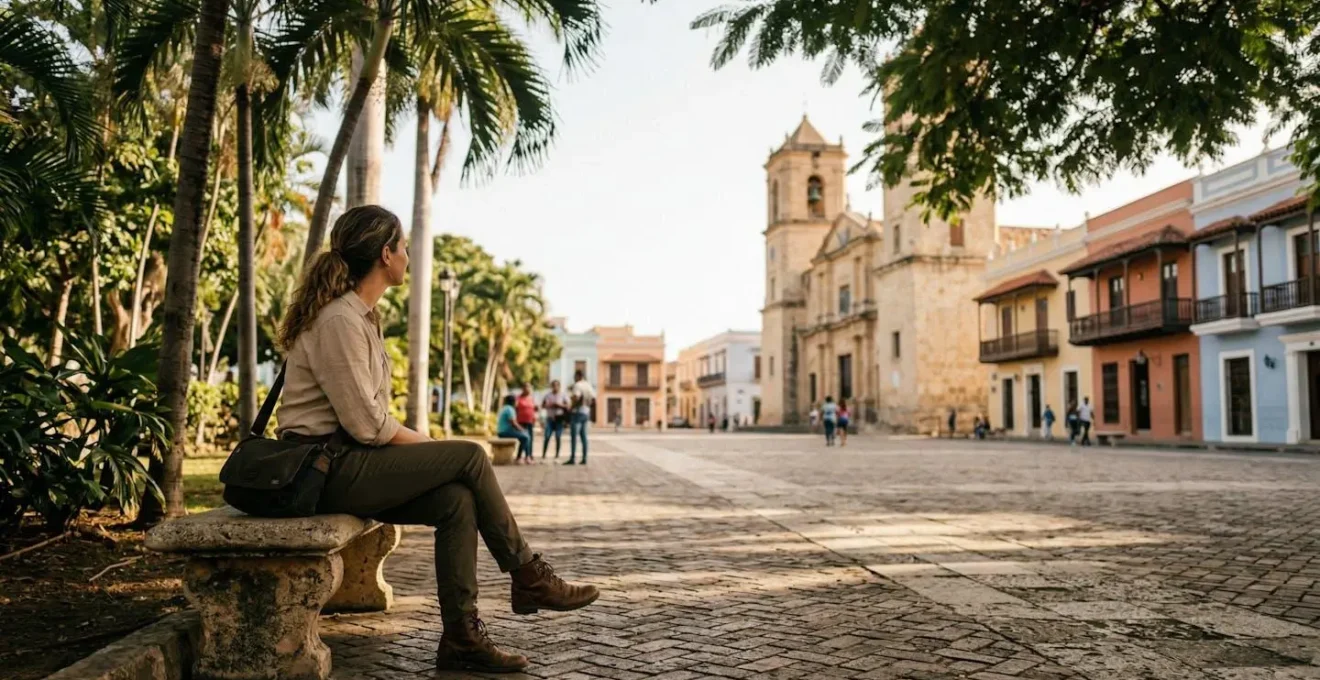
The biggest myth about solo travel safety in the Dominican Republic is that it requires avoiding local life. The opposite is true: real security comes from understanding and blending into it.
- Safety isn’t found in isolation, but by learning to read the “social barometer” of public spaces like parks and colmados.
- Authentic experiences aren’t handed to you; they’re earned through small, respectful interactions and observing the city’s unique rhythm.
Recommendation: Instead of focusing on what to avoid, focus on what to observe. Learning the unwritten rules of the street is your most powerful tool for a safe and deeply rewarding trip.
The idea of exploring a Dominican city center solo can be a mix of excitement and apprehension. You’re drawn to the vibrant history, the pulse of merengue music spilling from doorways, and the promise of authentic culture. Yet, you’ve probably also read the standard travel advice: be hyper-vigilant, don’t flash valuables, and stick to the well-trodden tourist paths. While well-intentioned, this advice often creates a barrier between you and the very experiences you came for, turning a journey of discovery into an exercise in avoidance.
Many guides focus on the potential dangers, listing neighborhoods to avoid and scams to watch out for. This approach, while necessary to an extent, misses the bigger picture. It treats the local environment as a static threat to be navigated, rather than a dynamic, living system to be understood. What if the key to safety wasn’t about building a wall around yourself, but about learning how to open the right doors? What if you could learn to read the city’s unwritten social codes and rhythms, allowing you to move with confidence and blend in naturally?
This guide is built on that premise. As an expat who has learned to navigate these streets, I can tell you that true safety lies in observation and understanding. It’s about knowing why the central park is the city’s living room, how to order a coffee in a way that earns a nod of respect, and recognizing the weekend “coro” rhythm that signals a safe and welcoming atmosphere. We will deconstruct the city’s social fabric, giving you the tools not just to survive, but to connect. You’ll learn to see the city not as a collection of risks, but as a community with its own logic—a logic you can learn to speak.
This article will guide you through the essential skills for navigating Dominican urban life. We’ll start with the heart of the city and move through daily interactions, transportation, and cultural participation, all through the lens of a savvy local.
Summary: Your Guide to Navigating Dominican Cities Solo
- Why Dominican Cities Are Organized Around a “Parque Central”?
- Santiago vs Santo Domingo: Which City Offers a More Authentic Vibe?
- How to Order Coffee in a Local “Colmado” Like a Resident?
- The Taxi Negotiation Mistake That Costs You Double in City Centers
- When Do City Streets Come Alive on Weekends?
- How to Explore Santo Domingo’s Modern and Ancient Sides in 48 Hours?
- How to Walk the Defensive Walls of Santo Domingo and Understand the Pirate Attacks?
- How to Participate in Local Traditions Without Being an Intruder?
Why Dominican Cities Are Organized Around a “Parque Central”?
The central park, or Parque Central, is far more than just a green space in a Dominican city; it’s the social and cultural epicenter. Understanding its function is the first step to reading the entire urban environment. Historically, these parks were laid out by Spanish colonists as the heart of the grid, surrounded by the most important buildings: the church, the governor’s office, and the homes of the wealthy. Today, that legacy continues as they serve as a social barometer for the entire neighborhood. The park’s population at any given time tells you everything you need to know about the area’s safety and rhythm.
Think of it as the city’s open-air living room. In the morning, you’ll see older men reading newspapers and debating politics. At lunchtime, office workers escape for a moment of shade. But the golden hour for observation is the late afternoon, from about 4 to 7 PM. This is when you’ll see families with children, teenagers flirting on benches, and elderly residents enjoying the cooling air. The presence of these groups, especially kids and seniors, is the strongest possible signal of a safe and stable community atmosphere. Their comfort is your best indicator of security. Conversely, a park that is empty during these prime hours, or populated only by loitering young men, signals a different dynamic that requires more caution.
The case of Parque Colón in Santo Domingo’s Zona Colonial is a perfect example. It’s a “home base” for travelers precisely because it functions as a reliable social hub. You can sit with a coffee, watch children chase pigeons near the cathedral, and get your bearings before venturing into the surrounding streets. The visible presence of the tourist police (POLITUR) adds a layer of official security, but the true feeling of safety comes from the constant, predictable flow of local life. By learning to read these signals, you’re no longer just a tourist looking at a landmark; you’re an observer understanding the heartbeat of the city.
Your Checklist: 5 Essential Steps to ‘Read’ a Dominican Park’s Safety Signals
- Observe the demographic mix: Look for families with children and elderly locals sitting on benches – their presence between 4-7 PM indicates a safe neighborhood atmosphere.
- Listen to the soundscape: Normal bachata/merengue from nearby colmados mixed with lottery sellers’ calls signals everyday local life versus tense silence or aggressive shouting.
- Check the police presence pattern: One or two CESTUR officers casually patrolling is ideal – too many suggests recent problems, none might mean less tourist priority.
- Notice the vendor ecosystem: Legitimate shoe-shiners and ice cream vendors with regular spots indicate established community order versus aggressive hustlers.
- Time your visits strategically: Early morning (7-9 AM) shows commuter patterns, lunchtime (12-2 PM) reveals worker rhythms, and evening (5-7 PM) displays family dynamics.
Santiago vs Santo Domingo: Which City Offers a More Authentic Vibe?
Choosing between the Dominican Republic’s two largest cities, Santo Domingo and Santiago, is a common dilemma for solo travelers seeking authenticity. The answer depends on what “authentic” means to you. Santo Domingo, the capital, offers a powerful blend of historical and cosmopolitan authenticity. Its Zona Colonial is a living museum, the oldest European city in the Americas, but it’s also a major tourist hub. This creates a “tourist bubble” with heavy police presence and plenty of English speakers, making it easier to navigate but also requiring you to be wary of targeted scams.
Santiago de los Caballeros, the country’s second city nestled in the fertile Cibao Valley, presents a different flavor. It’s the nation’s industrial and agricultural heartland, offering a more everyday, working-class authenticity. The tourist infrastructure is less developed, meaning Spanish is more essential and you’ll need to rely more on your own wits. The safety dynamic is more uniform; rather than a protected bubble, safety comes from blending in and moving with the local flow. It’s less about grand monuments and more about observing the rhythms of local markets and neighborhood life. As one blogger from Solo Travel Addict noted after a visit, “Santiago felt calmer and had some nice parks and malls.”
Ultimately, Santo Domingo is a historical giant with a modern, international pulse, making it a fantastic, if sometimes challenging, introduction. Santiago requires a bit more confidence and language skill but rewards the traveler with a glimpse into the unvarnished, everyday life of the Dominican people. Your choice depends on your comfort level and travel style. Are you looking for centuries of history on display, or the quiet authenticity of a city at work?
This comparison helps clarify the distinct experiences each city offers a solo traveler. For a detailed breakdown, the following table highlights key differences in safety and authenticity.
| Aspect | Santo Domingo | Santiago |
|---|---|---|
| Tourist Infrastructure | Heavy CESTUR presence in Zona Colonial, established tourist bubble | Less tourist-focused, requires more Spanish skills |
| Safety Dynamic | High police in tourist areas but targeted scams common | More uniform risk, need to blend in with locals |
| Authenticity Type | Historical & cosmopolitan – museums, colonial architecture | Everyday & working-class – local markets, neighborhood life |
| Weekly Rhythm | Constant tourist flow, always busy | Traditional work week with weekend ‘coro’ atmosphere |
| Areas to Avoid | Cristo Rey, Villa Agricola, Arroyo Hondo at night | Cienfuegos, Los Salados, La Yaguita de Pastor |
| Solo Navigation | Easy with apps, many English speakers | Spanish essential, fewer tourist services |
How to Order Coffee in a Local “Colmado” Like a Resident?
One of the quickest ways to bridge the gap between tourist and temporary local is to master a simple, daily ritual: ordering coffee at a colmado. These small neighborhood stores are the lifeblood of every Dominican barrio, selling everything from rice and rum to a single cigarette. More importantly, they are social hubs where a simple transaction, done correctly, can earn you a measure of acceptance. The key isn’t just knowing the words, but understanding the non-verbal protocol that goes with them. Rushing in, pointing, and speaking loud English marks you as a transient outsider. Following the local script marks you as someone who pays attention.
The process is a three-part play: the greeting, the order, and the connection. It begins the moment you enter. A simple “Saludos” or “Buenos días” while making brief eye contact with the owner is crucial. This isn’t a supermarket; it’s their space. This small act of respect establishes you as a polite individual, not an anonymous consumer. When you order, be specific. “Un cafecito, por favor” will get you the standard small, strong, and sweet coffee. Tapping a coin on the worn wooden counter while you wait is a subtle signal that you’re ready to pay and understand the rhythm of the place. It’s a small gesture that says, “I’ve been here before.”
Finally, while the owner prepares your coffee using the iconic aluminum ‘greca’, use the moment to make a small connection. A comment on the weather (“Que calor hoy, eh?”) is a universal icebreaker. This transforms the transaction from purely commercial to social. Leaving with a warm “Gracias, que pase buen día” closes the loop. Do this a couple of days in a row, and you’re no longer a stranger. You’re the foreigner who knows how to order coffee, a recognized and respected face in the neighborhood. This small skill is a powerful tool for building a sense of belonging and safety.
The Complete 3-Step Colmado Coffee Script
- Step 1 – The Greeting: Enter with ‘Saludos’ or ‘Buenos días/tardes’ while making brief eye contact with the owner behind the counter – this establishes you as respectful, not just another tourist.
- Step 2 – The Order: Say ‘Me da un cafecito, por favor’ for a small sweet coffee or ‘Un café mediano, normal de azúcar’ for medium with regular sugar – tap a coin on the counter while waiting to signal you’re ready to pay.
- Step 3 – The Connection: While waiting, comment on the weather (‘Que calor hoy, eh?’) or ask about the neighborhood (‘Esta tranquilo el barrio?’) then leave with ‘Gracias, que pase buen día’ to become a recognized face.
The Taxi Negotiation Mistake That Costs You Double in City Centers
Navigating taxis in Dominican city centers is often a source of anxiety for solo travelers. The common advice is to “negotiate the fare beforehand,” but this ignores the power imbalance. A tourist asking “how much?” is a clear signal to start the price high. The biggest mistake is negotiating from a position of ignorance. The street-smart solution is to shift the power dynamic by demonstrating you already know the fair price, even if you don’t. This is where the ‘App Bluff’ technique comes into play.
Ride-sharing apps like Uber and DiDi operate in major cities like Santo Domingo and Santiago. Even if you don’t plan to use them, they are your most powerful negotiation tool. Before hailing a regular taxi, discreetly check the estimated fare for your trip on the app. When a taxi driver quotes you a price—which will likely be significantly higher—don’t argue. Simply open the Uber or DiDi app on your phone so the driver can see the screen. As one traveler reported, this ‘visible app strategy’ is incredibly effective: ‘A taxi driver in Santo Domingo initially quoted 800 pesos… I opened Uber… showed the screen with the fare estimate of 350 pesos. Without any discussion, he immediately dropped to 400 pesos.’ This technique works because it replaces an argument with undeniable market data. It shows you’re not a naive tourist to be overcharged.
Beyond price, personal safety is paramount, especially given that, as confirmed by the U.S. State Department, the country’s road crash mortality rate is dangerously high. Before even starting a negotiation, quickly assess the vehicle and driver. Look for basic safety features like working seatbelts and a car in reasonable condition. Trust your gut about the driver’s demeanor; a professional will not be overly aggressive or seem agitated. And always carry small bills (100 and 200 peso notes) to avoid the classic “I don’t have change” scenario. Price is just one part of a safe ride; asserting your awareness on all fronts is key.
When Do City Streets Come Alive on Weekends?
For a solo traveler, an empty street can feel more threatening than a crowded one. In the Dominican Republic, safety is often found in numbers, and understanding the city’s weekly social rhythm—the coro—is essential. The streets aren’t uniformly safe or unsafe; their character changes dramatically depending on the day and time. Learning this timeline allows you to tap into the natural flow of local life, placing yourself in the safest and most vibrant environments. The weekend is a predictable performance, and you just need to know the schedule.
The energy begins to build on Friday afternoon around 4 PM. This is the ‘coro’ buildup, as office workers flood the streets and the volume of music from cars and businesses starts to rise. From 7 PM to 10 PM is the peak social hour. A key signal to look for is what I call the “plastic chair indicator.” When you see colmados and storefronts placing plastic tables and chairs on the sidewalk, it’s a non-verbal invitation. It means the space is transforming into a community gathering spot, a safe and welcoming place to be. Saturday mornings are for errands, with local markets buzzing with families between 10 AM and 2 PM, offering a perfect opportunity to blend in.
Sunday, however, is the main event. The morning is quiet, reserved for church and family gatherings, making it a perfect time for peaceful walks in usually busy areas. But the real magic happens in the afternoon. From 3 PM to 8 PM, the Malecón (waterfront promenade) transforms. Families descend upon the waterfront with music, food, and laughter. This is ‘family time’ on a city-wide scale. As one traveler shared about her experience, “I felt completely safe walking alone on Sunday afternoon when Dominican families were out in force. The presence of children playing and elderly couples strolling made it clear this was ‘family time,’ creating a naturally protective atmosphere for solo travelers.” By aligning your explorations with this rhythm, you’re not just avoiding risk; you’re actively participating in the safest, most inclusive moments of Dominican public life.
Santo Domingo’s Malecón is a nearly nine-mile-long street along the Caribbean Sea. At night, you can see street performers and enjoy live music at the restaurants. The area transforms on weekends – I felt completely safe walking alone on Sunday afternoon when Dominican families were out in force. The presence of children playing and elderly couples strolling made it clear this was ‘family time,’ creating a naturally protective atmosphere for solo travelers.
– Jetset Jazzmine, Things To Do in Santo Domingo
How to Explore Santo Domingo’s Modern and Ancient Sides in 48 Hours?
Santo Domingo is a city of stunning contrasts, where 16th-century cobblestone streets lie just a short ride away from a 21st-century skyline of glass and steel. For the solo traveler, experiencing this duality is key to understanding the nation’s identity. It’s about seeing not just the colonial past that is sold to tourists, but also the vibrant, modern present where most Dominicans live their lives. A well-planned 48 hours can allow you to time-travel between these two worlds, using the city’s surprisingly efficient infrastructure to your advantage.
A travel safety researcher aptly described the city’s transport system as a time machine, highlighting “the Metro as a time machine: Santo Domingo’s modern, clean, and safe Metro system to jump from the 16th-century Zona Colonial to the 21st-century world.” This insight is the key to your itinerary. Spend your first morning diving deep into the ancient side with a decolonial walking tour of the Zona Colonial, which goes beyond the Columbus narrative to uncover hidden Taíno and African histories. Follow it with a visit to the mystical Los Tres Ojos cave system, a pre-Columbian natural wonder.
Then, in the evening, pivot to the modern side. Take the clean and safe Metro or an Uber to neighborhoods like Piantini or Naco. Here, you’ll find upscale shopping malls like Blue Mall, trendy cafes, and the cosmopolitan energy of contemporary Dominican life. This is where you see the country’s economic engine at work, a world away from the historic stones of the old city. The second day can be a blend, visiting the magnificent Dr. Rafael María Moscoso Botanical Garden—the largest in the Caribbean—before returning to the Zona Colonial for a magical sunset over the Plaza de España, watching the Alcázar de Colón light up as night falls. This deliberate contrast provides a much richer and more complete picture of the capital.
48-Hour Modern vs. Ancient Santo Domingo Itinerary
- Day 1 Morning (Ancient): Start with a walking tour in the Zona Colonial to understand hidden Taíno and African history.
- Day 1 Afternoon (Ancient): Lunch at a traditional restaurant with live music, then explore the Los Tres Ojos cave system.
- Day 1 Evening (Modern): Take the Metro to Piantini for dinner at Blue Mall, experiencing Santo Domingo’s cosmopolitan side.
- Day 2 Morning (Mixed): Visit the Dr. Rafael María Moscoso Botanical Garden, bridging natural heritage and modern conservation.
- Day 2 Afternoon (Modern): Use Uber to reach contemporary neighborhoods like Naco for cafe culture away from tourist zones.
- Day 2 Evening (Ancient): Return to Zona Colonial for sunset at Plaza de España, with a view of the illuminated Alcázar de Colón.
How to Walk the Defensive Walls of Santo Domingo and Understand the Pirate Attacks?
The massive stone walls encircling Santo Domingo’s Zona Colonial are more than just a historical curiosity; they are a masterclass in urban defense that holds surprisingly relevant lessons for the modern solo traveler. Walking these ramparts, from the Fortaleza Ozama (the oldest European fortress in the Americas) to the various gates, allows you to understand the city’s layout and, by extension, its modern safety dynamics. The principles used to defend against pirates in the 16th century can be adapted into a personal strategy for situational awareness today.
Consider the infamous 1586 attack by Sir Francis Drake. His pirates used a classic distraction technique, faking an assault on one gate while the main force breached another. This historical event provides a direct parallel to modern street-level risks, where pickpocket teams often use one person to create a distraction while another strikes. The pirates understood the importance of vulnerabilities and sightlines, and so should you. The high vantage points along the walls are perfect for this. From up there, you can do your own reconnaissance: identify safe zones like hotels and busy plazas, spot the natural boundaries between the tourist-heavy Zona Colonial and the local barrios just outside, and observe the city’s flow without being in the middle of it.
The very design of the fortress teaches the principle of ‘defensive depth’—the idea of having multiple layers of protection and always having an escape route. This is a core tenet of modern personal safety. As you walk the walls, you’re not just seeing history; you’re practicing a mindset. You’re learning to think like a strategist, assessing the terrain, identifying potential chokepoints, and maintaining a high level of situational awareness. Start your walk early in the morning at the Puerta del Conde to see the city wake up, use the fortress towers to map out your day, and end at sunset to watch how the street dynamics change. The walls become your personal watchtower, a tool for understanding and navigating the city with confidence.
Key Takeaways
- True urban safety comes from understanding social rhythms, not from avoidance.
- Small, respectful interactions like ordering coffee are powerful tools for cultural integration.
- Leverage modern technology (like ride-sharing apps) to navigate traditional challenges (like taxi negotiations).
How to Participate in Local Traditions Without Being an Intruder?
The ultimate goal for many solo travelers is to move beyond mere observation and participate in local life. However, this is also where the fear of being an intruder is strongest. How do you join in without disrupting the natural flow or causing offense? The key in the Dominican Republic is respectful observation followed by invitation. Dominicans are generally warm and inclusive, but they appreciate when outsiders take the time to understand the rules of engagement before jumping in. Whether it’s a domino game on a street corner or spontaneous dancing at a colmado, there’s a protocol.
For a heated street domino game, for instance, the rule is to stand back, keep your hands visible, and simply watch. Your quiet, respectful presence will be noted. After a few minutes, someone will likely make a gesture, inviting you closer. For dancing, the rule is to wait to be invited. A polite invitation to dance bachata or merengue is a sign of acceptance into the group’s “coro.” Accepting with a smile (“Claro, con gusto!”) is great, but a polite refusal (“Gracias, pero estoy bien aquí tranquilo/a”) is also perfectly acceptable and respected. The insult is not in refusing, but in refusing rudely. This dynamic exists in many situations, from attending a local church service (dress modestly, sit in the back) to watching a Carnival procession (stay on the sidelines, don’t cross the route).
This respectful engagement also requires an awareness of the local context. A statistic cited by travel guide The Broke Backpacker notes that you should be understanding of the local economic realities, as 20% of the population struggles to get by on very little. This isn’t about pity, but about context. It informs your interactions, encouraging you to support local vendors and to be mindful of displays of wealth. For a more structured experience, a local culture guide from Dominican Tourbase suggests a specific venue: “Visit Jet Set Club in Santo Domingo on a Monday night. It’s a legendary spot where you can practice your new moves while listening to live merengue and bachata bands.” This offers a perfect, controlled environment to participate in the nation’s musical soul without feeling out of place.
Your journey into the real Dominican Republic starts with this shift in mindset. Step out not with fear, but with curiosity. Observe with respect, participate when invited, and let the vibrant, complex, and welcoming rhythm of the city be your ultimate guide.