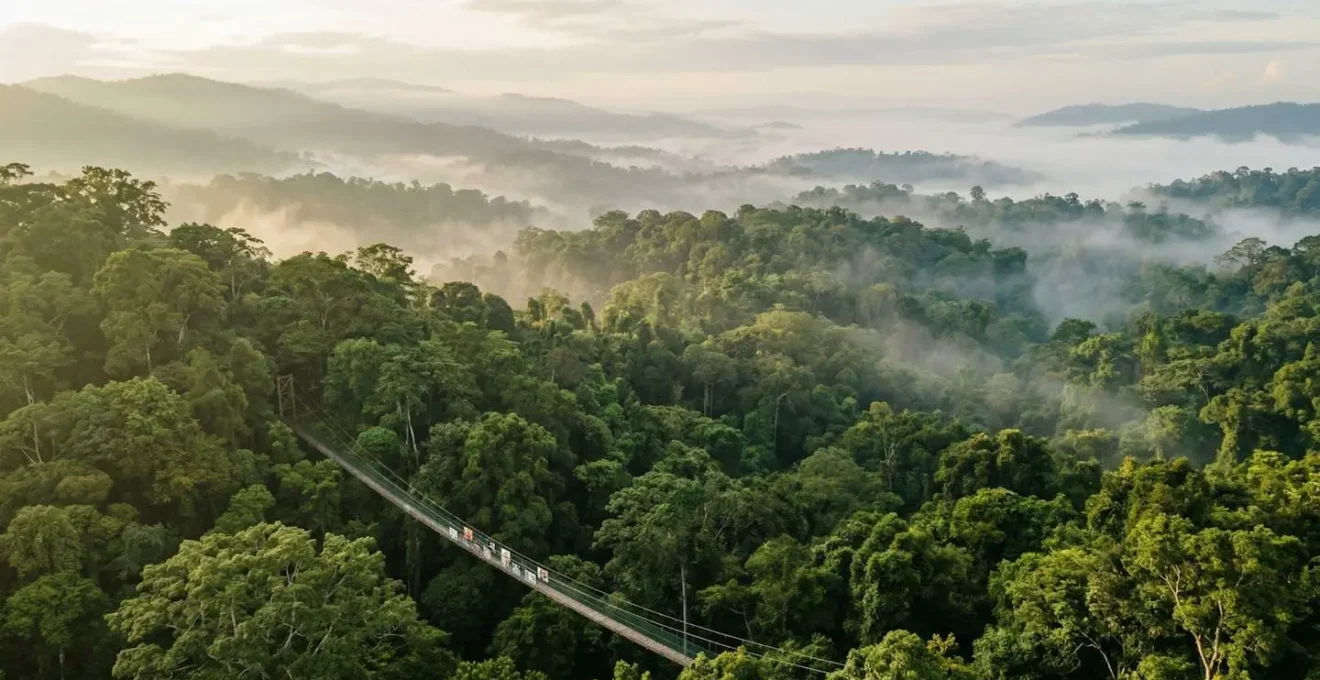
True jungle navigation isn’t about GPS; it’s about developing ‘Jungle Sense’—a sensory skill that transforms you from a tourist into an explorer.
- Cultivating this means choosing immersion over speed, learning to spot ‘pattern interrupts’ in the uniform green, and reframing challenges like rain or off-grid living as part of an authentic experience.
- Safety in the wild comes from calculated risk, not recklessness, by learning to read environmental cues and controlling your own physical and mental state.
Recommendation: Start by consciously choosing one sense to focus on during your next nature walk—sound, sight, or touch—to begin calibrating your awareness.
The rainforest canopy can feel like an impenetrable wall of green. For the uninitiated, the cacophony of unseen creatures and the sheer density of life is overwhelming. The common advice is predictable: hire a guide, stick to the trail, pack bug spray. While sound, this advice only scratches the surface, keeping you on the outside looking in. It treats the jungle as a museum to be viewed from a safe distance, not an environment to be experienced. You are kept from getting physically lost, but you remain disconnected, a passive observer of a world you don’t truly understand.
But what if the key to not getting lost wasn’t about following a path, but about learning to read the map written into the environment itself? The secret to truly exploring the rainforest canopy lies in developing what we guides call ‘Jungle Sense’. This is a deep, sensory awareness that tunes you into the forest’s rhythm. It’s the ability to see the subtle break in a pattern that reveals a hidden orchid, to hear the specific bird call that signals nearby life, and to feel the shift in the air that precedes a downpour. It is the active skill of immersion.
This guide will not just give you a checklist. It will teach you the mindset of an explorer. We will delve into how to choose your perspective from the canopy, train your eyes to find nature’s secrets, and implement strategies that go beyond basic advice. We’ll cover how to tackle natural challenges with confidence, discover the hidden beauty of the rainy season, and prepare your mind and body for a true connection with the wild. Forget just seeing the jungle; it’s time to learn how to experience it.
This article provides a comprehensive framework for developing your ‘Jungle Sense’ for an unforgettable canopy adventure. Below is a summary of the key areas we will explore to transform you from a simple visitor into a savvy explorer.
Summary: A Guide’s Secrets to Not Getting Lost
- Zipline or Hanging Bridges: Which Offers a Better Jungle View?
- How to Spot the Native Orchids Hidden in the Greenery?
- The Repellent Strategy That Actually Works in Deep Jungle
- 27 Charcos of Damajagua: How to Tackle the Falls Safely?
- Why Visiting the Jungle in the Rainy Season Is Actually Better?
- How to Plan a Mountain Retreat in the Central Cordillera?
- How to Build a Photography Itinerary Covering Coast, Mountain, and Desert?
- How to Prepare for a Stay in an Off-Grid Jungle Lodge?
Zipline or Hanging Bridges: Which Offers a Better Jungle View?
Your first decision in the canopy sets the tone for your entire experience: do you want a high-speed rush or deep, sensory immersion? This isn’t just about choosing an activity; it’s about choosing your perspective. Ziplines offer a thrilling, ‘bird of prey’ view. You soar over the canopy, scanning the vast green expanse in 30-60 second bursts of adrenaline. It’s a spectacular way to grasp the scale of the forest, but it’s a monologue, not a conversation.
Hanging bridges, by contrast, offer a ‘primate’s’ perspective. You move slowly, branch to branch, becoming part of the canopy ecosystem. This is where ‘Jungle Sense’ begins. The slower pace, often a one to two-hour journey, allows for sensory calibration. You start to distinguish the hum of insects from the rustle of leaves. The extended time in the canopy is crucial; some of the world’s most famous suspended walkways, like the Peruvian Amazon’s Explorama Lodge Canopy Walkway, stretch for over 1640ft (500m) to maximize this immersion. It is from this stable, lingering viewpoint that the forest truly reveals itself.
From these suspended walkways, you have the time and stability to observe life as it happens. Unlike the blur of a zipline, hanging bridges allow you to spot monkeys swinging through the branches, notice the flash of colorful birds flitting through the leaves, and discover the fascinating insects hidden amongst the flora. The experience shifts from a passive, high-speed flyover to an active, engaged exploration. It is the fundamental choice between seeing the forest and being in it.
How to Spot the Native Orchids Hidden in the Greenery?
The jungle doesn’t give up its secrets easily. Faced with a seemingly uniform “wall of green,” most visitors see only a fraction of the biodiversity around them. Spotting a delicate native orchid isn’t about having better eyesight; it’s about re-training your brain on how to look. The key is to stop looking *for* an orchid and start looking for a ‘pattern interrupt’—an anomaly in the texture, color, or shape of the canopy.
Instead of scanning aimlessly, focus your attention. Begin by identifying likely host trees, which often have rough, mossy, or fissured bark. Forks and crooks in branches are natural collection points for nutrients and moisture, making them ideal real estate for epiphytes. These are plants that live on other plants to get closer to the sunlight, and while Costa Rica alone has roughly 1,400 species of orchids, almost all are epiphytes. They are not parasites; they simply use the tree as a platform, feeding on accumulated water and dust. Your eyes should be drawn to these clusters of life on tree trunks and branches.
Once you’ve located a potential host, look for that break in the pattern: a splash of purple against the green, a waxy texture where there should be bark, or the distinct shape of petals. An even more advanced technique is to follow the pollinators. If you can track a specific hummingbird or butterfly known to favor certain orchids, you can let it lead you directly to its hidden food source. This transforms orchid spotting from a game of chance into a rewarding act of ecological detective work.
The Repellent Strategy That Actually Works in Deep Jungle
Simply packing a bottle of bug spray is a tourist’s move. A true jungle explorer understands that avoiding bites in the deep jungle requires a systematic, multi-layered defense strategy, not a single product. Researchers who spend extended periods studying animals in the treetops have developed these protocols out of necessity. It’s about thinking like a soldier, not a vacationer. Your goal is to create overlapping fields of protection.
The first layer is your clothing. Wear lightweight, loose-fitting, long-sleeved shirts and pants. This creates a physical barrier. The color matters; many biting insects are attracted to dark colors like black and blue, so opt for neutral tones like khaki, beige, or light green. Your second, and perhaps most crucial, layer is a gear treatment. Before you even leave home, treat your outer layer of clothing, your backpack, and even your boots with a Permethrin-based spray. Permethrin is an insecticide that kills ticks and mosquitoes on contact. It bonds to fabric and can last through several washes, creating a persistent protective shield around you.
The final layer is your skin. Only after the first two layers are in place should you apply a topical repellent to your exposed skin. Look for a repellent with a 20-30% concentration of DEET, which remains the most effective chemical deterrent. Application timing is key. You are most vulnerable during the twilight hours of dawn and dusk when mosquito activity peaks. A fresh application before a morning hike or as the sun sets is non-negotiable. This three-tiered strategy—physical barrier, treated gear, and targeted skin repellent—is the professional standard that actually works when you’re deep in the canopy.
27 Charcos of Damajagua: How to Tackle the Falls Safely?
Confronting a rushing waterfall and preparing to jump is a primal test of nerve. At places like the 27 Charcos of Damajagua, this isn’t just a possibility; it’s the main event. Safety here isn’t about avoiding the challenge, but about mastering your own response to it. It’s about transforming raw fear into focused energy. This is the essence of calculated risk, a cornerstone of any true adventure. The key lies in mental rehearsal and environmental assessment before you even approach the edge.
Your mind is your most important tool. Before your turn comes, find a quiet spot and visualize the entire sequence. See yourself approaching the edge with confidence, executing a clean jump, and landing safely in the deep water below. Run through this mental movie three times. Simultaneously, take control of your breathing. Use the “box breathing” technique: inhale for a four-count, hold for four, exhale for four, and hold for four. Repeating this cycle just a few times can slow your heart rate and convert anxiety into sharp focus.
With a clear mind, you can now assess the environment like a professional. Don’t just look at the water; read it. Look for color changes that indicate depth—darker blues and greens are generally deeper. Identify “boils” on the surface, which can signal submerged rocks or obstacles to avoid. Spot the eddies and currents to understand where the water will carry you after you land. Finally, pick your landing spot. Choose a specific point in the safe zone and lock your eyes onto it. This visual anchor will guide your body and provide a clear objective, preventing the disorientation that can lead to a bad jump. By combining mental preparation with a sharp environmental read, you are no longer a victim of the challenge; you are its master.
Your Pre-Jump Safety Checklist: Mastering the Falls
- Mental Rehearsal: Visualize the entire successful jump sequence, from approach to landing, at least three times.
- Breathing Control: Perform three cycles of “box breathing” (4-4-4-4 count) to calm your nervous system and sharpen focus.
- Water Assessment: Identify deep water zones (dark color), hazards (surface boils), and currents (eddies) before choosing a landing area.
- Landing Spot Lock: Pick a single, specific point in the safe landing zone and maintain unwavering visual focus on it throughout the jump.
- Listen to Your Guide: Always follow the specific instructions and hand signals from the certified local guides on site.
Why Visiting the Jungle in the Rainy Season Is Actually Better?
Most travel guides will steer you towards the dry season, citing more accessible trails and pleasant weather. They’re not wrong, but they’re missing the point. The dry season is the jungle on mute. The rainy season, or “green season,” is when the rainforest is at its most vibrant, most active, and most alive. If you want to experience the true pulse of the canopy, you need to embrace the rain. It’s a sensory feast, not an inconvenience.
The rain is a trigger for life. Biologists estimate that an incredible 50-90 percent of all rainforest life exists in the trees, and much of it becomes more active during and after rainfall. Amphibians emerge, insects take flight, and the sounds of the jungle intensify into a complex symphony. The air becomes heavy with the smell of wet earth and blooming flowers. Visiting in the rainy season is the difference between watching a rehearsal and attending the premiere performance.
For photographers and the visually-minded, the rainy season is a gift. The constant cloud cover creates a massive natural softbox, eliminating the harsh shadows of the dry season and producing rich, saturated colors. Raindrops clinging to leaves and spiderwebs create countless tiny jewels. The mist that often shrouds the canopy adds layers of depth and mystery to your landscape shots, creating a powerful atmospheric effect. By using a rain cover for your gear and a macro lens, you can capture the enhanced textures of wet bark and the intricate patterns of leaf veins, revealing a level of detail that is invisible in the dry, dusty conditions of the peak season.
How to Plan a Mountain Retreat in the Central Cordillera?
A true mountain retreat isn’t just about changing your location; it’s about changing your mode of perception. Escaping to the highlands of a region like the Central Cordillera is an opportunity for a full sensory recalibration. Instead of planning an itinerary based on sights to see, design your days around senses to engage. This themed approach transforms a simple trip into a profound, restorative experience.
Dedicate each day to a specific sense. A “Sound Day” could start with a pre-dawn walk to identify the chorus of birds, followed by a visit to an area known for howler monkeys, and end with time spent near a waterfall simply listening to its acoustic power. A “Smell Day” might involve visiting a coffee farm during the morning roasting, walking through fragrant pine forests in the afternoon, and seeking out night-blooming flowers after dusk. This framework forces you to slow down and pay attention to the subtle environmental details you would otherwise miss.
A key part of this sensory recalibration is a conscious digital detox. The constant overstimulation of our devices desensitizes us to the natural world. Implement a “digital sunset” ritual, a practice used in many successful remote retreats. At the actual time of sunset, all electronic devices are put away. The evening is then filled with analog activities: journaling about the day’s sensory experiences, listening to local storytellers, or identifying constellations with paper star charts. This simple act powerfully reconnects you to the natural circadian rhythms of the world, reminding you that the ground is much darker under the constant shade of a dense canopy, just as your mind is clearer without the constant glow of a screen.
How to Build a Photography Itinerary Covering Coast, Mountain, and Desert?
Photographing diverse landscapes like a coast, mountains, and a desert in a single trip is a challenge of narrative consistency. The goal isn’t just to get great individual shots, but to create a cohesive body of work that tells a story. A powerful way to structure this is to follow a narrative arc, such as the “Journey of Water.” This theme provides a creative thread that connects otherwise disparate environments.
Start your story with “Abundance” at the coast, capturing water in its most dynamic forms: crashing waves, misty spray, and teeming tidal pools. Use long exposures to show its motion. The second chapter, “Flow,” takes you to the mountains. Here, you document water’s journey through rivers, its power in waterfalls, and its ethereal form as mist clinging to the canopy of a suspension bridge network. Finally, chapter three, “Scarcity,” brings you to the desert. Your lens now searches for the memory of water in dry riverbeds, cracked earth, and the resilience of life in a single drop on a cactus. Using similar compositions or focal lengths across these chapters can create powerful visual connections and contrasts.
To execute this narrative, you must master the unique light of each environment. This requires planning not just where you’ll be, but *when*. The harsh midday sun that washes out coastal shots can be your best friend in the mountains, carving dramatic shadows on distant peaks. The soft golden hour light is perfect for compressing desert dunes with a telephoto lens, but the pre-dawn blue hour might be better for capturing the serene energy of the coast.
| Location | Optimal Light Time | Recommended Focal Length | Key Shot |
|---|---|---|---|
| Coast | Blue Hour (5:30-6:00 AM) | Wide Angle (24-35mm) | Waves with long exposure |
| Mountains | Harsh Midday (11 AM-2 PM) | Telephoto (70-200mm) | Dramatic shadows on peaks |
| Desert | Golden Hour (5:30-7:00 PM) | Telephoto (100-400mm) | Compressed dune patterns |
Key Takeaways
- True exploration is about developing sensory awareness (‘Jungle Sense’), not just following a trail.
- Choose immersion over speed; slow, deliberate observation reveals more than a high-speed rush.
- Reframe perceived negatives: the rainy season offers richer sensory experiences, and off-grid limitations are opportunities for deeper connection.
How to Prepare for a Stay in an Off-Grid Jungle Lodge?
Preparing for a stay in an off-grid jungle lodge begins long before you pack your bag. The most important preparation is mental: it’s about recalibrating your expectations and your own internal clock. The goal is to arrive already in sync with the jungle’s rhythm, not the rhythm of your daily life. This process, a Circadian Rhythm Recalibration, allows you to maximize your experience from the moment you step off the boat.
Start a week before your trip. Begin gradually shifting your bedtime and wake-up time to align more closely with the sunrise and sunset times of your destination. For the first few nights, use only candles or low-light lanterns after your new “sunset” time to naturally encourage melatonin production. The aim is to be able to wake at dawn without an alarm by the time you arrive. This ensures you’re alert and ready for wildlife viewing during the twilight hours, when the jungle is most active and visible from vantage points like a canopy walkway.
The second part of preparation is embracing a “systems-aware” mindset. In a true eco-lodge, features like solar panels for electricity, rainwater harvesting systems for showers, and biodigesters for waste are not limitations; they are the luxury. Understanding how these systems work connects you to the lodge and its environment. This was powerfully illustrated by a couple who journeyed to a remote Peruvian rainforest lodge; they traveled by boat on the Las Piedras River and, besides their backpacks and boots, brought all their own food and water supplies. This level of self-sufficiency highlights the reality of “off-grid.” By learning about your lodge’s resource management, you transform a potentially “limited” experience into a deeply educational one, appreciating every watt of power and drop of water.
The jungle has shared its secrets; now it’s your turn to listen. Begin planning your own sensory journey today, and step into the wild ready to see, hear, and feel it like never before.