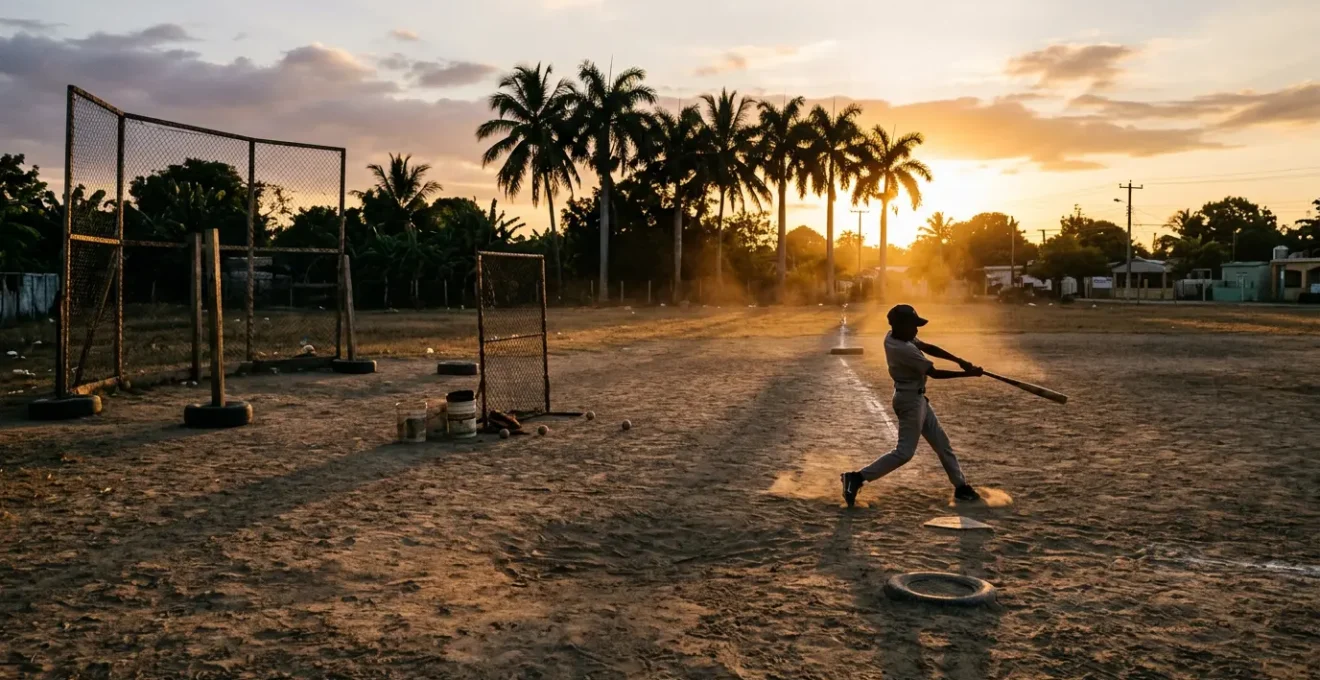
A trip to San Pedro de Macorís is not about seeing stadiums; it’s about understanding the complex system that produces baseball’s greatest players.
- Talent is forged in the history of the sugar industry, not just on manicured diamonds.
- Access to MLB academies is restricted, but the real culture thrives in public spaces and local games.
Recommendation: Approach your visit like a scout, focusing on observation and respect to truly grasp the “baseball terroir.”
For any serious baseball fan, San Pedro de Macorís is a name spoken with reverence. It’s the mythical “Cradle of Shortstops,” a small city that has produced an almost unbelievable number of Major League Baseball players. The desire to visit isn’t just about tourism; it’s a pilgrimage to the source. Most guides will tell you to watch a winter league game or try to catch a glimpse of a famous player. They might mention the poverty juxtaposed with the sudden wealth of a few stars. But this superficial view misses the point entirely. It treats the city like a zoo, and the players like exhibits.
To truly understand San Pedro, you must think like a talent scout, not a tourist. The key isn’t to find the next superstar, but to understand the baseball “terroir”—the unique socio-economic soil from which this talent springs. This means looking beyond the high walls of the academies and the bright lights of the stadiums. It requires digging into the city’s history with the sugar industry, observing the raw passion in neighborhood games on dirt fields, and learning the unspoken rules of a culture where baseball is more than a sport; it’s the primary engine of hope and social mobility. This guide is built on that principle: to help you trace the roots of greatness by showing you where and how to look.
This article will provide an insider’s perspective on navigating the Dominican baseball landscape. We will explore the reality of accessing MLB facilities, the economic impact of baseball wealth, the local etiquette for interacting with players, and the deep historical ties that make this place so unique. Get ready to see San Pedro de Macorís through the eyes of a regional expert.
Summary: A Scout’s Guide to San Pedro de Macorís
- Can Tourists Actually Visit the MLB Academies in Boca Chica?
- How Has Baseball Wealth Transformed Towns Like San Pedro?
- Where Do MLB Players Hang Out During the Winter in DR?
- Who Is More Famous Locally: Pedro Martinez or David Ortiz?
- The Etiquette for Approaching Players in Public Places
- How to Buy Tickets for a Licey vs Aguilas Game Like a Local?
- How to Tour a Cacao Plantation and Make Your Own Chocolate?
- How Does the Dominican Experience Differ from Other Caribbean Islands?
Can Tourists Actually Visit the MLB Academies in Boca Chica?
The short answer is no, not in the way a tourist visits a museum. These are high-security, professional training facilities, not public attractions. The area known as “Baseball City” in Boca Chica is a five-mile stretch that houses over 20 MLB academies, but they are gated compounds. Showing up unannounced and asking for a tour will result in a polite but firm refusal. The mission of these academies is to develop elite athletes, and unscheduled public access is a disruption they simply cannot afford. Security is tight for good reason: to protect the young prospects and the organization’s investment in them.
However, this doesn’t mean the experience is completely off-limits. For the dedicated baseball pilgrim, there are legitimate ways to get a glimpse inside this world. The key is to move from being a tourist to a planned observer. Some organized baseball camps and specialized tour operators have established relationships with certain academies. A recent group, for instance, had a positive experience during an organized tour of the New York Yankees academy, where they were welcomed to watch games and meet players. This is the most reliable way to gain official access.
Outside of formal tours, the culture is still accessible. You can observe academy life from public roads and watch for Dominican Summer League games, which are sometimes open to viewers in designated areas. More importantly, the real atmosphere is found in the surrounding ecosystem. The local eateries (comedores) are often filled with scouts, academy staff, and players’ families. And the true heart of Dominican baseball beats loudest on the countless neighborhood fields, or ‘campos de juego’, where the next generation hones their skills with raw passion. Observing a game on one of these fields is often more insightful than watching a sanitized academy practice.
How Has Baseball Wealth Transformed Towns Like San Pedro?
The impact of baseball money on San Pedro de Macorís is profound and complex. It’s not just a story of rags to riches; it’s a fundamental reshaping of the town’s social and economic fabric. The most visible sign is the architecture. You’ll see gleaming, modern mansions—often called “pelotero palaces”—with high walls and security, built right next to traditional, humble Dominican homes. This stark contrast is the clearest illustration of the economic disparity created by baseball. While the sport has lifted some families to incredible wealth, it has also highlighted the struggles of those left behind.
The scale of talent production is staggering. While the capital, Santo Domingo, has produced slightly more MLB players, its population is over ten times larger than San Pedro’s. The city’s ability to generate nearly 99 MLB players from a population of around 217,000 is a statistical anomaly that points to a unique system. This system is now a full-fledged industry. The presence of MLB academies provides a significant economic boost beyond player salaries. A study by Professor Carrie Meyer calculated the direct economic impact, finding that academies spent about $35 million in the DR in 2005 alone, excluding construction. This creates local jobs for groundskeepers, cooks, security, and administrative staff, making the baseball pipeline a vital socio-economic engine.
However, this transformation comes with challenges. The dream of an MLB contract becomes the primary goal for tens of thousands of young boys, often at the expense of education. For every Sammy Sosa or Robinson Canó, there are thousands who don’t make it and are left with limited skills outside of baseball. The wealth is highly concentrated, creating a visible class divide and putting immense pressure on young athletes who carry the hopes of their entire families. Understanding this dynamic is crucial to seeing San Pedro not just as a success story, but as a complex social ecosystem driven by the high-stakes lottery of professional baseball.
Where Do MLB Players Hang Out During the Winter in DR?
During the MLB off-season, the Dominican Republic becomes the center of the baseball universe, and many stars return home. However, finding them requires knowing where the professional and social currents flow. Forget celebrity-stalking; think like a scout observing talent in its natural habitat. The number one place to see active players is at Dominican Winter League (LIDOM) games. Stadia like Estadio Quisqueya Juan Marichal in Santo Domingo are the primary venues where you’ll see MLB stars either playing for their hometown teams or watching from the stands.
A prime example of this was the inaugural MLB Dominican Republic Series in March 2024, where stars like Rafael Devers and Yandy Diaz suited up for an official series in their home country, creating a festival atmosphere. Beyond official games, players are often visible at high-profile events. Charity golf tournaments and foundation galas are common during the winter months and are often publicized. These events offer a more relaxed setting where players are more open to brief interactions with fans who support their causes.
For more candid sightings, players frequent upscale restaurants and exclusive nightlife spots in major cities like Santo Domingo and Santiago. Luxury resorts such as Casa de Campo are also popular for private gatherings and family time. However, the most authentic encounters often happen in their hometowns. During holidays, it’s not uncommon to see a major star at a local colmado (neighborhood convenience store) or a casual restaurant in towns like San Pedro, Baní, or San Cristóbal. These are personal moments, and the etiquette of respectful observation is paramount. A quiet nod of recognition is often more appreciated than an intrusive request for a photo when a player is with their family.
Who Is More Famous Locally: Pedro Martinez or David Ortiz?
Posing this question in the DR is a great way to start a passionate debate, but for a scout, it misses the point. The question isn’t about which individual is more famous; it’s about understanding why San Pedro de Macorís produces so many heroes in the first place. The city is known as the “Cradle of Shortstops” for a reason. It is a system, a talent factory that has consistently churned out stars for decades. While Pedro and Big Papi are global icons, locally they are seen as two of the most brilliant products of a revered assembly line that also produced legends like Sammy Sosa, Alfonso Soriano, Fernando Tatis, and Robinson Canó.
The fame of these players is layered. Pedro Martinez, born in Manoguayabo but a national hero, is admired for his fierce intellect and technical perfection on the mound—a craftsman of the highest order. David Ortiz, from Santo Domingo, is beloved for his booming bat and even bigger personality—a charismatic leader who embodies joy and clutch performance. In San Pedro itself, the reverence is often for the shortstops who defined the city’s reputation, like Tony Fernandez and Alfredo Griffin. Each player represents a different facet of the Dominican dream.
Rather than ranking them, a regional expert sees them as pillars of a larger structure. Their success stories fuel the ambitions of the next generation practicing on dusty fields. Their wealth transforms local economies, and their foundations give back to the communities that raised them. The fame isn’t a competition; it’s a collective source of national and local pride. Asking who is *more* famous is like asking if the engine or the wheels are more important to a car. The real story is the entire vehicle—the powerful, relentless talent pipeline of the Dominican Republic.
The Etiquette for Approaching Players in Public Places
For a baseball nerd on a pilgrimage, the chance of seeing a hero in the wild is thrilling. But turning that sighting into a positive interaction depends entirely on understanding and respecting local etiquette. In the Dominican Republic, MLB players are national treasures, but they are also members of the community. They are sons, brothers, and fathers. Approaching them with the mindset of a respectful observer rather than an entitled fan is the first and most important rule. Reading the room is a critical skill.
The context of the encounter determines everything. Is the player at a public, fan-oriented event, or are they having a private moment? A player attending a Winter League game or a charity event is in “public mode.” They generally expect and are open to fan interaction. A polite request for an autograph or a photo between innings or during a designated meet-and-greet is usually appropriate. Thanking them for their community work at a charity event shows you see them as more than just an athlete and is often well-received. In these settings, they are ambassadors for the sport and their brand.
Conversely, when a player is in a private setting, the rules change completely. Interrupting a family dinner at a restaurant or approaching them on a golf course is considered a major breach of etiquette. These are their moments to decompress, away from the pressures of their professional lives. In these situations, the best approach is a simple, respectful nod from a distance, if you make eye contact at all. This acknowledges their presence without invading their personal space. The goal is to show respect for the person, not just the uniform they wear. As this table from an NPR report on the town’s culture illustrates, the setting is everything.
| Setting | Appropriate to Approach? | Recommended Action |
|---|---|---|
| Winter League Game | Yes | Polite request between innings |
| Restaurant with Family | No | Respectful nod only |
| Charity Event | Yes | Brief interaction, thank for community work |
| Local Colmado | Maybe | Read the room, respect personal space |
| Golf Course | No | Maintain distance, no interruption |
How to Buy Tickets for a Licey vs Aguilas Game Like a Local?
Attending a LIDOM game, especially the legendary rivalry between Tigres del Licey and Águilas Cibaeñas, is an essential Dominican experience. It’s less a sporting event and more a national festival. Buying tickets like a local is key to getting the full, authentic experience. Avoid the online tourist traps and head straight to the source: the official ‘boletería’ (stadium box office) at the stadium, like Estadio Quisqueya in Santo Domingo. This is where you’ll find the best prices and availability, especially if you buy a day or two in advance.
For convenience, many authorized bank locations and major supermarkets also sell tickets ahead of time, which can save you from long lines on game day. If you do find yourself buying tickets on the day of a big game, you’ll encounter official resellers outside the stadium. Haggling is part of the culture, but always do it respectfully. Knowing the base price helps you negotiate fairly. A key piece of insider knowledge is the concept of ‘precios populares,’ which are discounted tickets often available for weekday games or less-hyped matchups, making the experience accessible to everyone.
Choosing your seat is about more than just the view; it’s about declaring your allegiance. ‘Palco’ seats (box seats) offer a more focused view for serious baseball watchers. The ‘gradas’ (bleachers), however, are where the real party is, with constant music, dancing, and chanting. Most importantly, you must wear the right colors for your section. For a Licey-Águilas game, it’s blue for Licey and yellow for Águilas. Your ticket will grant you access to a specific section, and these are strictly divided by team loyalty. Wearing the wrong colors in the wrong section is a major social faux pas. Arrive 1-2 hours early to soak in the incredible pre-game atmosphere and find your place among the faithful.
Your Action Plan: Buying LIDOM Tickets Like a True Fan
- Visit the official ‘boletería’ (stadium box office) at Estadio Quisqueya for best prices.
- Check authorized bank locations and major supermarkets for convenient advance purchase.
- Buy from official resellers outside the stadium on game day (negotiate respectfully).
- Choose ‘palco’ seats for serious watching or ‘gradas’ (bleachers) for the party atmosphere.
- Wear team colors: Blue for Licey, Yellow for Águilas—crucial for sitting in the right section.
How to Tour a Cacao Plantation and Make Your Own Chocolate?
While the Dominican Republic is famous for its cacao, if you’re in San Pedro de Macorís to trace the roots of baseball, you’re in the wrong field. The real story, the true “terroir” of Dominican baseball talent, isn’t found among cacao pods—it’s rooted in the vast sugar cane fields that have dominated this region for over a century. To understand the city’s obsession with baseball, you must first understand its history with sugar.
The connection is direct and historical. San Pedro was founded in the late 19th century by Cuban sugar farmers fleeing their country’s War of Independence. They brought with them an extensive knowledge of sugar cane cultivation, which quickly became the region’s most important economic activity. This booming industry required a massive labor force, leading to the arrival of immigrants from other Caribbean islands, particularly the British West Indies. These immigrants brought something else with them: the sport of cricket.
The managers of the sugar plantations, many of whom were American, saw the organized cricket teams and offered them money to switch to the more familiar American sport of baseball. The transition was swift. Native Dominicans, working alongside the Caribbean immigrants in the fields and mills, picked up the game by watching them. The vast, flat grounds of the sugar plantations provided the perfect playing fields. Baseball became the primary form of recreation and social organization for the workers, a welcome distraction from the grueling labor. The sport became deeply woven into the cultural identity of the sugar towns, a tradition passed down through generations. So, while a chocolate tour is a lovely diversion, the real historical tour for a baseball scout is to understand this direct line from the sugar cane fields to the baseball fields.
Key Takeaways
- Baseball is the Dominican Republic’s defining cultural feature, setting it apart from any other Caribbean nation.
- The talent pipeline is a complex socio-economic engine, rooted in the history of the sugar industry, not just modern academies.
- Respectful observation and understanding the local context are more valuable than trying to get an autograph.
How Does the Dominican Experience Differ from Other Caribbean Islands?
While many Caribbean islands share beautiful beaches, warm climates, and a rich colonial history, the Dominican Republic has one cultural unifier that sets it profoundly apart: baseball. On other islands, cricket or soccer might be the dominant sport, but in the DR, baseball—or ‘beisbol’—is a quasi-religion. It is the national passion, the primary topic of conversation, and the most visible pathway to a better life. This singular focus has made the country a global superpower in the sport. After the United States, the Dominican Republic produces the most players in Major League Baseball, with some estimates suggesting that nearly 13% of all MLB players are Dominican.
This deep integration of baseball into the national identity creates a travel experience unlike any other. You feel it everywhere. It’s in the sound of a bat hitting a bottle cap in a dusty alley, in the heated arguments over Licey and Águilas in a local colmado, and in the murals of local heroes painted on city walls. This isn’t a hobby; it’s the cultural heartbeat of the nation. As author Mark Kurlansky noted in an interview about his work on the region:
San Pedro de Macoris, in the Dominican Republic, that’s known as ‘the town where shortstops come from’
– Mark Kurlansky, NPR Interview on ‘The Eastern Stars’
This reputation is earned daily on countless ‘campos de juego’ across the country. For a visitor, especially a baseball nerd, this provides an opportunity for unparalleled immersion. You don’t need a ticket to a stadium to see high-level baseball; you can find it being played with incredible skill and passion in almost any neighborhood. The Dominican experience is a chance to witness the raw, unfiltered love for a game that has come to define a nation’s soul and its dreams.
Now that you understand the culture, the history, and the etiquette, you are equipped to plan a meaningful baseball pilgrimage. Go with the eyes of a scout and the respect of a true fan to discover the heart of the game.
Frequently Asked Questions About How to Visit San Pedro de Macorís, the “Cradle of Shortstops”?
What are ‘precios populares’ and when do they apply?
Popular prices are discounted tickets offered for weekday games or less popular matchups, making baseball accessible to local fans.
Can I sit anywhere with my ticket?
No, seating sections are strictly divided by team loyalty – wearing wrong colors in the wrong section can cause social friction.
When should I arrive at the stadium?
Arrive 1-2 hours early for rivalry games to secure parking and experience the pre-game atmosphere with music and festivities.