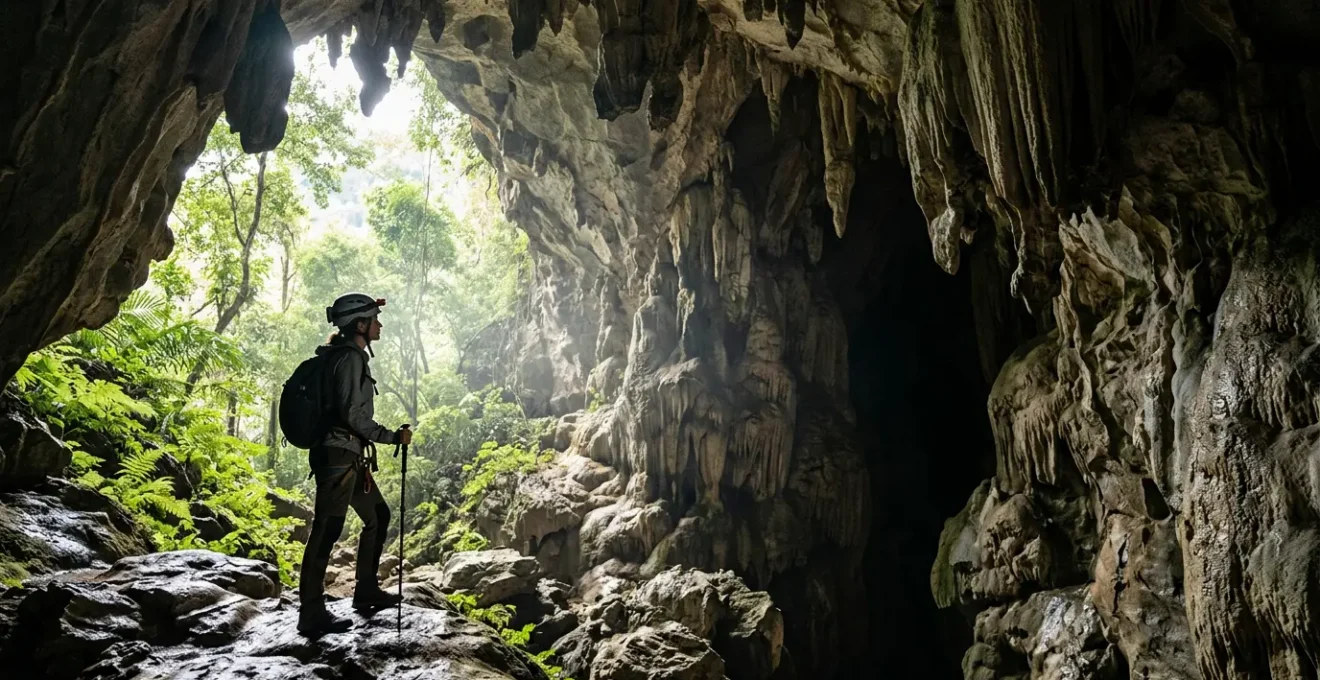
In summary:
- True cave safety goes beyond rules; it requires understanding the fragile geology and respecting the site’s history.
- Select a cave that matches your physical fitness. Los Tres Ojos is ideal for families, while Fun Fun Cave is for serious thrill-seekers.
- The biggest safety risk is slipping. Wear closed-toe shoes with aggressive, non-slip tread, never smooth-soled sneakers.
- Protect ancient Taino art by looking, not touching. The oils from your skin cause irreversible damage to these thousands-of-years-old pictographs.
- To avoid crowds at popular sites like Los Tres Ojos, visit on a weekday morning between 9 AM and 11 AM.
The Dominican Republic’s subterranean world is a profound draw for adventurers, historians, and families alike. The promise of turquoise cenotes in Los Tres Ojos or the ancient whispers from Taino pictographs in the Cueva de las Maravillas is irresistible. Most travel advice for these natural wonders is sensible but shallow, boiling down to generic tips like “bring a flashlight” or “watch your step.” While not incorrect, this advice misses the fundamental point of what it means to explore these environments safely and respectfully.
These caves are not static tourist attractions; they are living geological entities and fragile historical archives. The real key to a safe and enriching visit isn’t just following a checklist of rules, but developing a deeper awareness. It’s about understanding *why* limestone is slippery, *why* you must never touch a rock formation, and what the silent art on the walls is truly trying to tell you. This is the difference between being a tourist and becoming a conscious explorer.
This guide adopts the perspective of a speleologist—an expert in the study of caves. We will move beyond the surface-level tips to give you the foundational knowledge needed to navigate these incredible spaces. We’ll decipher ancient symbols, help you choose the right adventure for your group, equip you for the unique challenges of a cave environment, and show you how to capture its beauty without harming it. By understanding the living world beneath your feet, you will be equipped to explore it with both confidence and reverence.
To help you plan your subterranean journey, this guide is structured to answer your most pressing questions. From understanding the cultural significance of the sites to mastering the practicalities of exploration, each section is designed to build your confidence as a conscious cave visitor.
Summary: Safely Exploring the Caves of the Dominican Republic
- What Do the Taino Pictographs in the Caves Actually Mean?
- Fun Fun Cave or Three Eyes: Which Cave Experience Is Right for You?
- The Footwear Mistake That Leads to Slips on Wet Limestone
- How to Take Good Photos in Low Light Caves Without a Tripod?
- When to Visit The Three Eyes to Avoid the Cruise Ship Crowds?
- Where to Find the Best Preserved Taino Cave Art Accessible to Tourists?
- How to Explore the Rainforest Canopy Without Getting Lost?
- How to Build a Photography Itinerary Covering Coast, Mountain, and Desert?
What Do the Taino Pictographs in the Caves Actually Mean?
The dark walls of Dominican caves serve as the most enduring gallery of the island’s first people, the Taíno. These are not mere drawings but a complex language of spirituality, cosmology, and daily life. To visit these caves without understanding the pictographs is to see a library and only notice the shelves. According to recent archaeological studies, there are over 6,000 Taino pictographs and petroglyphs dating from 2000 BCE to 1500 CE, making this one of the richest collections of pre-Columbian art in the Caribbean. Each symbol is a window into a lost world.
These figures, typically drawn with charcoal mixed with animal fat, represent a deep connection between the spiritual and natural worlds. The cave itself was a sacred space. According to Taíno mythology, humanity emerged from a cave called Cacibajagua. This makes symbols found within them particularly potent. For instance, the recurring figure of the owl is deeply symbolic, as these creatures inhabit dark places and were thus associated with the origin of life and the portal to the spirit world.
Understanding a few key symbols transforms your visit from passive viewing to active interpretation:
- Twin Figures: These represent the essential duality of nature—sun and moon, day and night, rain and drought. Taíno mythology states that the sun and moon themselves were born from a cave, reinforcing this theme of cosmic origin.
- Atabey/Atabeyra: This prominent mother goddess figure symbolizes fertility, fresh water, and the very life-giving force of nature.
- Shamanic Figures: Often depicted with plates on their heads, these images represent the cohoba ritual, a shamanic ceremony using psychoactive substances to communicate with spirits.
When you see these pictographs, you are looking at the philosophical and religious texts of a civilization. The greatest safety rule here is one of preservation: never touch the art. The oils and bacteria on your hands can irreversibly damage these thousands-of-years-old messages, silencing a voice we are only just beginning to understand.
Fun Fun Cave or Three Eyes: Which Cave Experience Is Right for You?
Choosing the right cave is the first step to a safe and enjoyable trip. The Dominican Republic offers experiences at opposite ends of the adventure spectrum, perfectly illustrated by the contrast between the wild Fun Fun Cave and the serene Los Tres Ojos (The Three Eyes) National Park. Your choice should depend entirely on your group’s physical abilities, appetite for adventure, and available time. One is a high-octane expedition, while the other is a tranquil stroll through a geological wonder.
This paragraph introduces the concept of choosing a cave experience. The illustration below visually contrasts the high-adventure rappelling of Fun Fun Cave with the serene, accessible beauty of Los Tres Ojos cenotes, helping you picture which is right for you.
As the image suggests, these are two vastly different worlds. Fun Fun Cave is a full-body commitment. It involves horseback riding, a hike, and a thrilling rappel of over 20 meters into the earth, followed by a trek through an underground river. It is a genuine speleological expedition that requires good physical condition. In contrast, Los Tres Ojos is an easily accessible park in Santo Domingo, featuring a series of three stunning open-air limestone caverns, or cenotes. Paved walkways and stairs guide you through the site, making it perfect for families, casual tourists, and photographers.
To make an informed decision, consider the following breakdown of what each experience entails. This comparison highlights the key differences in physical demand, duration, and overall atmosphere.
| Aspect | Fun Fun Cave | Los Tres Ojos |
|---|---|---|
| Physical Demands | High – Rappelling 20+ meters, swimming through underground rivers | Low – Paved walkways, minimal stairs |
| Duration | Full day adventure (6-8 hours) | 1-2 hours self-guided or guided tour |
| Best For | Adventure seekers, experienced hikers | Families, photographers, casual tourists |
| Access | Horseback ride + rappelling required | Easy urban access in Santo Domingo |
| Atmosphere | Wild, untamed, extreme adventure | Serene park with turquoise cenotes |
Ultimately, self-awareness is the best safety tool. Misjudging the physical demands of a cave like Fun Fun can lead to exhaustion and accidents. Choosing the right cave ensures your memories are of wonder, not struggle.
The Footwear Mistake That Leads to Slips on Wet Limestone
Of all the potential hazards in a cave, the most common and easily preventable is a slip-and-fall accident. The culprit is almost always the same: inadequate footwear. Cave floors, especially those made of limestone, are deceptively slick when wet. This isn’t like a wet pavement; the combination of a thin film of water over smooth, calcite-rich stone creates a surface with exceptionally low friction. Visitors wearing standard sneakers, flip-flops, or any shoe with a smooth sole are taking a significant and unnecessary risk.
The importance of proper footwear cannot be overstated. As the Dominican Cave Safety Guidelines state, it’s the foundation of a safe exploration. In the “Real Estate Las Terrenas Cave Guide,” experts make this clear:
Non-slip, closed-toe shoes: Footwear with good traction is essential for walking on wet or uneven surfaces. Hiking boots or water-resistant sneakers are ideal.
– Dominican Cave Safety Guidelines, Real Estate Las Terrenas Cave Guide
This advice is not a mere suggestion; it’s a critical safety protocol. In fact, professional cave guides consistently emphasize that 100% of cave safety experts recommend water shoes or hiking boots with good traction over any smooth-soled alternative. The “mistake” is choosing fashion or convenience over function. A shoe that is perfectly safe for a city street can become a dangerous liability in the unique environment of a cave.
Action Plan: Selecting the Right Cave Footwear
- Choose non-slip, closed-toe shoes with aggressive tread patterns designed to channel water and grip uneven surfaces.
- If possible, test your footwear on a wet, smooth surface like tile before your trip to gauge its grip.
- Select shoes made from water-resistant or quick-dry materials that maintain their structure and grip even when fully submerged.
- Ensure a snug and proper fit to prevent your foot from sliding inside the shoe, which can cause blisters and instability.
- For caves involving water, consider amphibious hiking shoes or high-quality water shoes that offer both protection and quick-drying properties.
Investing in the right footwear is investing in your safety. It’s the single most important gear decision you will make before stepping into the subterranean world.
How to Take Good Photos in Low Light Caves Without a Tripod?
Photographing the inside of a cave presents a classic challenge: capturing the immense, dark beauty without the aid of a tripod, which is often forbidden to protect the fragile environment. The key is to maximize the light that reaches your camera’s sensor while keeping the device perfectly still. This requires a manual approach to your camera settings and using your own body and surroundings as a natural stabilizer. Forget auto mode; this is where a little technical knowledge makes all the difference.
First, you need to configure your camera to perform in low light. This involves a balance between three key settings: aperture, shutter speed, and ISO. Your goal is to let in as much light as possible (wide aperture), for as long as possible without causing motion blur (slower shutter speed), while electronically boosting the brightness (higher ISO). Here are the ideal settings for handheld cave photography:
- Widest Aperture: Set your lens to its lowest f-number (e.g., f/1.8, f/2.8, f/4). This opens the lens iris wide to gather maximum light.
- Shutter Speed: Aim for a speed you can hand-hold, typically around 1/25 or 1/30 of a second. Any slower, and the natural shake of your hands will create a blurry image.
- Boost ISO: Increase your ISO to between 640 and 2000. Start lower and increase only as needed, as higher ISOs can add digital “noise” or grain to the photo.
- Brace Yourself: This is the human tripod. Lean your body against a solid cave wall or rest your camera on a stable ledge or railing. Tuck your elbows into your chest to form a solid base.
- Use Burst Mode: Instead of taking one shot, hold the shutter button down to take a burst of 3-5 photos. Often, the middle shot in the sequence will be the sharpest, as the initial and final movements of pressing the button are eliminated.
Advanced Technique: Light Painting with a Flashlight
For those with a camera capable of long exposures, even without a tripod, a technique called “light painting” can yield stunning results. As explained in one photography guide, this involves using a low-intensity light source (like a small flashlight or even your phone) to “paint” parts of the scene during a long exposure. For example, by setting a 30-second exposure and bracing your camera, you can slowly move your light beam across the cave formations closest to you. This creates a beautiful “fade” effect, giving a sense of depth and mystery. The key is to keep the light moving at a constant speed to avoid harsh spots and to illuminate surfaces from an angle to create dramatic shadows.
By combining these technical settings with physical stability, you can overcome the low-light challenge and bring home sharp, evocative images of the cave’s hidden world, proving that a tripod isn’t always necessary for great photography.
When to Visit The Three Eyes to Avoid the Cruise Ship Crowds?
Los Tres Ojos National Park is one of the Dominican Republic’s most enchanting and accessible natural wonders. Its proximity to Santo Domingo, however, also makes it a prime destination for large tour groups, especially from cruise ships. Visiting during peak hours can mean sharing the serene beauty of the cenotes with hundreds of other people, turning a mystical experience into a crowded affair. The secret to enjoying its tranquility is strategic timing. The goal is to be there when the tour buses are not.
This paragraph introduces the challenge of crowds at Los Tres Ojos. The photo below captures the serene, golden-hour beauty you can experience by visiting at the right time, when sunlight filters into the turquoise waters without the crowds.
As the image shows, the reward for careful planning is an almost private viewing of a magical place. According to park officials and visitor data, the flow of tourists follows a predictable pattern. The large tour buses typically begin arriving around 11 AM and continue through the mid-afternoon. Weekends and national holidays are, unsurprisingly, the busiest times for both tourists and local visitors. Therefore, the golden window for a peaceful visit is on a weekday morning.
More specifically, visitor data shows that the caves are least crowded from 9 AM to 11 AM on weekdays. Arriving right when the park opens gives you at least an hour, often two, to explore the three main “eyes” or lakes before the major influx begins. This early morning light also provides a beautiful, soft illumination for photography.
To ensure a tranquil visit, follow this strategic checklist:
- Target Weekday Mornings: Plan your visit for a Tuesday, Wednesday, or Thursday, arriving between 9:00 and 10:00 AM.
- Check Cruise Schedules: A quick online search for the Santo Domingo cruise port schedule can tell you which days massive ships are in town. Avoid these days if possible.
- Avoid Holidays: Be aware of Dominican national holidays, as the park will be a popular spot for local families.
- Consider the “Siesta” Slot: Another potential quiet period is during the local lunch hour, roughly from 12:30 PM to 2:00 PM, when some smaller tour groups may be dining.
By treating your visit like a strategic appointment rather than a casual drop-in, you can experience Los Tres Ojos as it’s meant to be seen: a quiet, breathtaking sanctuary of water and stone.
Where to Find the Best Preserved Taino Cave Art Accessible to Tourists?
For visitors whose primary interest is history and archaeology, the Dominican Republic offers several exceptional sites to view well-preserved Taíno art. While thousands of pictographs are scattered across the island, only a few locations combine high-quality conservation, accessibility, and a significant quantity of art. Choosing the right site depends on your willingness to travel and your desire for either a curated museum-like experience or a more rugged, natural setting.
The most important site for Taíno art is undoubtedly the El Pomier Caves. As noted by the Dominican Maps research team, their significance is unparalleled.
The El Pomier Caves, situated within the El Pomier Anthropological Reserve, are of great archaeological importance. These caves house over 6,000 Taíno pictographs and petroglyphs, making them one of the largest collections of pre-Columbian art in the Caribbean.
– Dominican Maps Research Team, Hidden Caves in the Dominican Republic
While El Pomier holds the largest collection, the Cueva de las Maravillas (Cave of Wonders) offers the most accessible and best-protected viewing experience. This site has been developed specifically for tourism with a strong focus on conservation. It features a state-of-the-art lighting system that highlights its 500+ paintings without damaging them, paved walkways, and even an elevator, making it fully wheelchair accessible. It is the perfect choice for families and those with mobility concerns.
For a more adventurous option, the caves of Los Haitises National Park offer art in a more raw, natural context. Reached by boat and a short hike, these caves feel less like a museum and more like a discovery. The pictographs here are preserved by their natural environment rather than climate control. The following table compares these top three locations to help you decide.
This comparative analysis is based on data from various tourism and historical guides, including a helpful overview found in a guide to Taíno culture.
| Cave | Art Quantity | Accessibility | Conservation Status |
|---|---|---|---|
| El Pomier Caves | 6,000+ petroglyphs | Guided tours required | Excellent preservation |
| Cueva de las Maravillas | 500+ paintings | Wheelchair accessible, elevator | Climate-controlled, protected |
| Los Haitises Caves | Multiple cave sites | Boat access + hiking | Natural preservation |
For the best combination of preservation, art quality, and accessibility for a typical tourist, the Cueva de las Maravillas is the premier choice. For the sheer volume of art, El Pomier is unmatched, and for adventure, Los Haitises provides an unforgettable context.
How to Explore the Rainforest Canopy Without Getting Lost?
Exploring the dense rainforests of the Dominican Republic, such as those in Los Haitises National Park, presents a significant navigational challenge. Trails can be faint or non-existent, and the thick canopy can obscure the sun, making it easy to become disoriented. However, the island’s unique geology offers an unconventional but highly effective navigation tool: the caves themselves. Instead of being separate points of interest, cave systems can be used as a network of fixed, reliable landmarks to map your journey through the jungle.
This method relies on a principle of “natural wayfinding.” The landscape of a region like Los Haitises, which contains over 15,000 caves, is defined by its karst (limestone) topography. Rainwater filters through the porous rock, creating vast networks of underground passages. These geological processes leave visible clues on the surface. Cave entrances often have distinct features, such as changes in vegetation, unique rock outcroppings, or the presence of a stream or spring disappearing into the ground. By learning to recognize these signs, you can use cave entrances as giant, unmovable reference points on your mental or physical map.
A safe exploration strategy combines modern technology with this ancient wayfinding technique:
- Pre-hike Mapping: Before entering the rainforest, use an offline GPS mapping application on your phone (like Maps.me or Gaia GPS) to mark the known locations of major cave entrances in your intended area.
- Use Caves as Anchors: As you hike, use these marked caves as your primary waypoints. Instead of navigating from point A to B, you navigate from “Cave 1” to “Cave 2.”
- Follow Water Sources: Water is the architect of caves. Following a stream, especially one that disappears and reappears, will often lead you through a network of cave systems. This provides a natural “trail” through the wilderness.
- Identify Unique Formations: Pay close attention to the landscape. A uniquely shaped limestone hill or a distinctively large sinkhole can serve as a memorable landmark, confirming your position relative to a known cave.
By treating the rainforest and its underlying cave system as one interconnected environment, you shift from simply following a trail to actively reading the landscape. This not only makes you a safer and more confident hiker but also deepens your connection to the incredible geological story unfolding around you.
Key takeaways
- True cave safety is not just about rules, but about understanding the fragile, living geology and history you are visiting.
- Always choose a cave that matches your physical fitness level; the serene Los Tres Ojos and the extreme Fun Fun Cave are for very different types of visitors.
- Protecting history is paramount. The oils from a single touch can cause permanent damage to ancient Taino pictographs, so look but never touch.
How to Build a Photography Itinerary Covering Coast, Mountain, and Desert?
The Dominican Republic is a photographer’s dream, offering a stunning diversity of landscapes within a relatively small area. One can capture the subterranean blues of a coastal cenote in the morning and the misty greens of a mountain range in the afternoon. Building an effective photography itinerary is a matter of logistical planning and environmental awareness. The goal is to group locations geographically while being prepared for the unique challenges each environment poses to your camera gear, from coastal humidity to mountain coolness.
A logical itinerary would start with the easily accessible cave systems near the coast before moving inland. The country’s varied topography allows for a route that covers caves in multiple contexts—coastal, mountain, and even near-desert. This 7-day plan provides a template for capturing the island’s geological diversity:
- Days 1-2 (East Coast): Start with the Cueva de las Maravillas to photograph its well-lit pictographs and formations. The controlled environment is a great warm-up.
- Day 3 (Capital): Move to Santo Domingo to shoot the iconic coastal cenotes of Los Tres Ojos, focusing on the interplay of light and water.
- Day 4 (Mountains): Head inland to the mountainous region of Constanza. Explore smaller, less-visited mountain caves for a more rustic and adventurous feel.
- Day 5 (Desert): Journey southwest to the Baní Dunes, a unique desert-like landscape, to capture the stark contrast with the island’s lush interior.
- Day 6-7 (Adventure Finish): Conclude with the ultimate underground river photography challenge at Fun Fun Cave, putting your low-light and gear-protection skills to the test.
Crucial Gear Strategy: Managing Humidity and Temperature
Photographing in these varied environments requires protecting your equipment. The biggest threat is condensation. Caves are often significantly cooler and more humid than the outside air. When you exit a cool cave into the warm, humid tropical air, your cold camera lens will instantly fog up, rendering it useless for up to 20 minutes. To manage this, always keep a small, microfiber towel handy to wipe your equipment. Before leaving a cave, it’s wise to place your camera in a sealed plastic bag. This allows the camera to warm up to the outside temperature gradually without humid air directly contacting the cold lens, preventing condensation from forming in the first place.
By building an itinerary that flows logically across the country and by preparing for the environmental challenges of each location, you can create a comprehensive and breathtaking portfolio of the Dominican Republic’s incredible natural and historical diversity.
Start today by mapping out your own journey of conscious exploration, equipped with the knowledge to visit these sacred spaces safely, respectfully, and with a photographer’s eye for wonder.