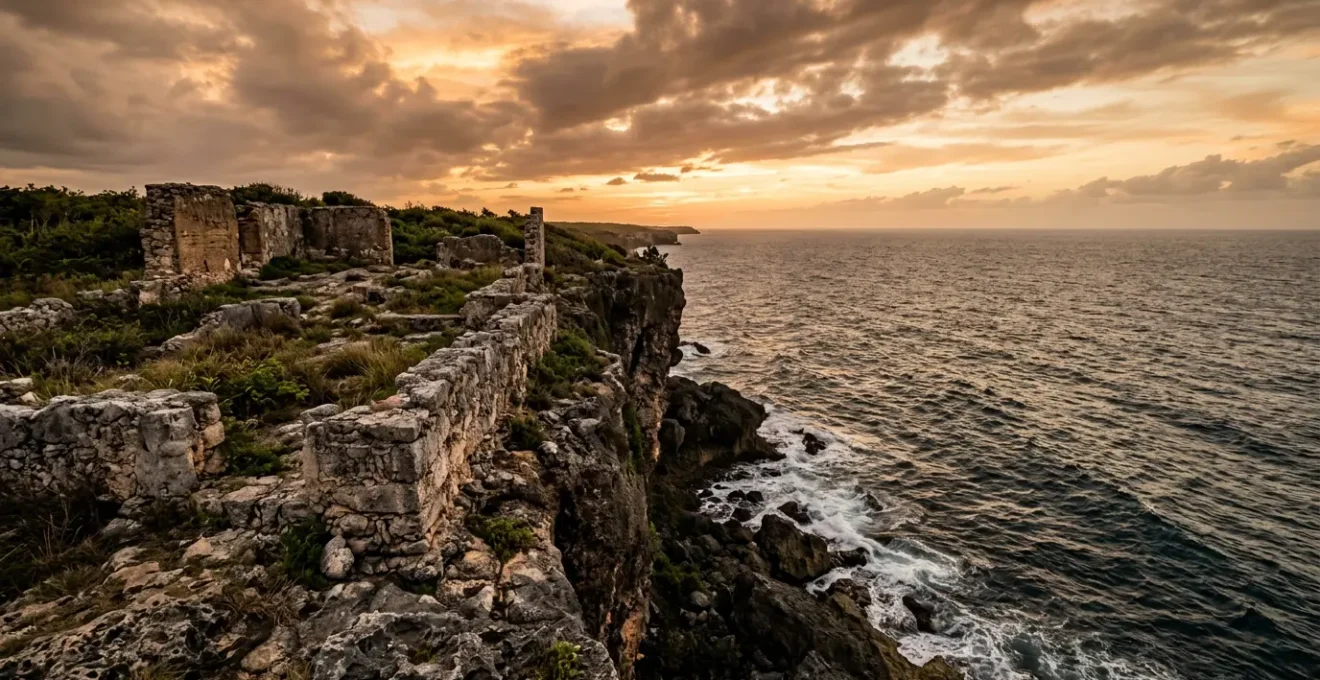
Visiting La Isabela is not a celebration of discovery, but an archaeological investigation into the blueprint for colonial failure and its devastating human cost.
- The site’s layout reveals the core functions of an extractive colony: a warehouse for tribute, a church for ideological control, and a fortified residence.
- Its rapid collapse directly led to the creation of the brutal encomienda system, which decimated the indigenous Taíno population.
Recommendation: Approach the ruins not as a tourist attraction, but as a primary source document. Read the landscape to understand the origins of a system whose consequences echo in the Caribbean today.
For the history enthusiast, the name La Isabela resonates with a profound and somber significance. It is, by all accounts, the first formal European settlement in the Americas. Most guides and historical summaries present it as a starting point, a foundational stone in the “New World.” They dutifully list the key structures: Columbus’s house, the first church, the warehouses. They mention its eventual abandonment due to hardships and conflicts, a simple narrative of a pioneering effort that didn’t pan out.
But this perspective misses the fundamental truth of the site. To an archaeologist, these ruins are not just the remains of a failed town; they are the physical blueprint of a colonial model built on flawed assumptions and brutal exploitation. The story of La Isabela is not one of a noble beginning but of a catastrophic failure whose consequences were immediate and far-reaching. The settlement’s collapse wasn’t an unfortunate setback; it was the crucible where the systematic subjugation of indigenous peoples, most notably through the encomienda system, was forged.
What if the key to understanding La Isabela is not to trace Columbus’s footsteps, but to excavate the layers of failure and understand how this specific place became the prototype for centuries of colonial exploitation? This is not a celebratory tour of discovery. It is an exercise in historical and archaeological honesty, confronting the grim realities of the conquest at its very inception. This guide will help you read the landscape of La Isabela, connecting its silent stones to the powerful and often tragic systems it created.
To fully explore this complex history, this article deconstructs the key elements and legacies of La Isabela. From the economic systems it birthed to its modern-day relevance, each section provides a lens through which to understand the site’s true significance.
Summary: Deconstructing the Legacy of a Failed Settlement
- What Was the Encomienda System and How Did It Shape the Population?
- The First Monastery: How to Visit the Ruins of San Francisco Safely?
- The Columbus Lighthouse: Is It Worth the Trip for History Lovers?
- The “Three Fathers” Myth: Who Really Founded the Dominican Republic?
- When Are the Ruins of La Isabela Open to the Public?
- How to Trace the Steps of Columbus and Drake in the First City?
- How to Identify Taino Influence in Modern Dominican Daily Life?
- How to Tour a Cacao Plantation and Make Your Own Chocolate?
What Was the Encomienda System and How Did It Shape the Population?
The encomienda system was not a pre-planned colonial policy, but a desperate improvisation born from the economic failure of La Isabela. Columbus had promised his royal patrons gold, but the mines yielded little. To justify the colony’s existence and reward his men, a new source of wealth was needed: forced labor. The system granted Spanish colonists (encomenderos) the right to demand tribute and labor from the indigenous Taíno population. In theory, the colonists were to provide protection and Christian instruction; in reality, it was a system of near-slavery.
The results were catastrophic. The Taíno people, who had a sophisticated society but no immunity to European diseases or concept of grueling, continuous labor in mines and fields, were devastated. As the historian David Stannard noted in his analysis of colonial labor systems:
The encomienda had driven many millions of native peoples in Central and South America to early and agonizing deaths.
– David Stannard, Historical analysis of colonial labor systems
This system, first tested on the inhabitants around La Isabela, became the blueprint for Spanish exploitation across the Americas. The demographic impact on Hispaniola was one of the most rapid and complete in recorded history. Historical demographic studies suggest that between 80% and 90% of the Taíno population died within 30 years of Columbus’s arrival, succumbing to disease, overwork, and violence. The landscape around La Isabela is not just the site of the first European town; it is the epicenter of a genocide.
Understanding the encomienda is crucial because it transforms a visit to La Isabela from a simple historical tour into a solemn reflection on the origins of systemic injustice in the Americas.
The First Monastery: How to Visit the Ruins of San Francisco Safely?
A search for the “first monastery” in the Americas often leads visitors to the impressive Ruinas del Monasterio de San Francisco in Santo Domingo. This is indeed a hugely significant site, representing the establishment of permanent religious orders. However, for the true genesis of the Church’s presence, one must look to the earlier, more fragile experiment at La Isabela. Here, the very first church was built—a structure whose archaeological remains tell a more profound story than the grand ruins of its successor.
At La Isabela, what remains is not a towering stone edifice but the humble stone foundations, painstakingly excavated. This was where the first Catholic Mass in the Americas was celebrated on January 6, 1494. The site is a powerful testament to the twin pillars of Spanish conquest: the sword and the cross. The church was not just a place of worship; it was an ideological anchor, the center of a project to spiritually, as well as physically, conquer a “New World.”
As the image reveals, the layout is clear, but the materials are rudimentary. The adjacent cemetery, also excavated, speaks volumes about the grim reality of life in the settlement, with a high mortality rate among both Spanish settlers and the subjugated Taíno. As for visiting safely, the practical concerns are straightforward: wear sturdy footwear for uneven ground, use sun protection, and carry water. The ruins are exposed and the Caribbean sun is intense.
The real challenge of a visit is not physical safety, but the intellectual and emotional task of confronting what these simple foundations represent: the beginning of a spiritual conquest that would reshape a hemisphere.
The Columbus Lighthouse: Is It Worth the Trip for History Lovers?
In Santo Domingo, the colossal Faro a Colón, or Columbus Lighthouse, stands as a 20th-century monument to the Admiral. It is a massive, cross-shaped brutalist structure that projects powerful beams of light and claims to house Columbus’s remains. For many tourists, it is a key stop. But for the serious history enthusiast, the question of its worthiness is critical, especially when compared to the authentic, primary-source ruins of La Isabela.
An archaeological perspective prioritizes authenticity over spectacle. The Columbus Lighthouse is a modern interpretation, a political statement built 500 years after the fact. La Isabela, by contrast, is the fact itself. It is the ground zero of the European experience in the Americas. To weigh their value, a direct comparison is necessary.
| Aspect | La Isabela Ruins | Columbus Lighthouse |
|---|---|---|
| Historical Period | 1493-1498 (Columbus’s actual settlement) | Built 1986-1992 (20th century monument) |
| Authenticity | Original foundations and archaeological remains | Modern brutalist structure |
| What You See | Columbus’s actual house, first church, warehouse ruins | Cross-shaped building with alleged Columbus remains |
| UNESCO Status | On tentative World Heritage list | Not recognized |
| Historical Significance | Site of first European town in Americas | Commemorative monument, controversial legacy |
As this comparative analysis drawn from UNESCO’s data shows, the two sites serve fundamentally different purposes. The Lighthouse commemorates an idea of Columbus, while La Isabela presents the unvarnished, complex, and ultimately failed reality of his project. For a traveler seeking a deep, unfiltered connection to the past, the choice is clear.
While the Lighthouse may be an impressive architectural feat, the silent, weathered stones of La Isabela offer an infinitely more profound and honest historical encounter.
The “Three Fathers” Myth: Who Really Founded the Dominican Republic?
The official narrative of the Dominican Republic’s founding centers on the Padres de la Patria—Juan Pablo Duarte, Francisco del Rosario Sánchez, and Matías Ramón Mella—who secured independence from Haiti in 1844. While their role is undeniable, this story omits centuries of prior resistance and the foundational struggles that truly shaped the island’s identity. To ask who *really* founded the nation requires looking back to the very first acts of resistance against colonial rule.
Long before the 19th-century patriots, the Taíno people mounted the first struggles for freedom in the Americas. The most significant of these was led by the Taíno *cacique* (chieftain) Enriquillo. Raised by Franciscan friars after his father was killed by the Spanish, Enriquillo initially collaborated with the colonial administration. However, after suffering profound abuse and injustice, he led his people into the mountains of Bahoruco and began a rebellion that the Spanish could not quell.
Enriquillo’s Guerrilla Resistance: The First Successful Indigenous Rebellion
From 1519 to 1533, Enriquillo waged a highly effective guerrilla war against the Spanish Empire. His deep knowledge of the terrain and strategic prowess allowed him and his followers to evade capture and inflict significant disruption on the colonial economy. Historical records indicate that Enriquillo mobilized more than 3,000 Taíno in his successful rebellion. Unable to defeat him militarily, the Spanish were eventually forced to negotiate, granting Enriquillo and his people their own autonomous territory in a treaty—an unprecedented victory for an indigenous leader.
Enriquillo’s rebellion is not just a footnote; it is a foundational act. It demonstrated that resistance was possible and established a legacy of autonomy and defiance that resonates through Dominican history. While the “Three Fathers” created the modern state, figures like Enriquillo laid the groundwork for the very idea of a free and independent people on the island of Hispaniola.
Therefore, a complete understanding of the nation’s origins must include these early indigenous heroes who fought for freedom centuries before the official “founding.”
When Are the Ruins of La Isabela Open to the Public?
Understanding the practical details of visiting La Isabela is essential for planning a meaningful trip. The site is not a high-traffic tourist destination, which is part of its appeal for the serious history enthusiast. This relative quiet allows for the kind of sober reflection the ruins demand. The park is officially known as the Parque Arqueológico e Histórico de La Isabela.
Typically, the archaeological park is open daily, but hours can be subject to change, especially on public holidays. It is always wise to confirm locally if possible before making the journey. The best time to visit is on a weekday morning. This allows you to avoid the worst of the midday heat and any potential weekend crowds, ensuring a more personal and contemplative experience with the ruins. The low morning light also provides excellent conditions for photography, accentuating the textures of the ancient stones.
The journey itself is part of the experience, taking you through the Dominican countryside to a relatively remote coastal location. Having the right information on hand ensures a smooth and rewarding visit, allowing you to focus on the history rather than the logistics.
Action Plan: Visiting La Isabela Archaeological Park
- Location & Transport: The park is located about 42 km west of Puerto Plata, near the village of El Castillo. Plan for a taxi or rental car for the journey.
- Admission & Guides: The admission fee is typically around 100 Dominican pesos per person. Free local guides are often available on-site; they work for tips and their knowledge is invaluable, so be generous.
- On-Site Exploration: Allow at least two hours to explore the ruins of Columbus’s house, the church, the warehouse, and the nearby quarry from which the limestone was extracted.
- Museum Visit: Do not skip the on-site museum. It contains a crucial collection of both Taíno artifacts and items from the 1500 Spanish settlers, providing a dual perspective on the contact period.
- Timing: Plan your visit for a weekday morning to ensure you have the time and tranquility needed to fully absorb the site’s profound history.
Proper planning transforms a simple visit into an archaeological exploration, allowing you to connect directly with this pivotal moment in world history.
How to Trace the Steps of Columbus and Drake in the First City?
Many historical tours of the Dominican Republic focus on Santo Domingo, the “First City of the Americas,” and the dramatic 1586 raid by Sir Francis Drake. While tracing Drake’s path of destruction through the Zona Colonial is a fascinating exercise in later colonial history, it overlooks a more fundamental question: where were the *very first* steps of European settlement taken? For that, we must leave Santo Domingo behind and return to La Isabela.
Tracing Columbus’s steps at La Isabela offers a far more foundational experience. It is a walk through a ghost town, an archaeological site where every remaining stone is a primary source document from the first five years of European presence. While Columbus himself was often absent, exploring other islands, the settlement he founded reveals his vision and its flaws. According to historical records, Columbus was absent from La Isabela from April 24 to September 29, 1494, a period of instability that plagued the settlement from its inception.
A self-guided walking tour of La Isabela is a chronological journey through the functions of a fledgling colony. Here is a logical path to follow:
- Start at the Bay: Stand overlooking the bay where the ships anchored, trying to imagine the landscape as it appeared in 1493.
- Proceed to Columbus’s House: The foundations of his residence (the tápia) are a testament to his authority and separation from the common settlers.
- Visit the Church Site: Contemplate the site where the first Mass was held, representing the ideological mission of the enterprise.
- Examine the Royal Warehouse (Alhóndiga): This is perhaps the most crucial building. These ruins were the center of the extractive economy, where tribute (gold, food) was collected from the Taíno, fueling the entire system.
- End at the Museum: Here, the objects tell the story. Seeing the Taíno pottery alongside Spanish armor and tools provides a tangible sense of the cultural collision that occurred on this very ground.
This archaeological pilgrimage is more revealing than following Drake’s later rampage, as it takes you back to the source—to the flawed blueprint from which so much of subsequent history would unfold.
Key Takeaways
- La Isabela’s failure was not an accident but a direct result of its flawed extractive model, leading to the creation of the brutal encomienda system.
- The authentic ruins of La Isabela offer a more profound historical insight for enthusiasts than modern commemorative monuments like the Columbus Lighthouse.
- The story of the Taíno did not end with the conquest; their legacy persists today in the genetic makeup and cultural practices of the Dominican people.
How to Identify Taino Influence in Modern Dominican Daily Life?
The narrative of La Isabela and the encomienda system is one of catastrophic demographic collapse for the Taíno people. For centuries, the conventional story was one of complete extinction. However, modern science and cultural anthropology have revealed a more complex and resilient truth: the Taíno legacy was never entirely erased. Their influence persists, subtly but powerfully, in the very fabric of modern Dominican life.
The most startling evidence comes from genetics. Despite the near-total collapse of their society, Taíno ancestry survived. As one recent study from PNAS reveals, the native components in some modern Caribbean genomes are closely related to the ancient Taíno, suggesting a direct and unbroken lineage. In fact, other recent genetic studies reveal that up to 30% of Dominicans have mitochondrial DNA of Indigenous origin. This “ghost DNA” is a silent, biological testament to survival against impossible odds, challenging the myth of total extinction.
Beyond genetics, the Taíno influence is alive in the culture, particularly in rural areas. It is found in the language, with words like hamaca (hammock), barbacoa (barbecue), and tabaco (tobacco) being direct Taíno contributions to global vocabulary. It is also present in agriculture and cuisine. As scholarly research confirms:
Contemporary rural Dominicans retain elements of Taíno culture including linguistic features, agricultural practices, food ways, medicine, fishing practices, technology, architecture, oral history, and religious views.
– Scholarly research, Wikipedia entry on Taíno cultural survival
The cultivation of yuca (cassava) to make casabe bread, a Taíno staple, is a direct culinary inheritance. Traditional fishing techniques and knowledge of medicinal plants have also been passed down through generations. Recognizing these elements transforms one’s perception of the Dominican landscape from a purely colonial creation to a place of deep indigenous roots.
The Taíno people are not just a historical footnote from the time of La Isabela; they are ancestors whose legacy is woven into the DNA, language, and daily life of the modern Dominican Republic.
How to Tour a Cacao Plantation and Make Your Own Chocolate?
At first glance, touring a cacao plantation seems like a pleasant but unrelated diversion from the grim history of La Isabela. However, understanding the rise of cacao as a cash crop is essential to understanding the *economic consequences* of La Isabela’s failure. The two are deeply intertwined. When the search for gold proved futile, the Spanish colonial model was forced to pivot from mining to large-scale agriculture for export.
Cacao, a plant native to the Americas and sacred to many indigenous cultures, was one of the crops repurposed for this new economic reality. Europeans found the traditional bitter cacao drink unpalatable until they added another colonial commodity: sugar. This combination created a product with massive demand in Europe, and in doing so, it directly fueled the expansion of the transatlantic slave trade. The insatiable appetite for sugar to make chocolate palatable required a vast and brutal labor force, which was supplied by enslaved Africans after the indigenous Taíno population had been decimated.
Therefore, a visit to a cacao plantation is not just about tasting chocolate; it’s about witnessing the next chapter of the extractive economy that began at La Isabela. It’s an opportunity to ask critical questions about how global commodities are produced and whose labor makes them possible. When choosing a tour, it is historically meaningful to support small, locally-owned organic farms. This choice helps to correct, in a small way, the historical pattern of extraction where profits flowed out of the community and back to colonial powers or external corporations.
By making your own chocolate on a local farm, you engage directly with a crop that shaped the post-La Isabela colonial world and can consciously support a more equitable model of production today.
Frequently Asked Questions About La Isabela’s History
Can you see Columbus’s actual house at La Isabela?
Yes, the archaeological site includes the foundations of the Columbus house, known as a tápia structure made of rammed earth and cut limestone. It is considered the oldest remnant of a European residential structure in the Americas.
How long did La Isabela survive as a settlement?
La Isabela was a functioning settlement for only about five years. It was formally established in 1493 and largely abandoned by 1498, after Santo Domingo was established as the new capital in 1496-1497. The settlement was plagued by disease, food shortages, mutinies, and conflict almost from its inception.
What archaeological work has been done at the site?
Significant excavations were carried out between 1989 and 1999 by a collaborative team including historical archaeologists from the Florida Museum of Natural History, the Dirección Nacional de Parques de la República Dominicana, and the Universidad Nacional e Experimental Francisco de Miranda in Venezuela.