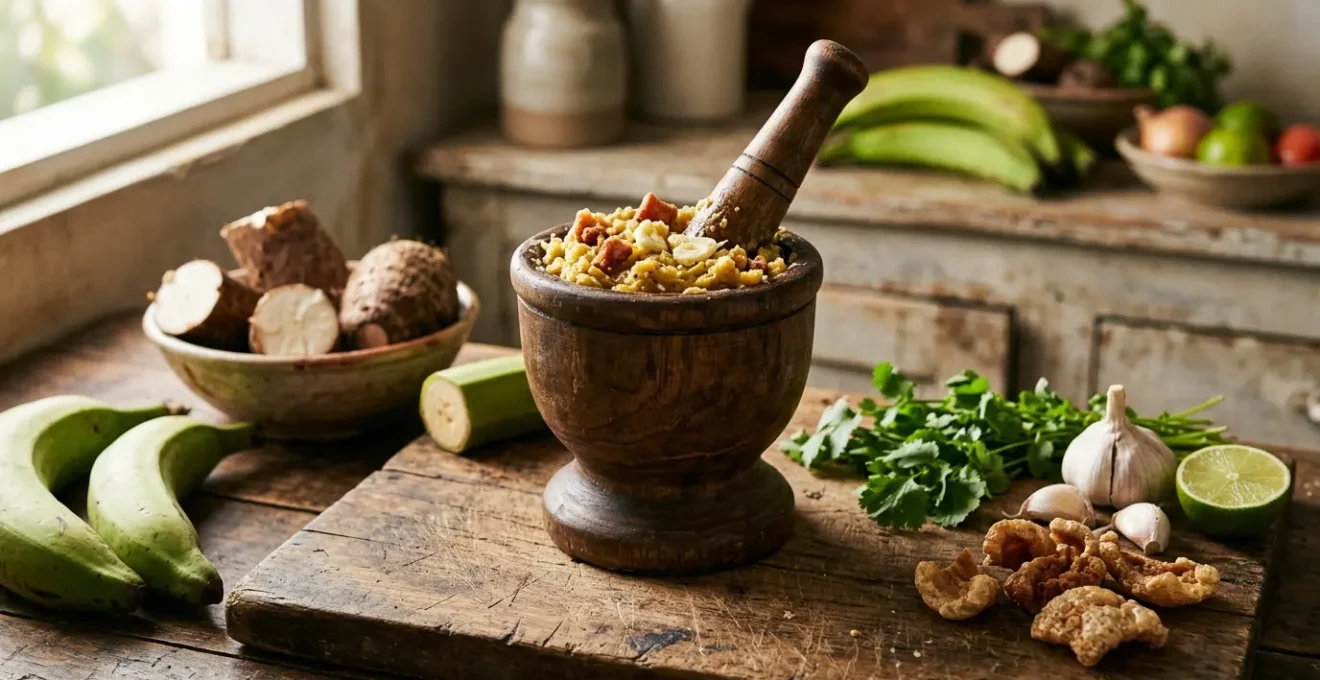
Dominican cuisine is more than a fusion; it’s a historical archive where every dish tells a story of adaptation, survival, and creolization.
- Core dishes like Mofongo and Sancocho are direct descendants of African and Spanish culinary techniques, transformed by Caribbean ingredients and circumstances.
- National identity is literally served on a plate with “La Bandera,” whose components symbolically represent the colors and ideals of the Dominican flag.
Recommendation: To truly understand this food, you must approach it as a culinary archaeologist, tracing its roots back to the first cultural encounters at historical sites like La Isabela.
When you sit down to a Dominican meal, you are not just about to eat; you are about to open a history book written in flavors and textures. For the history buff, each plate is an artifact, a tangible link to the past. The common understanding is that the island’s cuisine is a simple blend of Taíno, Spanish, and African influences. While true, this statement is merely the table of contents. It tells you *what* is in the book, but not the dramatic stories held within its pages.
This surface-level view misses the fascinating narrative of *how* and *why* these elements combined. It wasn’t a peaceful potluck; it was a process of “forced fusion” and adaptation born from colonization, the brutal reality of the slave trade, and the resilient ingenuity of people determined to create a culture of their own. The real key to understanding the Creole palate is to see it as a culinary archive. Each recipe preserves a moment in time: a Spanish colonist’s failed attempt to grow wheat, an enslaved African’s technique for preparing starchy vegetables, and a Taíno method for cooking over a fire.
This guide moves beyond the simple “mix” to explore the stories simmered into the island’s most iconic dishes. We will dissect the origins of mofongo, trace the evolution of sancocho from its Spanish ancestor, decode the national symbolism of rice and beans, and even see how a single failed settlement provides the first chapter in this compelling gastronomic history. Prepare to taste the story of the Dominican Republic.
To navigate this culinary expedition, this article breaks down the key historical and regional influences that have shaped the Dominican palate. The following summary provides a roadmap to the stories behind the island’s most iconic flavors.
Summary: The Creole Palate Unpacked
- Mofongo and Mangú: The African Origin of Mashed Plantains
- How Did the Spanish “Cocido” Evolve into Dominican Sancocho?
- Rice, Beans, and Meat: Why Is This Combination the National Flag?
- Samaná vs Montecristi: How Does the Creole Flavor Change by Region?
- Why Are Sweet Beans (Habichuelas con Dulce) Only Eaten at Easter?
- What Are the “Holy Trinity” Spices of Dominican Cooking?
- How to Visit the Ruins of La Isabela to Understand the First Failed Settlement?
- How Does the Dominican Experience Differ from Other Caribbean Islands?
Mofongo and Mangú: The African Origin of Mashed Plantains
The tradition of mashing starchy vegetables is one of the most direct and powerful culinary legacies of West Africa in the Caribbean. Dishes like mofongo and mangú are living proof of this heritage. They descend from a broader African culinary tradition of pounding staples like yams, cassava, and plantains into a dense, starchy mass known as fufu. When enslaved Africans were brought to the island, they adapted this fundamental technique to the ingredients available, with the plantain becoming a primary staple.
The linguistic evidence itself serves as a historical marker. As culinary historian Cruz Miguel Ortíz Cuadra notes in his work on regional food history:
The word ‘mofongo’ stems from the Angolan Kikongo term ‘mfwenge-mfwenge,’ meaning ‘a great amount of anything at all.’
– Cruz Miguel Ortíz Cuadra, Eating Puerto Rico: A History of Food, Culture, and Identity
This direct linguistic link turns the dish into a piece of the culinary archive, preserving the memory of its origins. While mangú is made from boiled plantains mashed with butter or oil, mofongo uses fried plantains, which are then mashed with garlic and pork cracklings (chicharrón). This variation showcases the process of creolization, where an African technique was enhanced with Spanish ingredients like pork and garlic.
The plantain’s central role cannot be overstated. With an estimated consumption of around 300 plantain units per person per year, it remains the caloric and cultural backbone of the Dominican diet. Mofongo and mangú are therefore not just side dishes; they are foundational pillars of the island’s gastronomy, representing a direct and enduring taste of its African soul.
How Did the Spanish “Cocido” Evolve into Dominican Sancocho?
Sancocho is arguably the heart of Dominican communal cooking, a hearty, one-pot stew that brings together families and celebrates special occasions. While it feels distinctly Caribbean, its story begins across the Atlantic with a Spanish dish: the cocido. A humble stew of chickpeas, meats, and vegetables, the cocido was a staple in Spain and acted as a culinary blueprint carried by colonists to the New World.
The evolution from cocido to sancocho is a prime example of culinary creolization. The first major adaptation is believed to have occurred in the Canary Islands, a Spanish territory off the coast of Africa that was a crucial stopover on the way to the Americas. Here, the dish was adapted into a fish stew using local ingredients. This “proto-sancocho” was then introduced to the Caribbean.
Case Study: The Sancocho Migration
The journey of sancocho is a story of migration and adaptation. According to historical analysis, the dish was first cooked on the Canary Islands as a fish-based stew. Once it arrived in the Caribbean with Spanish colonizers, it was completely transformed. The real genius of Dominican sancocho lies in how it absorbed other cultural influences. Enslaved Africans introduced their knowledge of root vegetables, adding yuca, yautía (malanga), and ñame (yam), which gave the stew its characteristic thickness and heartiness. Simultaneously, Taíno traditions of communal cooking and the use of native crops and herbs were incorporated, creating a truly new dish. This transformation from a simple Spanish stew into a complex, multi-meat, root-vegetable-laden meal is a perfect illustration of how three cultures merged in a single pot.
Unlike the Spanish cocido, which often serves its components separately (broth first, then vegetables, then meat), the Dominican sancocho is a democratic, one-pot affair where all ingredients meld together. It embodies the concept of a new, unified culture. Each spoonful contains a taste of Spain’s culinary structure, Africa’s agricultural knowledge, and the bounty of the native Taíno land, a true culinary melting pot that tells the island’s history.
Rice, Beans, and Meat: Why Is This Combination the National Flag?
In the Dominican Republic, the midday meal is the most important of the day, and at its heart is a dish so ubiquitous it’s known as “La Bandera Dominicana”—The Dominican Flag. This combination of white rice, red beans, and a portion of braised meat (usually chicken or beef) is more than just lunch; it’s a daily ritual of national identity. But how did this simple trio become so deeply symbolic?
The dish’s name and symbolism are directly tied to the nation’s birth. The earliest this national dish could have existed, according to food historians, was in the 1840s when the Dominicans declared their independence from Haiti. La Bandera became a powerful, everyday expression of this newfound patriotism. It transformed a plate of food into a political and cultural statement that could be shared by all citizens.
The Symbolism of La Bandera
The genius of La Bandera lies in its direct, visual connection to the national flag. Each component represents a part of the flag and its corresponding meaning:
- The white rice represents the white cross on the flag, a symbol of salvation and peace.
- The red beans (habichuelas guisadas) represent the red quarters of the flag, symbolizing the blood shed by the nation’s heroes.
- The meat (carne guisada), often dark in color, is associated with the blue quarters, symbolizing liberty.
This simple yet profound connection makes eating La Bandera an act of patriotism. For Dominicans, both on the island and in the diaspora, it is a source of pride and a nostalgic taste of home, a constant reminder of their heritage.
Typically served with a simple green salad, slices of avocado, and often a side of fried plantains (tostones), La Bandera is a perfectly balanced meal. Its composition reflects the historical fusion of cultures: rice and meat-stewing techniques from Spain, beans native to the Americas, and the ever-present plantain with its African roots. It is the ultimate expression of the Creole palate—a dish born from history and elevated to the status of a national symbol.
Samaná vs Montecristi: How Does the Creole Flavor Change by Region?
While a unified Creole palate exists across the Dominican Republic, the country’s diverse geography and history have created distinct regional flavor profiles. The contrast between the cuisine of the northeastern Samaná Peninsula and the northwestern region of Montecristi is a perfect example. The key to Samaná’s unique flavor is coconut, a direct result of a specific wave of immigration in the 19th century.
This distinct culinary identity is a historical artifact of a unique migration. As noted in historical records, these settlers, often referred to as “Samaná Americans,” maintained many elements of 19th-century African American culture, including their dialect and, most importantly, their cuisine. They integrated their food traditions with local ingredients, creating a fusion that was different from the primarily Spanish-African blend found elsewhere.
Case Study: Samaná’s Coconut Cuisine and the African-American Settler Legacy
Beginning in 1824, thousands of freed African Americans, seeking refuge from the harsh realities of life in the United States, immigrated to the Samaná Peninsula. They brought with them their own culinary traditions from the American South, which heavily featured coconut, a staple not as prominently used in the Hispanic-influenced parts of the island. This led to the creation of Samaná’s signature dishes, such as “pescado con coco” (fish in coconut sauce) and “moro de guandules con coco” (rice with pigeon peas and coconut). This community’s relative isolation allowed them to preserve their cultural and culinary autonomy for generations, creating a distinct Afro-Caribbean flavor profile that is a hallmark of the region.
In contrast, the cuisine of the arid northwestern region around Montecristi is shaped by its dry climate and history of cattle ranching. Here, you’ll find a greater emphasis on goat meat (chivo) and dishes that reflect a more direct Spanish and Taíno heritage, with less of the coconut-infused flavor that defines Samaná. This regional variation demonstrates that the Dominican palate is not monolithic; it’s a dynamic map of the island’s layered history, with each region telling its own unique story.
Why Are Sweet Beans (Habichuelas con Dulce) Only Eaten at Easter?
One of the most unique and surprising dishes in the Dominican culinary repertoire is Habichuelas con Dulce. This sweet, creamy dessert made from red beans, milk, sugar, and spices is a beloved tradition, but one that is strictly seasonal, appearing only during the period of Lent and Easter (Cuaresma y Semana Santa). For the uninitiated, the idea of a sweet bean dessert can be perplexing, but its story reveals a fascinating intersection of religious observance, social ritual, and global trade history.
The primary reason for its seasonality is religious. During Lent, traditional Catholic practice called for abstaining from meat on certain days. Habichuelas con Dulce, a rich, hearty, and highly caloric dish, emerged as a perfect festive solution. It provided a satisfying and indulgent treat during a time of dietary restriction, turning a period of sacrifice into an opportunity for a different kind of feast. It is a brilliant example of culinary ingenuity in response to cultural-religious constraints.
Case Study: A Lenten Ritual of Sharing and Global History
Habichuelas con Dulce is much more than a dessert; it’s a social institution. It is traditionally made in enormous batches, far more than one family could consume, with the express purpose of sharing it with neighbors, friends, and family. This act of giving and receiving reinforces community bonds during the most important religious holiday of the year. Furthermore, the ingredient list reads like a history of colonial trade routes. It combines New World staples like red beans and sweet potatoes with coconut milk (an African and Asian influence) and a host of spices—cinnamon, nutmeg, cloves—that arrived in the Caribbean via the vast European-controlled spice trade. Each bowl is a microcosm of global history, a sweet and creamy testament to centuries of cultural exchange.
Served hot or cold and often accompanied by small milk cookies or a piece of casabe (cassava bread), no two households make Habichuelas con Dulce exactly the same way. Every family has its own secret recipe, passed down through generations. This makes the dish not only a symbol of Easter but also a cherished piece of family heritage, a sweet entry in the island’s vast culinary archive.
What Are the “Holy Trinity” Spices of Dominican Cooking?
At the heart of nearly every savory Dominican dish is an aromatic flavor base known as sofrito. This foundational technique, inherited from Spanish cuisine, is the non-negotiable first step that builds the characteristic taste of the island’s food. While the concept of a sofrito—sautéing aromatics in oil to start a dish—is common throughout Latin America, the Dominican version has a unique identity, a “holy trinity” of herbs and spices that sets it apart from its Caribbean cousins.
The core ingredients are garlic, onions, bell peppers, and tomatoes (or tomato paste). However, the Dominican distinction comes from the specific and generous use of two key herbs: cilantro and/or its more pungent cousin, culantro (also known as recao or sawtooth coriander), and a particular variety of oregano known as Dominican oregano (Lippia micromera), which is more potent and earthy than its Mediterranean counterpart. This combination creates a fresh, herbaceous, and deeply savory profile that is the signature of Dominican stews, beans, and rice dishes.
This specific herb profile represents a “Creole deviation” from the original Spanish sofrito, adapted to local Caribbean ingredients and tastes. Today, a modern tension exists in Dominican kitchens between traditionalists who meticulously prepare their sofrito from fresh, whole ingredients for every meal, and those who opt for the convenience of pre-made sofrito pastes or powdered seasonings like sazón packets and bouillon cubes. This debate itself reflects the evolving nature of the cuisine, caught between a reverence for historical technique and the demands of modern life.
Action Plan: Deconstructing Sofrito Flavor
- Identify the core components: Start by recognizing the base of garlic, onion, and bell pepper in a Dominican dish.
- Listen for the herbaceous notes: Pay close attention to the distinct, fresh flavor of cilantro or the more assertive punch of culantro.
- Detect the earthy foundation: Try to isolate the unique, slightly minty and earthy flavor of Dominican oregano, which grounds the sofrito.
- Compare with other versions: Taste a Puerto Rican or Cuban dish to notice the difference; they often use different pepper varieties or lean more heavily on cumin, lacking the Dominican cilantro-oregano signature.
- Experiment in the kitchen: Recreate the base by sautéing these ingredients to understand firsthand how this foundation builds the entire flavor of a dish.
Understanding this foundational flavor base is essential. It’s the culinary alphabet from which the poetry of Dominican cooking is written. Every “guisado” (stew) and “locrio” (seasoned rice) begins here, with this specific and aromatic trinity of flavors.
How to Visit the Ruins of La Isabela to Understand the First Failed Settlement?
For the history buff looking to “taste” history, a journey to the north coast of the Dominican Republic is essential. Here lie the ruins of La Isabela, the first permanent European settlement in the Americas, founded by Christopher Columbus in 1493. More than just an archaeological site, La Isabela is ground zero for the Dominican palate—the site of the very first, failed attempt at food fusion. Visiting these ruins provides a profound understanding of how the Creole cuisine was ultimately born from necessity and adaptation.
The Spanish colonists arrived with European agricultural expectations. They tried to cultivate wheat, grapes, and other familiar crops, but the tropical environment was unforgiving. Their supplies dwindled, and starvation became a real threat. Meanwhile, the indigenous Taíno people thrived on their own food systems, centered on yuca (cassava), corn, and sweet potatoes. The Spanish initially viewed these native foods with suspicion, but desperation forced their hand.
This historical moment, when the Spanish were forced to eat Taíno food to survive, is the true beginning of the fusion. As historian José del Castillo powerfully states, a native staple became the unlikely savior of the European expansion effort:
The cassava of the natives and its derivative, the casabe, ‘would become the bread of the conquest’ that supplied the companies that took part in the expeditions which departed from the Hispaniola island to other territories of the American continent.
– José del Castillo, quoted in Dominicana Online
This “fusion by necessity” at La Isabela sets the stage for the entire history of Dominican food. It demonstrates that the celebrated “mix” was not a planned culinary project but a story of survival. The following itinerary allows a modern visitor to conduct their own “gastronomic archaeology” at this crucial site.
Checklist: A Culinary History Itinerary for La Isabela
- Begin at La Isabela National Park: View the ruins where Spanish colonists first failed to adapt to local food systems.
- Visit the site museum: Learn how attempts to grow European wheat failed while Taíno yuca and corn were abundant.
- Examine the evidence: Understand that Spanish colonists eventually ate casabe (Taíno yuca bread) out of desperation, a fusion born of necessity.
- Contrast in Santo Domingo: After your visit, travel to the Colonial Zone and taste successful food fusion in dishes that harmoniously blend all three cultures.
- Synthesize the experience: Reflect on how the culinary rigidity at La Isabela’s failed settlement contrasts with the adaptability that created today’s thriving Dominican food culture.
Key Takeaways
- Dominican food is a “culinary archive” of historical events, where each dish records a story of migration, adaptation, and identity—not just a simple blend of cultures.
- Foundational techniques, like mashing plantains for Mofongo and stewing meats for Sancocho, have direct, traceable roots in African and Spanish traditions that were transformed by Caribbean ingredients.
- The uniqueness of the Dominican palate lies in its deep and central Taíno foundation (yuca, casabe) and its specific herb profile (cilantro/culantro, Dominican oregano), which distinguishes it from other Caribbean cuisines.
How Does the Dominican Experience Differ from Other Caribbean Islands?
While the Dominican Republic shares a common historical thread of Taíno, Spanish, and African influences with its Hispanic Caribbean neighbors, Puerto Rico and Cuba, its culinary experience is distinct. This uniqueness is so pronounced that in both 2018 and 2019, the city of Santo Domingo was named a Culinary Capital of the Caribbean by the Ibero-American Academy of Gastronomy. The difference lies in the specific ratio of its influences, the prominence of certain ingredients, and a flavor profile that leans more herbaceous than spicy.
The most significant distinction is the depth of the Taíno influence. Hispaniola was the epicenter of Taíno culture, and their culinary DNA is more deeply embedded in Dominican food than elsewhere. The widespread use of yuca in many forms, particularly casabe bread, and the tradition of barbacoa (barbecue) are powerful, living legacies of the island’s first inhabitants. While other islands have Taíno influences, they are often less central to the daily diet.
To better understand these nuances, a direct comparison of key dishes and flavor profiles reveals the subtle but important distinctions between the cousins of the Hispanic Caribbean.
| Aspect | Dominican Republic | Puerto Rico | Cuba |
|---|---|---|---|
| Plantain Dish | Mangú (boiled-then-mashed) | Mofongo (fried-then-mashed with chicharrón) | Fufú de plátano (different texture) |
| Stew Signature | Sancocho (one-pot, democratic meal, multi-meat versions common) | Sancocho (similar but different meat preferences) | Ajiaco (distinct preparation) |
| Spice Profile | Milder, less spicy; heavy use of cilantro/culantro and Dominican oregano | More use of adobo and sazón blends | Cumin-forward, different sofrito base |
| Taíno Influence Depth | Strongest – epicenter of Taíno culture; deep embedding of yuca, casabe, barbacoa | Moderate Taíno influence | Less pronounced indigenous influence |
| Other Influences | Concentrated Taíno-Spanish-African mix; some Middle Eastern (kipes) | Similar base plus strong U.S. influence | Chinese influence (fried rice), Spanish dominant |
Ultimately, the Dominican culinary experience stands apart through its unique balance. It is less defined by the heavy seasoning blends found in Puerto Rico or the cumin-forward notes of Cuba. Instead, it offers a profile that is arguably fresher and more herbaceous, grounded in its profound Taíno roots and the signature sofrito that serves as its unmistakable calling card.
Now, it’s your turn to be a culinary archaeologist. Start exploring these dishes not just as food, but as living history. Taste the stories that have simmered for centuries and uncover the rich, complex narrative of the Dominican people, one delicious bite at a time.