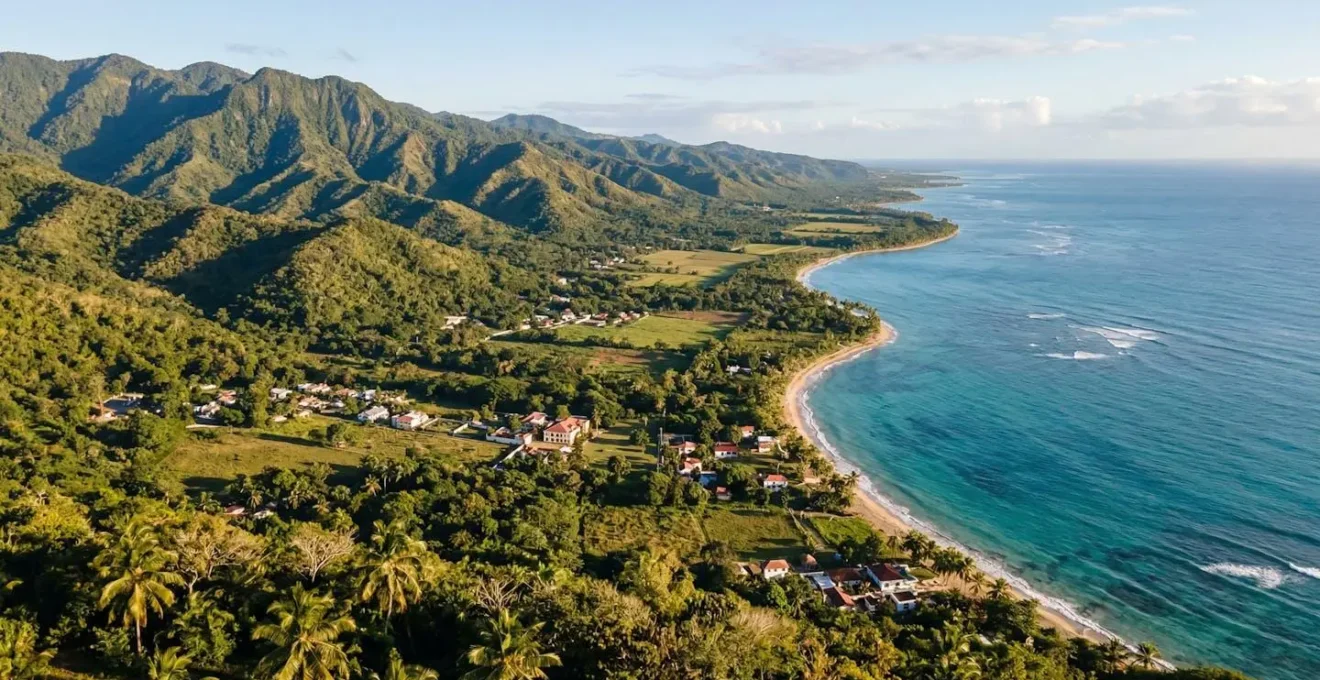
Thinking the Dominican Republic is just another interchangeable Caribbean beach spot is a common mistake for seasoned travelers.
- It operates on the scale of a diverse Latin American country, not a small tourist-focused island, with vast mountain ranges and bustling cities.
- This “Socio-Economic Tapestry” creates a richer, more complex cultural experience beyond the resort walls, blending Spanish colonial history with vibrant, modern life.
Recommendation: Approach the DR not as a simple beach vacation, but as an exploratory road trip destination that rewards curiosity and planning.
For the frequent Caribbean traveler, the islands can start to blend into a beautiful but familiar pattern: turquoise waters, rum punch, and a laid-back, English-speaking rhythm. You know the routine, you’ve perfected the art of beach-hopping, and you might think you’ve seen all the region has to offer. The Dominican Republic often appears on this checklist, usually filed under “Punta Cana” as a synonym for sprawling all-inclusive resorts. This perception, however, misses the fundamental truth of the destination.
The key to understanding the DR is to stop seeing it as just another island and start seeing it for what it is: a large, economically dynamic, and topographically diverse Latin American nation that happens to be in the Caribbean. Its experience is defined less by idyllic seclusion and more by a vibrant, sometimes chaotic, national life. This isn’t a place where tourism is the only engine; it’s a country with major cities, agricultural heartlands, and a “Geographic Insulation” provided by its mountain ranges that creates a world of its own. This article is for the traveler who’s been to Jamaica, Barbados, and Antigua, and is now asking: what truly makes the Dominican Republic different? The answer lies beyond the beach.
This guide deconstructs the Dominican experience, comparing it to its neighbors on practical terms like cost, culture, and logistics. We will explore how its unique identity as a Spanish-speaking hub shapes everything from its safety profile to its potential as a base for Caribbean exploration. Prepare to see the DR not as a final stop, but as a new starting point.
Summary: Decoding the Dominican Republic’s Unique Caribbean Identity
- DR vs Jamaica vs Mexico: Where Does Your Dollar Go Further?
- Why the “Latin” Vibe Sets DR Apart from the English Caribbean?
- How to Use Santo Domingo as a Hub for Caribbean Hopping?
- The Safety Myth: Is DR More Dangerous Than Its Neighbors?
- When Is the Risk of Hurricanes Lowest in the Central Caribbean?
- How to Choose the Right Punta Cana Resort When They All Look the Same?
- How to Navigate Dominican City Centers Safely as a Solo Traveler?
- How to Plan a Road Trip Across 3 Iconic Provinces Without Getting Stranded?
DR vs Jamaica vs Mexico: Where Does Your Dollar Go Further?
The conversation about value often starts and ends with the price of an all-inclusive package, but the true economic difference in the Dominican Republic lies in the cost of living *outside* the resort. For travelers who venture beyond the gates, the DR presents a compelling value proposition rooted in its large, diversified economy. Unlike smaller islands heavily reliant on expensive imports, the DR has robust local agriculture and manufacturing. This translates into noticeably lower costs for everyday expenses, from a meal at a local eatery to transportation.
Recent data confirms this affordability. For instance, living costs in the Dominican Republic are 42.3% lower than in the United States, a gap more significant than in many of its English-speaking neighbors. This extends beyond daily expenses to larger investments. The Dominican Republic offers some of the most accessible real estate in the Caribbean, with fewer restrictions on foreign buyers compared to islands like Saint Vincent and the Grenadines. This socio-economic reality makes it a destination where your budget can stretch from a simple vacation to a longer-term stay or investment, an option less feasible on more expensive islands.
This table illustrates the cost differences for life outside a resort. The DR consistently offers a lower cost structure, particularly in essentials like rent and local food, making independent travel significantly more affordable.
| Country | Monthly Cost (Single Person) | Rent + Utilities | Restaurant Meal |
|---|---|---|---|
| Dominican Republic | $480 | $311 | $7 (fast food) |
| Jamaica | $599 | $473 | $10 (fast food) |
| Haiti | $450 | $280 | $5 (local meal) |
| Trinidad & Tobago | $680 | $520 | $12 (fast food) |
Why the “Latin” Vibe Sets DR Apart from the English Caribbean?
The term “Latin vibe” is often used as a simple descriptor for Spanish-speaking countries, but in the Dominican Republic, it signifies a profound cultural and social structure that feels distinctly different from the Anglophone Caribbean. This isn’t just about language; it’s about the energy of a nation with a deep Spanish colonial history and a bustling, mainland-style public life. While many Caribbean islands revolve around the tourist-centric rhythm of beaches and bars, Dominican life is centered in its lively town squares (parques), bustling markets, and the ubiquitous colmados (corner stores) that function as social hubs.
This creates a more immersive, and at times more challenging, cultural experience. Life is lived publicly, with music, conversation, and commerce spilling onto the streets with an intensity that can feel more like a major Latin American capital than a tranquil island getaway. The social fabric is woven with the sounds of merengue and bachata, the passion of domino games in the park, and a general formal-politeness in interactions that contrasts with the more casual, direct style of the English Caribbean. For the experienced traveler, this “vibe” means engaging with a complete and self-contained society, not just a service-oriented tourism industry.
As this image of a public plaza suggests, the evening brings entire families and communities together, showcasing a multi-generational social life that is the heartbeat of the nation. It is this rich social tapestry, independent of tourism, that offers a depth of cultural immersion rarely found elsewhere in the region.
How to Use Santo Domingo as a Hub for Caribbean Hopping?
While many smaller Caribbean islands are destinations in themselves, the Dominican Republic’s size and strategic location make it a powerful hub for exploring the wider region. As the second-largest nation in the Caribbean after Cuba, covering 48,671 square kilometers, its capital, Santo Domingo, serves as a significant air and sea port with connections that are often more extensive and affordable than those from smaller islands. For the savvy traveler, this transforms the DR from a single destination into a launchpad.
However, navigating this requires a strategic approach. Direct flights between Caribbean islands are notoriously sparse and expensive. The key is to leverage the DR’s position within larger airline networks, using hubs like Miami (MIA) or Panama City (PTY) to create efficient two-leg journeys. Furthermore, Santo Domingo offers one of the few viable sea links in the region via the ferry to San Juan, Puerto Rico. It’s also important to recognize the “linguistic curtain”; the most affordable and frequent routes from Santo Domingo connect to other Spanish-speaking destinations. Crossing over to the English, French, or Dutch Caribbean often involves higher costs and more complex itineraries. By understanding these logistical nuances, a trip to the DR can become the starting point for a multi-island adventure.
Action Plan: Strategic Caribbean Island Hopping from Santo Domingo
- Route Planning: Prioritize booking two-leg routes via major hubs like Miami (MIA) or Panama City (PTY) for the best connections to the Lesser Antilles.
- Sea Travel: Consider the Ferries del Caribe service to San Juan, Puerto Rico, as the most practical and reliable non-air link for regional travel.
- Regional Airlines: Research smaller Dominican carriers such as Sky High and Air Century for direct flights to nearby islands like Aruba, Curaçao, and St. Maarten.
- The Linguistic Curtain: Acknowledge that the most budget-friendly routes from Santo Domingo (SDQ) connect to Spanish-speaking destinations (e.g., Puerto Rico, Colombia, Panama).
- Budgeting: Plan for significantly higher travel costs and fewer direct options when your itinerary requires crossing into the English, French, or Dutch-speaking islands.
The Safety Myth: Is DR More Dangerous Than Its Neighbors?
Safety is a primary concern for any Caribbean traveler, and the Dominican Republic often faces a reputation for being more dangerous than its neighbors. However, this perception is frequently misinformed. While petty crime exists, particularly in larger cities like Santo Domingo, it is not dramatically different from other major tourist destinations in the region. The real, and often overlooked, safety issue for the independent traveler in the DR is not crime, but road safety. The country’s driving culture can appear chaotic to outsiders, with variable road conditions and a different set of unwritten rules.
For a solo traveler, understanding how to navigate this environment is paramount. As one experienced traveler notes, the key is a proactive approach to transportation choices.
I spent six days traveling solo across the Dominican Republic’s eastern side, including Santo Domingo, Miches, and Punta Cana. The key to safety was understanding local transportation options – I primarily used app-based rides in cities and pre-arranged transfers for longer distances. The capital Santo Domingo requires more caution than beach resort areas, but with basic precautions like avoiding flashy jewelry and having small bills ready, I felt secure throughout my journey.
– Jazzmine, Jetset Jazzmine
This highlights a crucial distinction: while tourist areas have a strong and visible police presence to deter crime, navigating from point A to B requires more traveler agency. Choosing an Uber or a registered ATEC taxi over a high-risk *motoconcho* (motorcycle taxi) is a more critical safety decision than worrying about violent crime, which is low in tourist zones. The danger isn’t necessarily from people, but from the infrastructure itself.
When Is the Risk of Hurricanes Lowest in the Central Caribbean?
Hurricane season, officially from June to November, is a major factor in Caribbean travel planning. While no island is entirely immune, the Dominican Republic possesses a unique geographical advantage that mitigates its risk compared to many of its neighbors. Over its history, the Dominican Republic has experienced over 140 hurricanes since 1851, but its large landmass and topography play a crucial defensive role.
The island benefits from a phenomenon known as the “hurricane hole” effect. Two massive mountain ranges, including the Cordillera Central, run through the country’s core. These high-altitude barriers act as a natural shield, disrupting and weakening storm systems as they approach land. Furthermore, Puerto Rico, to the east, often absorbs the initial and most powerful impact of storms moving westward from the Atlantic. This was dramatically illustrated in 2017 during Hurricane Irma; while neighboring islands suffered catastrophic damage, the Dominican Republic was largely spared, experiencing only minor secondary effects. This “Geographic Insulation” makes the DR a statistically safer bet during the volatile late summer and early autumn months.
The best time to visit for lowest hurricane risk is from December to May. However, even within the hurricane season, the months of June, July, and November historically see far less activity. For the risk-aware traveler, the DR’s natural defenses make it a more resilient choice than flatter, more exposed islands in the central Caribbean.
How to Choose the Right Punta Cana Resort When They All Look the Same?
To the uninitiated, Punta Cana appears as a monolithic stretch of all-inclusive resorts, each promising the same sun, sand, and swim-up bars. For the discerning traveler, however, navigating this “resort paradox” requires looking beyond the marketing and understanding two key factors: beach geography and resort architecture. Not all beaches are created equal, and their character dictates the experience. The northern beaches offer wilder waves, while the southern shores boast the calm, turquoise water of classic Caribbean postcards.
Matching the beach to your preference is the first step:
- Uvero Alto & Macao (North): Golden sands and consistent waves, ideal for surfers and those seeking a more natural, less developed coastline.
- Arena Gorda & Bavaro: The bustling heart of Punta Cana, with calmer waters perfect for water sports and extensive resort infrastructure. This is the “classic” Punta Cana experience.
- Cabeza de Toro & Cap Cana (South): The luxury zone. Expect pristine white sand, tranquil turquoise waters, and exclusive, high-end properties.
Secondly, the resort’s design philosophy defines the atmosphere. A sprawling “mega-resort” with a trolley system offers endless options for families, while a “boutique all-inclusive” provides the intimate, quiet service ideal for couples. Party-centric hotels, with their modern design and vibrant nightlife, cater to a completely different crowd.
Choosing correctly means dissecting what lies behind the identical-looking beachfront photos. The table below categorizes the resort types to help align your travel style with the right property.
| Resort Type | Characteristics | Best For | Example Properties |
|---|---|---|---|
| Mega-Resorts | Sprawling complexes with trolleys, multiple pools | Families, large groups | Bahia Principe complexes |
| Boutique All-Inclusives | Intimate, quiet, personalized service | Couples, honeymoons | Zoëtry Agua |
| Party-Centric Hotels | Modern, sleek, vibrant nightlife | Young adults, singles | Breathless |
How to Navigate Dominican City Centers Safely as a Solo Traveler?
For the solo traveler venturing into Dominican cities like Santo Domingo or Santiago, safety is less about avoiding danger and more about mastering the art of confident, informed navigation. The energy is intense, and blending in requires understanding the local flow. The most critical skill is knowing the tiered system of local transportation, as this is where a traveler is most vulnerable.
A clear hierarchy exists, and sticking to the safer tiers is non-negotiable for a solo visitor:
- Tier 1 (Safest): App-based rides like Uber or DiDi are the gold standard. They offer a fixed price, a trackable route, and driver accountability.
- Tier 2 (Safe): ATEC-syndicated official taxis are a reliable alternative, identifiable by their proper branding and meters.
- Tiers 3-5 (Use with Caution or Avoid): *Carros Públicos* (shared taxis on set routes) and *Gua-guas* (public buses) are for the budget-conscious and require basic Spanish and local knowledge. *Motoconchos* (motorcycle taxis) should be avoided entirely by tourists due to the high risk of accidents.
Beyond transportation, the urban landscape offers its own unique safety net, a concept one traveler cleverly identified as the “Colmado as Safety Anchor” strategy.
Case Study: The Colmado as a Safety Anchor
Dominican corner stores, known as colmados, are far more than just shops; they are the informal social and logistical centers of every neighborhood. For a solo traveler, they serve as invaluable safety anchors. If you’re lost, a colmado is the most reliable place to get directions. Because they are always staffed and frequented by locals, their presence is a good indicator of a neighborhood’s general safety. They stay open late and, in areas with some tourist traffic, the owners often speak enough English to help. Using a colmado as a landmark or a quick stop to get your bearings is a powerful strategy for navigating unfamiliar city districts with confidence.
Key takeaways
- The DR’s value is in its low cost of living outside resorts, driven by a strong local economy.
- The “Latin vibe” is a deep cultural structure of public social life, distinct from the tourist-centric English Caribbean.
- The country’s size and geography provide natural defenses against hurricanes, making it a more resilient choice during storm season.
How to Plan a Road Trip Across 3 Iconic Provinces Without Getting Stranded?
The ultimate expression of the Dominican Republic’s difference is the road trip. With over 1,633 km of coastline and vast mountainous interiors, the DR is a country best explored by car, offering a sense of discovery impossible on smaller islands. A journey spanning provinces like Samaná (jungle and coast), Barahona (desert and raw beaches), and Pedernales (pristine nature reserves) reveals a diversity of landscapes that feels more like a continental tour than an island hop. However, this freedom comes with a need for meticulous planning. The “infrastructural paradox” of the DR means you can find a modern highway that suddenly gives way to a poorly maintained rural road.
Getting stranded is a real risk for the unprepared. The key is to anticipate the gaps in infrastructure. This means planning for “fuel deserts,” especially on the remote route from Barahona to Pedernales, where gas stations are scarce. It means identifying “ATM black holes” in the southwest and carrying sufficient cash. And it means being prepared for logistical hurdles that don’t exist in more developed travel markets. One of the most common pitfalls is rental car insurance; the mandatory ‘Casa de Conductor’ policy is almost never included in online bookings and must be paid for at the counter.
A successful road trip demands self-sufficiency. Your vehicle becomes your lifeline, so preparation is everything. Before you even turn the key, a thorough checklist is essential to bridge the gap between adventure and misadventure.
- Offline Maps: Download maps for the entire country (Google Maps or Maps.me) before departure, as cell service is unreliable in mountain and remote coastal areas.
- Fuel & Cash: Identify fuel deserts and ATM-scarce regions on your route and plan accordingly by filling up your tank and wallet in major towns.
- Rental Car Diligence: Prepare for the mandatory ‘Casa de Conductor’ insurance at the rental counter and document the car’s pre-existing condition with a detailed video before leaving the lot.
- Emergency Supplies: Always stock your car with ample water, snacks, and a basic first-aid kit, especially when heading into mountainous or sparsely populated zones.
By shifting your perspective from a passive beachgoer to an active explorer, the Dominican Republic reveals itself as one of the most rewarding and multifaceted destinations in the Caribbean. The next step is to embrace this different approach and start planning your own journey of discovery.