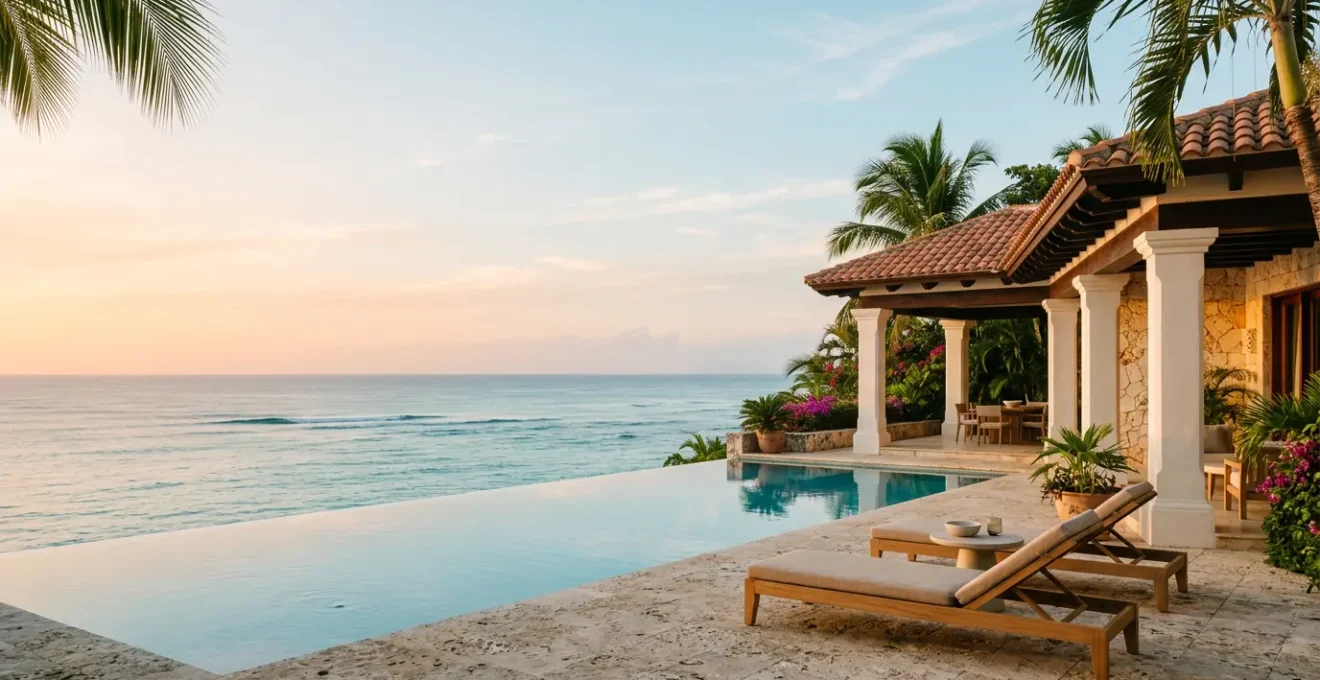
The true cost of a Casa de Campo villa isn’t in the hidden fees you avoid, but in the seamless luxury experience you fail to architect.
- A private villa is often more cost-effective than multiple hotel rooms for groups, offering superior space and privacy.
- Understanding the difference between a cook and a chef, or “beachfront” versus true beach access, is crucial for managing expectations.
Recommendation: Shift your focus from simple cost-cutting to strategic value creation by mastering the resort’s logistics and service tiers for a truly flawless group getaway.
Organizing a multi-generational family reunion or a milestone group trip is a monumental task. The dream is a sprawling private villa in Casa de Campo, with everyone together under one roof, sharing laughter by a private pool. The nightmare? Drowning in a sea of unexpected costs, logistical headaches, and “hidden fees” that turn a dream vacation into a stressful ordeal. Many guides will tell you to simply “read the fine print” or “ask about resort fees,” but this surface-level advice misses the point entirely.
The secret to a successful Casa de Campo villa rental isn’t about defensively avoiding fees; it’s about proactively becoming the architect of your group’s experience. It’s about understanding the subtle but critical differences in service tiers, mastering the resort’s unique logistics, and making strategic choices that unlock a level of comfort, privacy, and value that a block of hotel rooms could never offer. This is where you transform a simple rental into a bespoke, unforgettable event.
This guide moves beyond the obvious to give you the insider perspective of a luxury broker. We will deconstruct the key decisions you’ll face, from staffing your villa and choosing the right community to coordinating activities for all ages. By the end, you will not only know how to avoid financial surprises but also how to engineer a truly seamless and exceptional stay.
To help you navigate these critical decisions, we have structured this guide to address the most pressing questions that arise when planning a luxury villa stay. From initial cost comparisons to on-the-ground logistics, each section provides the clarity needed to plan with confidence.
Summary: The Insider’s Guide to Renting a Casa de Campo Villa
- Chef vs Cook: Which Staff Level Do You Need for Your Villa?
- Cap Cana or Casa de Campo: Which Gated Community Is More Exclusive?
- Villa vs 5 Hotel Rooms: Which Is Cheaper for a Family of 10?
- How Does Security Work in Private Villa Compounds?
- How to Organize Grocery Pre-Stocking Before You Arrive?
- Where to Find Private Beach Access That Actually Lives Up to the Photos?
- How to Find “Soft Adventure” Activities Suitable for Multi-Generational Families?
- How to Buy Custom-Made Jewelry in Santo Domingo?
Chef vs Cook: Which Staff Level Do You Need for Your Villa?
One of the most significant upgrades a villa offers over a hotel is personalized dining, but the choice between a “cook” and a “chef” is a crucial one that defines the entire experience. This isn’t just a matter of semantics; it’s a decision about service tiers. A cook is typically skilled in local, homestyle cuisine. They will expertly prepare delicious Dominican dishes but usually work from a set repertoire or follow your specific instructions. This is an excellent, cost-effective option for families seeking authentic, casual meals.
A private chef, on the other hand, is a culinary professional who provides a full-service restaurant experience. They design custom menus based on your preferences, source high-quality ingredients, handle complex dietary restrictions with creativity, and manage artistic plating and presentation. This elevated service is an experience in itself, perfect for milestone celebrations or groups with discerning palates. The investment reflects this, with a professional chef service costing upwards of $315 USD per day plus taxes and ingredients, according to Casa de Campo’s official pricing. Choosing the right level depends entirely on your group’s expectations: are you looking for comfortable convenience or a curated culinary journey?
Cap Cana or Casa de Campo: Which Gated Community Is More Exclusive?
When choosing a luxury enclave in the Dominican Republic, the two premier names that emerge are Casa de Campo and Cap Cana. While both offer unparalleled security and world-class amenities, their character and feel are distinctly different. The question isn’t which is “more exclusive,” but which style of exclusivity best aligns with your group’s vision. Casa de Campo, established in 1974, is the sprawling elder statesman. It feels less like a resort and more like a self-contained, high-end town, radiating an “old money” legacy and a family-friendly atmosphere.
Its centerpiece is not just golf, but also Altos de Chavón, a stunning replica of a 16th-century Mediterranean village perched above the Chavón River. This cultural heart gives Casa de Campo a depth and character that is unique. Getting around its 7,000 acres almost always requires renting a golf cart, which becomes part of the daily experience.
Cap Cana is the modern counterpart, a testament to sleek, new-world glamour. It is larger in acreage but feels more concentrated around its state-of-the-art marina, a magnet for the international yachting set. The vibe is more adult-oriented, with a focus on fine dining and high-energy beach clubs. The choice depends on your group’s dynamic: multi-generational families often prefer the vast, town-like feel of Casa de Campo, while groups of adults seeking a glamorous scene may gravitate towards Cap Cana’s modern polish.
To make an informed decision, a side-by-side comparison is invaluable. The following table breaks down the key differences in atmosphere, amenities, and overall vibe.
| Feature | Casa de Campo | Cap Cana |
|---|---|---|
| Property Size | 7,000 acres | 30,000 acres |
| Established | 1974 (Old World Legacy) | Early 2000s (Modern Glamour) |
| Daily Resort Fee (Adult) | $25 per adult | Comparable luxury tier |
| Daily Resort Fee (Child 4-12) | $12 per child | Comparable luxury tier |
| Signature Golf Course | Teeth of the Dog (Pete Dye) | Punta Espada (Jack Nicklaus) |
| Vibe | Sprawling, town-like, old money | Concentrated, marina-focused, new money |
| Cultural Attraction | Altos de Chavón village | World-class marina |
| Transportation | Golf carts (rental required) | More walkable/shuttle-friendly |
| Best For | Multi-generational families | Adults, yachting, fine dining |
Villa vs 5 Hotel Rooms: Which Is Cheaper for a Family of 10?
For a group organizer, the primary financial question is one of value arbitrage: does a single large villa truly provide better value than multiple hotel rooms? On the surface, the nightly rate of a luxury villa seems high. However, when you do the math for a group of 10, which would require at least five hotel rooms, the villa almost always emerges as the more economical and vastly superior choice. This is because villas are not all-inclusive; you pay for the space and staff, then manage food costs separately, which provides significant control over your budget.
Consider the raw numbers. A luxury accommodation cost analysis suggests rates of $400-$600 per room per night for high-end hotels. For five rooms, this translates to $2,000-$3,000 per night. In contrast, a spacious, high-quality five-bedroom villa might range from $1,500-$2,500 per night. The savings are immediate, but the value extends far beyond the price tag. You gain a private pool, a communal living and dining area, a kitchen to prepare cost-effective breakfasts and snacks, and an unparalleled level of privacy that is impossible to replicate in a hotel setting.
Case Study: The Economics of a Group Villa Rental
A comparative analysis for a group trip illustrates this principle perfectly. Two families, totaling eight people, would have spent approximately $400 per night for four separate hotel suites. Instead, they opted for a luxury 4-bedroom villa with a private pool for just $160 per night in the mid-season. This move cut their accommodation cost by more than half while providing significantly more space and amenities. Furthermore, having a full kitchen eliminated the need for expensive restaurant meals for every breakfast and many dinners, compounding the savings and proving the villa to be the smarter financial and experiential choice.
How Does Security Work in Private Villa Compounds?
A primary concern for any family or group organizer is the safety and security of their party. This is an area where elite gated communities like Casa de Campo excel, providing a multi-layered system designed for peace of mind. The foundation of this security is the controlled-access protocol. It is standard practice in Dominican gated communities to have 24/7 guarded entryways with controlled visitor access and regular security patrols. No one enters the property without authorization.
However, this robust security can create logistical friction if not managed correctly. You cannot simply have a food delivery driver or an off-resort taxi show up at the gate. The key to a seamless experience is understanding and using the pre-registration system. By working with your villa manager or concierge, you provide a list of all expected guests in advance. Upon arrival, their IDs are checked against this approved list, ensuring a smooth and welcoming entry. The same process applies to authorizing vendors, from caterers to airport transfer services. This proactive communication transforms a potential bottleneck into an invisible layer of protection, allowing you to relax completely, knowing that access to your private sanctuary is strictly controlled.
Your Action Plan: Guest & Vendor Authorization Protocol
- Pre-Register Guests: Submit a complete list of guest names and identification details to your villa management at least 48 hours before arrival.
- Arrival Verification: Ensure all guests have their ID ready to present at the main security gate, where guards will verify them against the pre-registered list.
- Authorize Vendors: For any external service (e.g., food delivery, taxi, private tour), call the villa concierge or main gate in advance with the vendor’s details and expected arrival time.
- Visitor Policy: If you plan to have visitors who are not on the original guest list, inform security ahead of time. Unannounced visitors will be stopped at the gate until you provide direct authorization.
- Departure Logging: Be aware that all entries and exits of both guests and vendors are logged by security, ensuring a complete record of who is on the property at all times.
How to Organize Grocery Pre-Stocking Before You Arrive?
One of the most underrated luxuries of a villa rental is arriving after a long day of travel to a fully stocked kitchen. There is no need for a frantic, post-flight supermarket run. Instead, cold drinks, fresh snacks, and all the ingredients for your first night’s dinner are waiting for you. This is not a happy accident; it’s a piece of experience architecture that you can and should arrange in advance. Eliminating this initial logistical friction sets a tone of effortless relaxation for the entire trip.
The process is remarkably simple and is typically coordinated through your villa’s concierge or chef. You provide a detailed grocery list—from local tropical fruits and Dominican coffee to specific brands of spirits and children’s snacks. The staff handles the procurement, delivery, and unpacking. This allows you to hand-pick the quality and type of products you want, a level of personalization impossible in an all-inclusive hotel. You can opt for local, organic produce or imported comfort foods, tailoring the pantry to your group’s exact tastes.
While there is a service fee for this coordination, it is a small price to pay for the immense convenience. For budgeting purposes, the financial arrangement is straightforward. As private chef Adam Brunet explains regarding ingredient costs:
The chef does the shopping for you, and you give them either cash or a bank card. Expect around €30-50 per person per day for quality ingredients.
– Adam Brunet, Private Chef Cost: 2026 Price Guide
Where to Find Private Beach Access That Actually Lives Up to the Photos?
The term “beachfront” can be one of the most misleading in real estate, and in Casa de Campo, it’s essential to understand the local definition to avoid disappointment. You may see stunning photos of a villa perched on a cliff with turquoise water below, listed as “beachfront.” However, this does not always mean you can walk out the back door and onto the sand. The reality is often more nuanced and requires careful verification.
In many cases, “beachfront” signifies a direct, unobstructed ocean view, which is spectacular in its own right but may not include swimmable, sandy access from the property itself. This is a critical distinction for families with small children or anyone dreaming of spontaneous dips in the sea. Caribbean villa rental specialists offer a crucial piece of insider knowledge:
Beachfront in Casa de Campo often means an ocean view, sometimes from a cliff, not a walk-out-onto-the-sand situation. Private beach access almost always refers to access to the shared resort beach, Minitas Beach.
– Caribbean villa rental specialists, Casa de Campo Luxury Resort Guide and Villa Rentals
This does not diminish the quality of the experience, as Minitas Beach is a beautifully maintained private resort beach with full service, restaurants, and water sports. However, if true walk-out beach access is a non-negotiable for your group, you must explicitly ask your rental agent: “Does this villa have direct, sandy beach access from the property, or does it have access to Minitas Beach?” Clarifying this single point will ensure your expectations perfectly match the reality on the ground.
How to Find “Soft Adventure” Activities Suitable for Multi-Generational Families?
One of the greatest challenges for a group organizer is planning activities that engage everyone, from grandparents seeking relaxation to teenagers craving excitement and young children needing entertainment. This is where “soft adventures”—accessible, low-intensity, yet highly engaging experiences—become invaluable. Casa de Campo’s sheer scale and variety of amenities make it uniquely suited for this, but orchestrating the logistics requires professional help. The key is to leverage your villa’s concierge service.
Instead of trying to herd everyone into a single activity, a skilled concierge can architect a day where sub-groups pursue their interests before reuniting. They can book tee times at the world-renowned Teeth of the Dog golf course for the avid golfers, arrange a leisurely afternoon of shopping and exploring the artisan workshops in Altos de Chavón for others, and schedule a private catamaran trip for those wanting to be on the water. They handle the transportation, timing, and ticketing, removing all logistical friction and allowing each family member to enjoy their preferred pace of vacation.
Case Study: Concierge-Led Experience Architecture
A villa specialist recounted how their concierge team flawlessly coordinated a day for a diverse family group. They pre-arranged a visit to Altos de Chavón village in the afternoon for the whole family. For the golfers in the group, morning tee times were secured at Teeth of the Dog, complete with transportation, club rentals, and caddies. This allowed them to enjoy a world-class round of golf and then seamlessly rejoin the rest of the family at the villa for a poolside lunch. In the late afternoon, the entire group embarked on a private river cruise below the cliffs of the village, offering a different, relaxing perspective on the landscape they had explored earlier. This demonstrated how professional concierge services expertly handle complex logistics for groups with varying mobility levels and interests, ensuring everyone has a perfect day.
Key Takeaways
- Shift your mindset from a planner to an “experience architect” by focusing on logistics and service tiers, not just cost.
- The distinction between a cook (executes) and a chef (designs) is a critical decision that shapes your entire in-villa dining experience.
- Always verify the definition of “beachfront”; in Casa de Campo, it often means a spectacular ocean view, while “private beach access” typically refers to the resort’s Minitas Beach.
How to Buy Custom-Made Jewelry in Santo Domingo?
A trip to the Dominican Republic offers a unique opportunity to acquire a lasting and beautiful souvenir: custom-made jewelry featuring the island’s signature gemstones. The country is the world’s only source for Larimar, a stunning sky-blue pectolite, and is also known for its high-quality amber. A day trip to Santo Domingo’s historic Zona Colonial can be a treasure hunt, but purchasing a custom piece requires more than just finding a shop; it demands a discerning eye and a clear strategy.
Your first step is to bypass the aggressive street vendors and seek out established, reputable jewelry workshops. Look for stores with permanent addresses, professional displays, and on-site artisans. These jewelers can show you a range of raw and polished stones, explaining the variations in quality and color that determine the price. The deepest blue Larimar, for example, is the most valuable. For a custom piece, you will be involved in selecting the specific stone and designing the setting—be it in silver or gold. Ask to see a portfolio of their work to gauge their craftsmanship.
When you’ve settled on a design, be sure to get a clear, written quote that specifies the metal, stone quality, and final price. While some negotiation is expected, be respectful and realistic. The value is in the unique stone and the artisan’s skill. A reputable jeweler will provide a certificate of authenticity, which is especially important for high-value pieces. By approaching the purchase as a collaboration with an artisan rather than a simple transaction, you not only ensure a fair price but also create a piece of jewelry with a personal story—a truly invaluable memento of your trip.
By shifting your perspective from merely renting a property to architecting a complete experience, you unlock the true potential of a Casa de Campo villa. This strategic approach to planning is the definitive way to ensure your group getaway is not only free of surprises but is remembered for its seamless luxury for years to come.