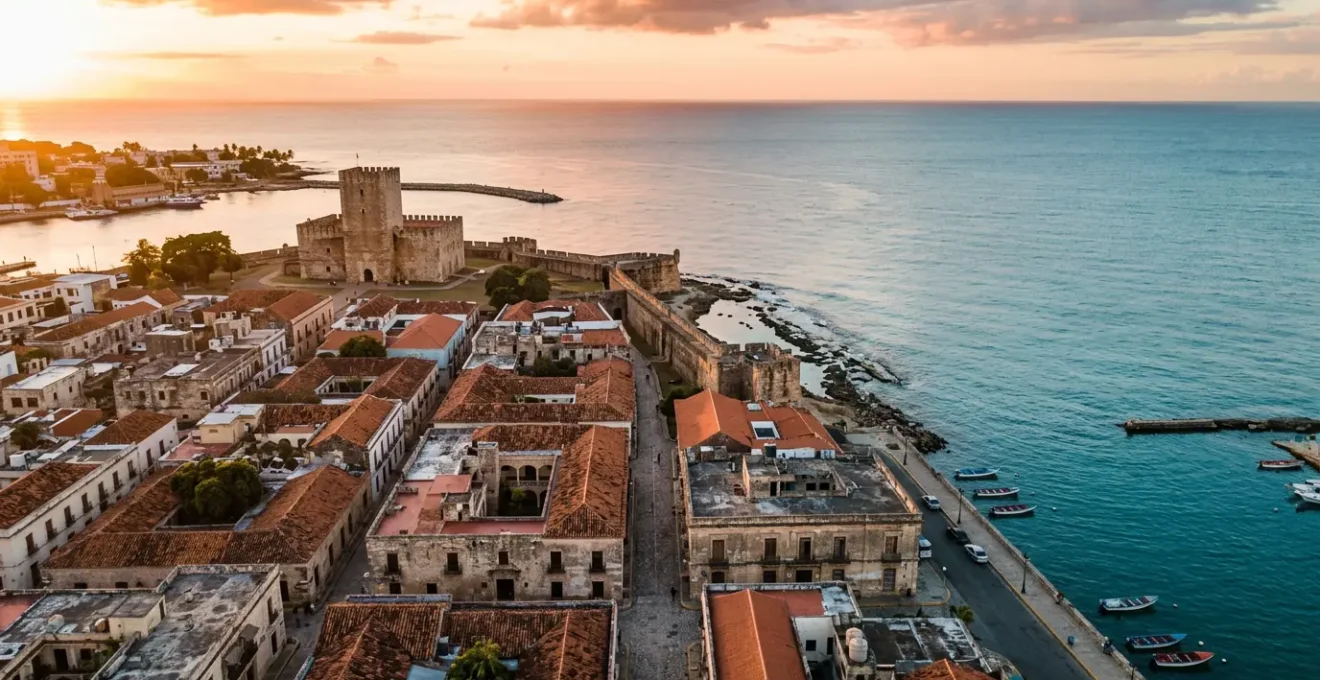
Santo Domingo is more than a list of historical “firsts”; it’s the living blueprint for conquest and civilization in the Americas, and you can still read its secrets in the stone.
- Discover how the city’s grid layout became the strategic DNA for nearly every city in the New World.
- Unravel the multi-century mystery of Christopher Columbus’s tomb and why the controversy is more valuable than the truth.
- Learn how Sir Francis Drake’s 1586 raid wasn’t just piracy, but a forensic lesson that exposed the city’s fatal flaw.
Recommendation: Use this guide to transform your visit from a simple tour into a historical investigation, seeing the city not as a museum, but as a 500-year-old strategic document.
To walk the cobblestone streets of Santo Domingo’s Colonial Zone is to feel the weight of five centuries under your feet. It’s a city that breathes history, where every coral-stone facade and every fortified tower whispers tales of conquistadors, pirates, and pioneers. Many visitors come to check off a list of famous “firsts”—the first cathedral, the first hospital, the first university in the Americas. This is the story everyone knows, the surface-level tour that fills guidebooks.
But for the true history buff, this is only the beginning. The real story of Santo Domingo is far more complex and fascinating. It’s not just about what was built, but *why* it was built that way. This city isn’t a static museum; it was the original laboratory for the European colonization of a hemisphere. It is a colonial blueprint where the ambitions, innovations, and brutal realities of the Age of Discovery were tested and perfected. The very layout of its streets, the design of its defenses, and the legends surrounding its most famous residents are all part of a strategic DNA that would be copied, feared, and challenged for centuries.
Forget the simple checklist. This guide will show you how to see the city through a historian’s eyes. We will move beyond the plaques and monuments to understand the strategic thinking behind them. We will connect the dots between a failed early settlement and the triumph of Santo Domingo’s design, decipher the architectural dialogue between its fortresses, and stand on the very walls that faced the terror of Sir Francis Drake’s invasion. This is your journey into the heart of the New World’s first city, where the ghosts of Columbus and Drake are still waiting to tell their stories.
This article provides a framework for understanding the city’s profound historical layers. The following summary outlines the key areas we will explore to piece together Santo Domingo’s incredible story.
Summary: Decoding the Strategic DNA of America’s First City
- Why Is Santo Domingo Officially Recognized as the “First” City?
- Fortaleza Ozama or The City Walls: Which Defense Structure Tells a Better Story?
- The “Columbus Tomb” Controversy: What Is Fact and What Is Legend?
- How to Use the Museum Pass to Save Money on Historical Sites?
- In What Order Should You Visit the “Firsts” (Cathedral, Hospital, University)?
- How to Visit the Ruins of La Isabela to Understand the First Failed Settlement?
- How to Explore Santo Domingo’s Modern and Ancient Sides in 48 Hours?
- How to Walk the Defensive Walls of Santo Domingo and Understand the Pirate Attacks?
Why Is Santo Domingo Officially Recognized as the “First” City?
The title of “first” is more than just a chronological claim; it’s a declaration of foundational importance. Santo Domingo, founded by Bartholomew Columbus in 1498, was the first permanent European settlement in the Americas, but its true significance lies in being the first deliberate colonial blueprint. Unlike accidental or temporary outposts, this was a city designed to be a seat of power, a template for administration, and a model for all future urban centers in the New World. It was here that the Spanish crown tested the institutions that would govern its vast empire for centuries.
The city’s genius is most visible in its urban planning. In 1502, Governor Nicolás de Ovando laid out the city on a revolutionary grid pattern, a design that was practical, defensible, and easily replicable. This model of straight streets and square blocks became the standard for Spanish colonial towns from Mexico to Argentina. The 1.06 km² Colonial Zone, a UNESCO World Heritage site, is the physical proof of this legacy. Within this grid, Santo Domingo established the keystones of colonial society: the first cathedral (Catedral Primada de América, begun 1512), the first hospital (San Nicolás de Bari, 1503), the first university (Santo Tomás de Aquino, 1538), and the oldest military fortress (Fortaleza Ozama, 1502). These weren’t just buildings; they were instruments of spiritual, social, intellectual, and military control—the full package of European civilization imposed upon a new land.
Therefore, Santo Domingo is “first” not merely for being the oldest, but for being the original prototype from which the urban and administrative landscape of Latin America was born. It was the first chapter in a new book of world history, and its text is written in the stones of the Zona Colonial.
Fortaleza Ozama or The City Walls: Which Defense Structure Tells a Better Story?
Santo Domingo’s defenses tell a fascinating story of evolving threats. This is an architectural dialogue written in stone, with two main characters: the brooding, medieval Fortaleza Ozama and the sprawling, more modern City Walls. Each tells a different tale of power and paranoia. The Fortaleza Ozama, begun in 1502, is the oldest military fortress in the Americas. Its primary feature, the Tower of Homage, is a classic medieval keep. Its purpose was twofold: to control the mouth of the Ozama River, the city’s economic lifeline, and to project royal authority inward, intimidating the populace and suppressing potential rebellions. It is a symbol of internal control and centralized power.
The city walls, constructed later and modified over centuries, tell a different story. They were a direct response to external threats, specifically the rise of piracy and the ambitions of rival European powers. Their design incorporates bastions for cannon warfare, a leap in military technology from the fortress’s simple keep. While Fortaleza Ozama was about securing the port for Spain, the walls were about keeping enemies—like Sir Francis Drake—out of the city itself. They also served a secondary purpose as a tool for customs control, channeling all trade through fortified gates.
This comparative table, based on historical and architectural analysis, highlights their distinct roles. Information from multiple historical sources, including an in-depth walking tour analysis, helps clarify the differences.
| Feature | Fortaleza Ozama (1502) | City Walls & Gates |
|---|---|---|
| Primary Purpose | River mouth control & royal authority | Pirate defense & customs control |
| Construction | Medieval keep design | Bastions for cannon warfare |
| Labor Force | Enslaved Taíno & African workers | Enslaved African workers |
| Strategic Value | Internal control & port security | External threats (Drake’s 1586 attack) |
| Current Access | 70 DOP ($1.24 USD) | Free walking access |
Ultimately, neither structure tells the complete story alone. The Fortaleza Ozama speaks of the initial consolidation of power, while the city walls speak of the struggle to maintain that power against a hostile world. Together, they form a compelling narrative of colonial defense.
The “Columbus Tomb” Controversy: What Is Fact and What Is Legend?
Few historical artifacts in the Americas are as wrapped in mystery and national pride as the purported tomb of Christopher Columbus. The central question—is he buried in Santo Domingo’s monumental Faro a Colón or in the Seville Cathedral in Spain?—is a detective story spanning five centuries and multiple continents. For the history buff, the controversy itself is more revealing than a simple answer. It’s a case study in how history is built, contested, and used to forge national identity. The known facts are a whirlwind of relocations.
The Journey of Columbus’s Remains: A Multi-Century Mystery
Christopher Columbus died in Spain in 1506, but his remains have traveled extensively. Initially buried in a monastery, they were moved to Seville Cathedral in 1513, then transported to Santo Domingo Cathedral in 1536 per his wishes. When France took over Hispaniola in 1793, remains thought to be his were moved to Havana, Cuba. After the Spanish-American War in 1898, those remains were returned to Seville, where DNA testing in the 21st century confirmed they belonged to Columbus. However, the story doesn’t end there. In 1877, workers in the Santo Domingo Cathedral discovered a lead box inscribed “The illustrious and excellent man, Don Colon, Admiral of the Ocean Sea,” containing human remains. The Dominican Republic claims these are the true remains, which were overlooked during the 1793 transfer. They now reside in the massive, cross-shaped Faro a Colón mausoleum, but Dominican authorities have never allowed DNA testing, preserving the enigma.
This creates two plausible, yet competing, burial sites. The scientific evidence points to Seville, but the historical and circumstantial evidence in Santo Domingo cannot be easily dismissed. This ambiguity has become part of the site’s very identity. As one tourism analysis from a Santo Domingo heritage assessment notes:
The ambiguity itself has become a core part of the site’s appeal. The mystery is more engaging for tourism and storytelling than a definitive, boring answer would be, making the controversy a valuable asset.
– Tourism analysis from Santo Domingo heritage documentation, Santo Domingo Colonial Heritage Assessment
Ultimately, the “Columbus Tomb” is a powerful lesson in contested legacy. Whether the bones are authentic or not is almost secondary. The claim itself is a profound statement of national pride and a testament to Santo Domingo’s central role in the Columbian saga.
How to Use the Museum Pass to Save Money on Historical Sites?
For any history enthusiast eager to soak in every detail of the Colonial Zone, the question of a museum pass often arises. While a single pass covering all sites doesn’t always exist in a formalized way, the strategy is about smart planning to maximize your time and budget. Given that the current pricing shows most individual sites charge around 70 DOP (about $1.24 USD), saving money is less about a single ticket and more about a strategic approach to visiting.
The key is to think like a local and plan like a historian. This means being aware of free days, museum closures, and the geographical clustering of sites. Visiting a single museum might be cheap, but costs add up quickly when you plan to visit the dozen or more significant locations in the Zona Colonial. A strategic approach can easily save you 20-30% on entrance fees and, more importantly, save you precious time by avoiding crowds and closed doors. Before purchasing any bundled tickets or passes offered by tour operators, consider this checklist to build your own efficient and economical tour.
Your Action Plan: Maximizing Santo Domingo’s Historical Sites
- Check for free admission days: Many museums offer free entry on the first and last Sunday of each month. Plan your trip around these if possible.
- Avoid Mondays: This is the most crucial rule, as the vast majority of museums and historical sites are closed for maintenance.
- Go early: Arrive between 8 AM and 10 AM to experience the sites with fewer crowds and better morning light for photography.
- Cluster your visits: The Museum of the Dominican Man, the Museum of History and Geography, and the Museum of Modern Art are all located together at the Plaza de la Cultura. Plan to see them on the same day.
- Ask for discounts: Always inquire about reduced prices for students or seniors at the ticket counter, even if not advertised.
- Book online in advance: For high-demand sites, booking tickets online at least 24 hours ahead can guarantee entry and sometimes offer small discounts.
This method transforms your visit from a random series of stops into a well-executed historical expedition, ensuring you spend more time absorbing the past and less time waiting in lines or paying unnecessary fees.
In What Order Should You Visit the “Firsts” (Cathedral, Hospital, University)?
Visiting Santo Domingo’s “firsts” shouldn’t be a random walk, but a curated journey that tells a story. Instead of simply checking sites off a list, you can walk a thematic route that reveals the very structure of colonial society. By visiting the key institutions in a specific order, you can physically trace the pillars of power that the Spanish used to build their empire: spiritual authority, social control, and intellectual justification. This route allows you to read the city’s layout as a text on colonial ambition.
The journey begins with the ultimate symbol of divine right, the Cathedral, and flows through the mechanisms of controlling the body and mind, before ending with a glimpse into the lifestyle of the ruling elite. It’s a walk through the colonial power structure made manifest in architecture.
Here is a suggested thematic walking route that connects these foundational sites into a coherent narrative:
- Start with Spiritual Power: Begin your day at the Catedral Primada de América (construction 1512-1540). Its grand Gothic and Renaissance facade was designed to inspire awe and project the absolute authority of the Catholic Church, the spiritual backbone of the conquest.
- Walk to Social Control: A short walk takes you to the Ruins of the Hospital San Nicolás de Bari (1503). As the first hospital, it represented a more subtle form of power—the control over life, death, and public health, framing the Crown as a benevolent caretaker while reinforcing social order.
- Continue to Intellectual Power: Proceed to the site of the first University, Santo Tomás de Aquino (1538). This was where the colony’s administrators, lawyers, and theologians were trained, creating a loyal local elite to perpetuate Spanish rule.
- Add a Hidden Gem: While walking between these sites, make sure to traverse Calle Las Damas, the first paved street in the Americas, where the colonial elite would promenade.
- End with the Elite: Conclude your tour at the Alcázar de Colón, the palace of Columbus’s son, Diego. This provides a window into the opulent lifestyle of the ruling family, the ultimate beneficiaries of this entire power structure.
This path isn’t just the most efficient; it’s the most insightful, allowing the stones of Santo Domingo to tell you the story of how an empire was built, one institution at a time.
How to Visit the Ruins of La Isabela to Understand the First Failed Settlement?
To truly understand why Santo Domingo succeeded, you must first visit the site of a profound failure: La Isabela. Located on the northern coast of Hispaniola, a day trip away from the capital, the ruins of La Isabela are a masterclass in colonial miscalculation. Visiting this archaeological site provides the crucial prequel to Santo Domingo’s story. It’s an exercise in forensic history, where you can read in the barren landscape the exact mistakes that Governor Ovando was so careful to avoid when he laid the blueprint for the new capital.
La Isabela was the first attempt at a permanent European city in the New World, but it was doomed from the start. Its story serves as the “what not to do” manual for colonization.
La Isabela’s Failure: Lessons That Built Santo Domingo
Villa Isabela was established by Columbus in 1493 as the New World’s first attempted city. The site failed due to a cascade of poor choices: it lacked a safe, defensible harbor; the surrounding land was unsuitable for the European crops the settlers tried to plant; disease outbreaks, including influenza, decimated the population; and brutal policies led to constant, violent conflict with the native Taíno inhabitants. When Nicolás de Ovando founded Santo Domingo in 1502, he systematically addressed each of La Isabela’s failures. He chose a site with a protected harbor at the Ozama River mouth, access to fertile lands for agriculture, and a superior defensive position. The ruins at La Isabela now serve as an essential archaeological study in the fatal errors of early colonial planning.
The physical evidence at the site is hauntingly eloquent. An archaeological overview of the ruins reveals the story without a single word. As one record from the excavation notes, the layout is a ‘forensic crime scene’ of failure. The stone houses for Columbus and the Spanish elite stand apart from the temporary huts of the common settlers, showing a deep social disconnect from day one. The prominent location of the cemetery near the settlement’s center speaks to the horrifically high mortality rate. Most tellingly, the lack of significant fortifications shows a fatal underestimation of both environmental and human threats. Visiting allows you to see, not just read about, the desperate conditions that led to the colony’s collapse within five years.
A trip to La Isabela is not a detour from the story of Santo Domingo; it is the essential first chapter. It transforms your appreciation for the capital from admiration of its age to a deep respect for its calculated, hard-won success.
How to Explore Santo Domingo’s Modern and Ancient Sides in 48 Hours?
Santo Domingo is a city where the 16th and 21st centuries exist in a constant, vibrant dialogue. To experience its true character, you must explore how its ancient heart, the Colonial Zone, pumps life into its modern body. A 48-hour itinerary can be designed not just to see sights, but to trace the echoes of history through the city’s contemporary landscape. The key is to pair historical sites with their modern counterparts, revealing the city’s continuous, evolving narrative. As recent tourism data indicates a surge in curated cultural experiences, this approach aligns perfectly with a deeper, more meaningful way to travel.
This itinerary is a journey through time, showing how decisions made 500 years ago still shape life today. You will see how colonial architecture influenced 20th-century neighborhoods and how the memory of dictatorship is being reclaimed in public spaces.
- Day 1 Morning (The Foundation): Start with a walking tour of the Colonial Zone’s UNESCO sites. Immerse yourself in the 16th century by visiting the Cathedral, Calle Las Damas, and Fortaleza Ozama. This is your historical baseline.
- Day 1 Afternoon (The Echo): Visit the Alcázar de Colón, then step out of the old city into the adjacent Gazcue neighborhood. Here you’ll see how wealthy Dominicans in the early 20th century adapted colonial and European styles into their own grand neocolonial villas.
- Day 1 Evening (Atmosphere): Dine at a restaurant in the beautifully illuminated Plaza de España, overlooking the Ozama River. You’ll be sitting in the shadow of the Alcázar, experiencing the colonial atmosphere as a modern luxury.
- Day 2 Morning (Expansion): Walk a portion of the Malecón, the city’s seaside boulevard. This represents the city’s 20th-century expansion, a deliberate move to embrace the sea and modern urban life, turning its back on the old walled city.
- Day 2 Afternoon (Reckoning): Visit the Plaza de la Cultura, a complex of museums built on the former estate of dictator Rafael Trujillo. Pair this with a visit to the powerful Memorial Museum of Dominican Resistance to understand the country’s struggle for freedom in the 20th century.
- Day 2 Late Afternoon (Identity): Conclude with a visit to the controversial Faro a Colón (Columbus Lighthouse). This massive, brutalist monument from 1992 is a perfect symbol of modern Dominican Republic’s complex and often contentious relationship with its colonial past.
This 48-hour plan ensures you don’t just see Santo Domingo—you understand its journey. You witness how a city grapples with its monumental history while forging a dynamic modern identity.
Key takeaways
- Santo Domingo was more than the first city; it was the strategic and administrative blueprint for the European conquest of the New World.
- The city’s defenses reveal a constant evolution against threats, from internal control (Fortaleza Ozama) to external raids (the city walls).
- The city’s history is a powerful story of learning from failure, as seen in the stark contrast between the doomed settlement of La Isabela and the successful design of the new capital.
How to Walk the Defensive Walls of Santo Domingo and Understand the Pirate Attacks?
Walking the defensive walls of Santo Domingo is more than a scenic stroll; it’s a journey into the heart of 16th-century geopolitics and fear. These battered stone ramparts are a testament to the constant threat posed by pirates, privateers, and rival empires. To truly understand them, one must view them through the eyes of their most famous assailant: Sir Francis Drake. His devastating raid in 1586 was a masterclass in military strategy that brutally exposed the walls’ critical weaknesses and changed the face of Caribbean defense forever.
The story of the attack is not just history; it’s a tactical lesson. The city had prepared for a naval assault, but Drake was a more cunning adversary. This forensic analysis of his raid reveals how he outsmarted the city’s defenses.
Drake’s 1586 Raid: A Strategic Analysis of Santo Domingo’s Defenses
According to historical records from sources like the U.S. Library of Congress, on January 1, 1586, Sir Francis Drake executed a brilliant two-pronged attack. His ships opened fire on Fortaleza Ozama at the harbor entrance, creating a loud and terrifying diversion that drew the city’s defenders to the coast. Under the cover of this feint, his second-in-command, Christopher Carleill, landed 1,000 soldiers undetected at the Haina River, miles to the west. They marched overland and attacked the city from its undefended landward side. The city walls failed because they were designed to repel an attack from the sea; the gates were mere customs checkpoints, useless against a determined land assault. Drake’s forces swarmed into the city, occupying it with little resistance.
Drake occupied Santo Domingo for exactly one month. He was not a simple pirate bent on destruction; he was a privateer, an agent of the English crown, conducting economic warfare. He methodically burned sections of the city to apply pressure, using the magnificent cathedral as his headquarters. The historical record of the negotiations states that “Drake set fire to more buildings and threatened to destroy his own headquarters the oldest church in the whole of the Americas.” This psychological warfare worked. He eventually extracted a crippling ransom of 25,000 ducats (a fortune worth millions today) before departing, leaving the city humiliated and impoverished. The raid was a wake-up call for the entire Spanish Main, proving that no city was safe and forcing a complete rethink of colonial defensive strategy.
When you walk these walls today, you are not just seeing an ancient monument. You are standing on the front line of a 400-year-old crime scene, a place that taught the Spanish Empire a brutal lesson about the difference between perceived strength and actual security. Your visit is an opportunity to read these lessons etched in stone and appreciate the city as a dynamic player in a high-stakes global game.