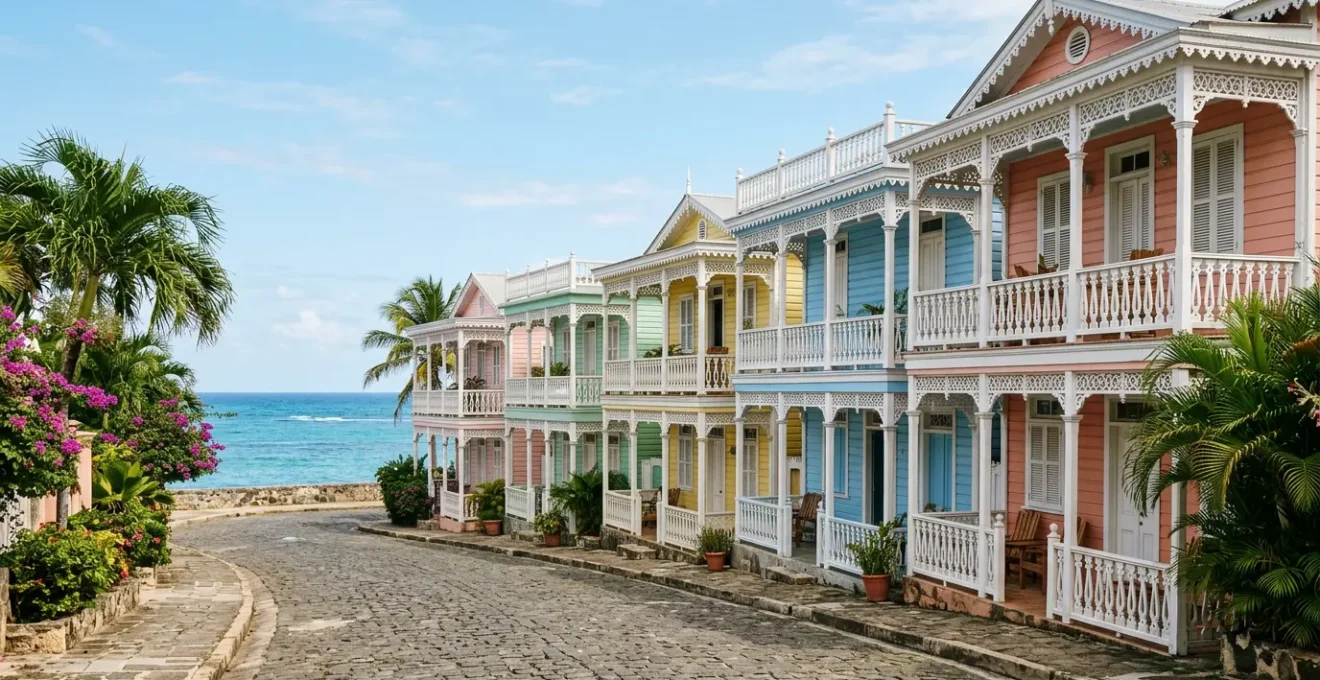
To truly appreciate Puerto Plata’s Victorian architecture, one must adopt a preservationist’s gaze, reading the story of mercantile ambition and Caribbean adaptation in each colorful façade and intricate detail.
- The iconic pastel colors were not just decorative but a public display of wealth and a practical response to intense tropical sun.
- Distinguishing the city’s wooden, asymmetrical Victorian style from the stone, symmetrical Neoclassical forms of Santo Domingo is key to understanding the island’s architectural history.
Recommendation: Plan a thematic walking tour focused on “reading” the architecture—observing fretwork, paint layers, and maintenance challenges—rather than just sightseeing.
For the design lover, Puerto Plata’s historic center presents a living museum, a stark and beautiful contrast to the colonial-era architecture that dominates much of the Caribbean. The question is not merely where to find these iconic Victorian “gingerbread” houses, but how to truly *see* them. Many guides will point you to Calle Beller or the vibrant Umbrella Street, offering a checklist of picturesque spots. They’ll mention the great fire of 1863, which razed the city and paved the way for a prosperous merchant class to rebuild in the fashionable style of the day. This historical fact is the starting point, not the end of the story.
However, a simple walking tour often misses the plot. It overlooks the rich architectural language spoken by these structures. But what if the key to appreciating these wooden gems wasn’t in cataloging locations, but in decoding their very fabric? The true magic lies in shifting your perspective from that of a tourist to that of a preservationist. It involves understanding why a specific shade of yellow was a status symbol, how to differentiate local craftsmanship from imported trends, and recognizing the constant battle against a tropical climate that seeks to reclaim them. This guide is built on that premise. It provides the framework to read the structural legibility of these homes and appreciate the material dialogue between European fashion and Caribbean necessity.
This article provides an analytical toolkit for your exploration. We will delve into the meaning behind the vibrant color palettes, provide a clear method for distinguishing Victorian from Neoclassical styles, and offer professional techniques for capturing their beauty. We’ll examine the preservation challenges and expand our view to surrounding towns, culminating in a plan for a self-guided tour that provides context, not just coordinates.
Summary: A Guide to Puerto Plata’s Gingerbread Architecture
- Why Are Victorian Houses Painted in Pastels and Bright Colors?
- Victorian vs Neoclassical: How to Spot the Difference in Dominican Towns?
- How to Photograph the Wooden Fretwork Details Without Glare?
- The Termite Challenge: How Do Owners Maintain These Wooden Gems?
- 3 Towns Outside Puerto Plata That Have Preserved Vernacular Architecture
- How to Plan a Self-Guided Walking Tour of Historic Streets Without Missing Context?
- How to Plan a Road Trip Across 3 Iconic Provinces Without Getting Stranded?
- How to Photograph the White Sands Without Overexposing Your Shots?
Why Are Victorian Houses Painted in Pastels and Bright Colors?
The vibrant color palette of Puerto Plata’s Victorian district is its most defining characteristic, but it is far more than a simple aesthetic choice. From a preservationist’s viewpoint, these colors are historical documents. The prevalence of bright pastels—sky blues, mint greens, and sunny yellows—is a direct adaptation to the Caribbean environment. Unlike the somber greys and deep burgundies of their European or North American counterparts, these lighter hues were more effective at reflecting intense solar radiation and proved more resistant to fading under the harsh tropical UV exposure. This was a practical consideration of material durability in a challenging climate.
Beyond practicality, color was a powerful expression of mercantile prosperity. In the late 19th century, following the city’s economic boom, imported chemical paints from Europe were expensive and highly sought-after. To paint one’s home in these fashionable, bright colors was a public declaration of wealth and status, a way for the rising merchant class to distinguish themselves. The layers of paint visible on many older structures tell a story of changing fashions and fortunes over decades.
Today, these colors are a cherished part of the city’s identity, but their survival is precarious. Of the original building stock, it’s estimated that fewer than 187 of the 375 original Victorian houses remain. Modern restoration efforts now often involve historical research to identify and replicate the original 19th-century color palettes, ensuring the architectural narrative remains authentic. When you look at these houses, you are seeing a dialogue between climatic necessity, economic ambition, and historical memory, all told through color.
Victorian vs Neoclassical: How to Spot the Difference in Dominican Towns?
A key skill for any architectural enthusiast in the Dominican Republic is the ability to distinguish the mercantile Victorian style of Puerto Plata from the governmental Neoclassical style prevalent in Santo Domingo. This is the foundation of the “preservationist’s gaze.” The two styles tell vastly different stories about the country’s history. Victorian architecture represents the rise of a new, prosperous merchant class in the late 19th century, while Neoclassicism embodies the established power and formal order of the colonial and state government. This distinction is not merely academic; it is visible in the materials, forms, and philosophies of the buildings themselves.
The most immediate difference is the primary material. Puerto Plata’s Victorianism is a celebration of wood, with its iconic, intricate fretwork known as “gingerbread.” This allowed for ornate, individualistic, and often asymmetrical designs. In stark contrast, Neoclassical buildings are defined by the grandeur and permanence of stone and masonry, favoring imposing symmetry and order. The following table, based on an architectural overview of the Dominican Republic, breaks down the key distinguishing features.
| Feature | Victorian (Puerto Plata) | Neoclassical (Santo Domingo) |
|---|---|---|
| Primary Material | Wood with decorative fretwork | Stone and masonry |
| Design Philosophy | Asymmetry and individuality | Symmetry and grandeur |
| Typical Elements | Bay windows, turret roofs, wooden balconies | Columns, porticos, triangular pediments |
| Color Palette | Bright pastels and varied hues | White, cream, or natural stone |
| Social Context | Rising merchant class (1865-1920) | Government and colonial power |
Casa Luperón vs. Colonial Palace: A Direct Architectural Comparison
This contrast is perfectly embodied by comparing two iconic buildings. The Gregorio Luperón Museum in Puerto Plata, a prime example of the local Victorian style, features a wraparound wooden veranda, intricately carved balusters, and a welcoming soft yellow façade. It speaks of domestic comfort and mercantile success. Conversely, Santo Domingo’s neoclassical structures, such as those in the Colonial Zone, often feature imposing stone construction with formal Doric columns and strict symmetry, projecting an image of institutional authority rather than private prosperity, as highlighted by local historical guides.
How to Photograph the Wooden Fretwork Details Without Glare?
Capturing the soul of Puerto Plata’s Victorian architecture means focusing on its most expressive feature: the intricate wooden fretwork, or “gingerbread” trim. However, the combination of glossy paint and the brilliant Caribbean sun creates a significant technical challenge for photographers—glare. These bright reflections can obscure the delicate craftsmanship, turning a detailed pattern into a washed-out white patch. To do justice to this artistry, you must control the light and reflections with a preservationist’s precision.
The single most crucial tool for this task is a circular polarizing filter (CPL). This small accessory, which screws onto the front of your lens, is designed to cut down on reflected light from non-metallic surfaces like painted wood and glass. By rotating the filter while looking through your viewfinder or at your screen, you can visibly reduce or eliminate glare, revealing the true color and texture of the paint and the crisp shadows of the carved wood beneath. As the experts at Urth Magazine note in their guide on architectural photography:
CPL filters are ideal for reducing bright reflections in your images, which distract from or hide important architectural details
– Urth Magazine, Architecture Photography Guide
Beyond using a CPL, your position and lens choice are critical. Shooting from across the street with a moderate telephoto lens (around 85-100mm) helps compress the layers of fretwork on a balcony or veranda, creating a rich, repeating pattern and avoiding the “keystoning” effect (where vertical lines appear to converge) that occurs with wide-angle lenses up close. Also, pay attention to the sun’s position. Use the high Caribbean sun to your advantage by focusing on the intricate shadow patterns the fretwork casts upon the walls, adding another layer of depth and texture to your composition.
The Termite Challenge: How Do Owners Maintain These Wooden Gems?
The beauty of Puerto Plata’s wooden architecture is matched only by its fragility. In a tropical climate, the primary adversary of any wooden structure is the relentless termite. For owners of these historic homes, maintenance is not a periodic task but a constant, ongoing battle. Preserving these 19th-century gems requires a sophisticated blend of traditional craftsmanship and modern science, a testament to the dedication of the city’s residents and preservationists.
The core of the challenge lies in protecting the original timber. Many of these houses were built with resilient local hardwoods, but even these are not immune. Modern preservation techniques focus on prevention and targeted treatment. Borate-based wood treatments, for instance, are a popular choice. They are effective against termites and other wood-boring insects, and because they have low toxicity to humans, they can be applied thoroughly without rendering the building uninhabitable. When original sections are too damaged to save, the real work of a preservationist begins: sourcing period-appropriate wood, often mahogany or other tropical hardwoods, and employing carpenters skilled in traditional joinery techniques to seamlessly integrate the new with the old.
Casa 40 Restaurant: A Successful Victorian Restoration Project
A shining example of successful preservation is the Casa 40 restaurant. This building, dating to around 1900, underwent a complete restoration in 2018. The project meticulously preserved the original Victorian character, including its delicate wooden fretwork. According to a guide on the city’s historic center, the restorers used modern borate treatments to protect the timber from future termite damage while sourcing authentic materials for repairs. Today, its success as a thriving restaurant demonstrates that historic preservation is not only culturally vital but can be economically viable when executed with care.
This commitment to preservation is supported by a legal framework. Since the introduction of a historic preservation law in 1970, private restoration efforts have been encouraged and have gained momentum. This combination of private passion, skilled craftsmanship, and supportive legislation is what keeps these wooden treasures standing for future generations to admire.
3 Towns Outside Puerto Plata That Have Preserved Vernacular Architecture
While Puerto Plata is the undisputed epicenter of Dominican Victorian architecture, the style’s influence radiated along the North Coast, adapting to different local conditions and creating unique architectural vernaculars. For the dedicated design enthusiast, a journey beyond the city reveals how this “high style” was translated and transformed. Exploring these nearby towns provides a deeper understanding of the region’s shared architectural heritage. Three towns, in particular, offer distinct and rewarding experiences for an architectural pilgrimage.
First, Montecristi, about two hours to the west, presents a fascinating frontier interpretation of the Victorian style. Adapted to a more arid climate, its houses often feature distinctive double-height balconies and a more austere, elongated form. The style here feels more rugged, reflecting the town’s history as a hardy outpost. The famous clock tower, designed by Gustave Eiffel, adds a touch of European industrial design to the unique local fabric.
Second, heading east for about 2.5 hours brings you to the Samaná Peninsula, where a different cultural influence is visible. The architecture in towns like Sánchez shows a unique blend of Victorian elements with North American styles. This is due to the 19th-century arrival of English-speaking American Methodist immigrants, who brought their own building traditions. Look for different rooflines and veranda styles that set this area’s vernacular apart from that of Puerto Plata’s primarily European-influenced design. This cultural fusion created a truly unique regional dialect of Caribbean architecture.
Finally, just an hour south of Puerto Plata lies Santiago de los Caballeros. As an inland hub for agriculture, Santiago’s architecture shows a transition from the port city style. While Victorian elements are present, the homes are often characterized by wider, more expansive verandas designed to provide shade and capture breezes, a clear adaptation to the inland heat and a lifestyle centered around the land rather than the sea. This exploration shows how a single architectural style can have widespread influence across the North Coast while being thoughtfully adapted to local life.
How to Plan a Self-Guided Walking Tour of Historic Streets Without Missing Context?
The best way to experience Puerto Plata’s architectural treasures is on foot, but a truly rewarding tour requires more than a map. To avoid simply wandering from one picturesque façade to the next, a preservationist’s approach is to structure the walk thematically. This transforms a simple stroll into an active process of discovery and comparison, allowing you to read the city’s history in its buildings. The key is to move beyond “what” and “where” and focus on “why” and “how.”
Start your orientation at the heart of it all: Parque Independencia. As the local tourism office notes, this central park, with its beautiful Victorian gazebo, is surrounded by some of the most significant buildings and serves as the perfect starting point. From here, instead of following a rigid path, adopt a methodological approach. One effective method is the “Look Up, Look Down, Look Through” technique. Look up at the ornate fretwork and varied rooflines. Look down to find original geometric floor tiles, like those at the historic La Mariposa ice cream shop. Look through open doorways and windows to catch glimpses of interior courtyards (patios), a key feature of this architecture.
Another powerful thematic route is the “Boom and Bust” tour. Start at a beautifully restored gem like La Casita Azul (The Blue House), a symbol of peak prosperity. Then, walk along streets with a mix of maintained and decaying houses, observing the ongoing challenges of preservation. End your walk at a successfully repurposed building, like the Casa 40 restaurant, to see how historic structures can have a vibrant future. This narrative approach connects you to the living story of the city, not just its static past. Incorporate stops like the Fortaleza San Felipe for colonial context and the Amber Museum—housed in a stunning Victorian mansion—to understand the economic engine that funded this architectural boom.
Don’t forget to include modern interventions like Umbrella Street and Paseo de Doña Blanca. While created for photo opportunities, they are set against authentic Victorian backdrops and have become part of the area’s evolving historical narrative. This contextual, thematic approach ensures you leave with a deep appreciation, not just a full camera roll.
Key Takeaways
- Adopt a “preservationist’s gaze” to read the history, economy, and climate adaptations in the architecture.
- The iconic pastel colors were status symbols and a practical response to the tropical climate, not just a decorative choice.
- Mastering the use of a circular polarizing filter (CPL) is essential for photographing the intricate details of the fretwork without glare.
How to Plan a Road Trip Across 3 Iconic Provinces Without Getting Stranded?
Transforming your architectural exploration into a multi-day road trip—an “architectural pilgrimage”—is the ultimate way to witness the evolution of Victorian style across the Dominican Republic’s northern provinces. Such a trip requires more than a destination; it demands practical planning to ensure a smooth and safe journey. The routes connecting Puerto Plata with Santiago, Montecristi, and Samaná are generally well-maintained, but being prepared for local driving conditions and logistics is paramount.
The most important consideration is fuel and services. While major highways are reliable, smaller coastal or mountain roads can have long stretches without gas stations. A prime example is the beautiful coastal road to Montecristi. As noted in a guide for architectural routes, it’s wise to fill your tank at the Texaco station in Luperón, as it’s the last reliable fuel stop before reaching Montecristi. Similarly, always be vigilant for unmarked speed bumps (“policías muertos” or “sleeping policemen”), which are common in small towns and can cause serious damage if hit at speed.
Secondly, understanding travel times versus distance is crucial. The drive to Samaná, for instance, involves navigating mountain curves, which can significantly increase your travel time compared to a highway route of a similar distance. Using a logistics-focused approach can help you plan your itinerary, photography stops, and overnight stays effectively.
This table provides a practical overview for planning your architectural road trip from Puerto Plata:
| Route | Distance | Drive Time | Road Conditions | Key Stops |
|---|---|---|---|---|
| Puerto Plata-Santiago | 70km | 1 hour | Excellent highway | Navarrete junction |
| Puerto Plata-Montecristi | 180km | 2.5 hours | Good coastal road | Luperón (fuel), La Isabela |
| Puerto Plata-Samaná | 240km | 3 hours | Mountain curves | Sánchez Victorian houses |
How to Photograph the White Sands Without Overexposing Your Shots?
While the primary focus for a design lover is the architecture, the story of Puerto Plata’s Victorian style is incomplete without its coastal context. The juxtaposition of ornate, colorful man-made structures against the brilliant white sands and turquoise waters of the Caribbean is a powerful visual narrative. However, photographing this scene presents a significant technical hurdle: managing the extreme dynamic range. The bright sand and water can easily trick your camera’s meter, leading to overexposed, detail-less beaches or, conversely, dark, silhouetted buildings. The challenge is to balance both elements in a single, compelling frame.
The key is to prioritize the preservation of detail in the highlights—the sand and water. It’s much easier to recover detail from shadows in post-processing than to reclaim information from “blown-out” highlights. Therefore, a professional approach is to deliberately underexpose your shot by 1 to 2 stops. This will make the overall image appear darker on your screen, but it will ensure the vibrant colors of the houses and the subtle textures of the sand are retained. The use of a polarizing filter becomes doubly important here, as it reduces glare on both the painted houses and the surface of the water, enhancing color saturation across the entire scene.
Compositionally, aim to create a dialogue between the architecture and the sea. Use a wide-angle lens (around 24mm) to frame a shot that includes a Victorian balcony or fretwork in the foreground, with the beach and ocean extending into the background. This creates a strong sense of place. The best light for this is during the “golden hour”—the hour after sunrise or before sunset. The warm, soft light of this time complements the pastel house colors beautifully and dramatically reduces the harsh contrast you’d find at midday.
Your Action Plan: Juxtaposing Architecture and Coastline
- Filter for Control: Mount a circular polarizing filter (CPL) to reduce glare on both the bright sand/water and the colorful painted Victorian houses simultaneously.
- Prioritize Highlights: Intentionally underexpose your camera by 1-2 stops to retain all the detail in the white sand, even if the buildings look a bit dark in the viewfinder.
- Compose for Context: Use a wide-angle lens (e.g., 24mm) to frame shots that place Victorian balconies or architectural details in the foreground with the ocean visible in the background.
- Wait for Golden Hour: Shoot during the first or last hour of sunlight when the warm light complements the pastel house colors and reduces the harsh contrast on the beach.
- Frame the Narrative: Create ‘sense of place’ shots by including the full Victorian houses along with elements of beach life or street vendors to add context and story to the image.
Now, equipped with this preservationist’s toolkit—an eye for stylistic differences, a method for contextual exploration, and the technical skills to capture it all—you are ready. Go beyond being a spectator and become an active reader of this remarkable architectural landscape.