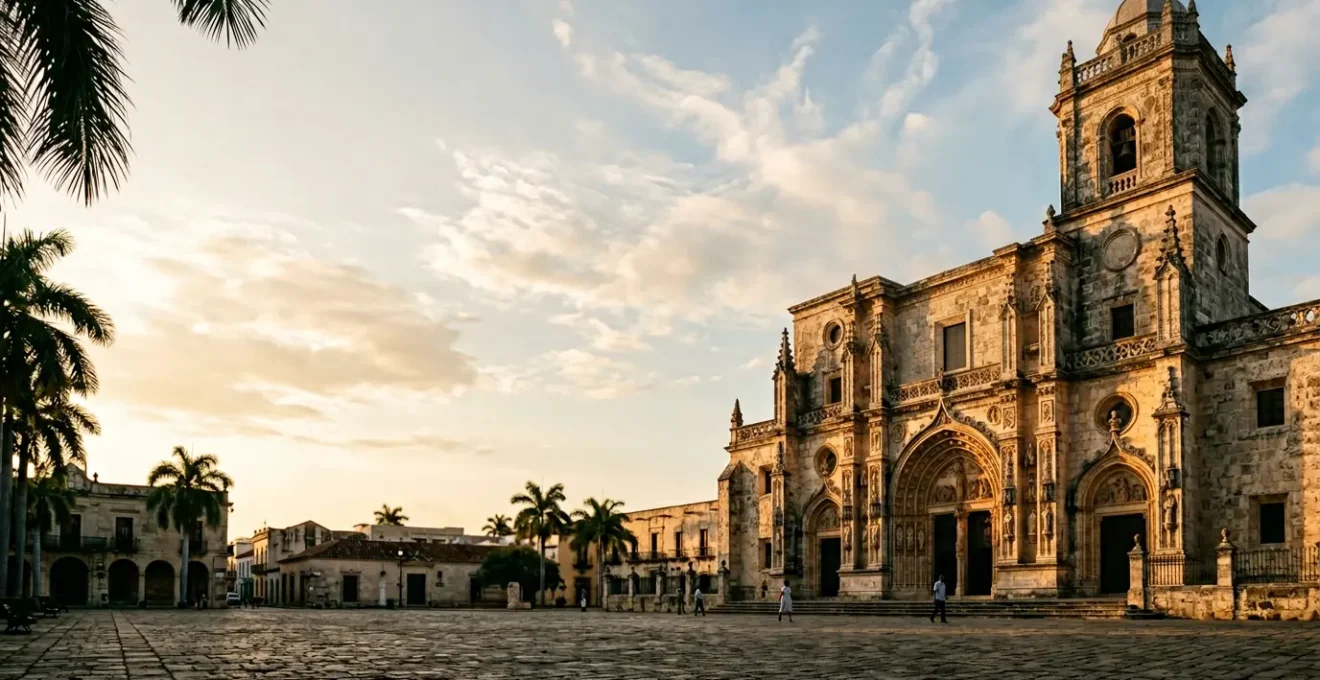
The uniqueness of Dominican Baroque lies not in a single, pure style, but in its layered, pragmatic response to conflict, climate, and its status as the New World’s first European city.
- Early Gothic and Plateresque foundations were constantly overlaid with Baroque elements, often as pragmatic repairs after devastating pirate attacks.
- The tropical climate and local coral limestone are not just materials but active agents, shaping the architecture’s appearance, texture, and preservation challenges.
Recommendation: To truly appreciate these buildings, one must learn to read them as historical documents, tracing the lines of both ambitious builders like the Columbus family and disruptive forces like Sir Francis Drake.
When one imagines Spanish colonial architecture, a familiar picture often emerges: sun-bleached stucco walls, terracotta-tiled roofs, and perhaps a tranquil inner courtyard. Santo Domingo, the first permanent European settlement in the Americas, certainly possesses these elements. Yet, to see its architectural heritage as merely a textbook example is to miss the drama etched into its every stone. Many guides point to the famous landmarks, but few explain why they look the way they do—a complex visual story that goes far beyond simple aesthetics.
The common approach is to catalogue styles—a touch of Gothic here, a hint of Renaissance there. But this fails to capture the dynamic forces at play. The true narrative of Santo Domingo’s architecture is not one of static design, but of adaptation, reaction, and survival. What if the key to understanding this unique architectural dialect wasn’t in identifying pure styles, but in deciphering an architectural palimpsest, where layers of history are written, erased, and rewritten over one another?
This guide moves beyond the surface to explore the very forces that forged the Dominican Baroque. We will examine how military necessity, a demanding tropical climate, and the city’s role as a religious and administrative center created a style that is resilient, pragmatic, and profoundly expressive of its history. By understanding these influences, you will learn to read the city’s walls not as inert structures, but as a living testament to five centuries of ambition, conflict, and faith.
To fully appreciate this complex architectural narrative, we will delve into the specific details that define Santo Domingo’s character. The following sections break down everything from spotting international influences on facades to tracing the footsteps of the city’s most famous builders and breakers, providing a comprehensive framework for your own architectural exploration.
Summary: A Field Guide to Santo Domingo’s Architectural DNA
- Spanish vs French Influence: How to Spot the Difference in Facades?
- How to Visit the Cathedral Primada Without Being Disrespectful?
- The Challenge of Maintaining limestone Buildings in a Tropical Climate
- 3 Baroque Buildings That Are Not on the Main Tourist Map
- When Does the Sun Highlight the Reliefs of the Alcázar?
- How to Walk the Defensive Walls of Santo Domingo and Understand the Pirate Attacks?
- How to Plan a Self-Guided Walking Tour of Historic Streets Without Missing Context?
- How to Trace the Steps of Columbus and Drake in the First City?
Spanish vs French Influence: How to Spot the Difference in Facades?
At first glance, Caribbean colonial architecture can seem like a homogenous blend of European styles adapted for the tropics. However, a trained eye can easily distinguish between the approaches of the two main colonial powers: Spain and France. The difference is a matter of philosophy, reflecting distinct priorities of defense versus social display. Spanish colonial architecture, particularly in a strategic outpost like Santo Domingo, is fundamentally inward-facing. Buildings turn their backs to the street with thick, fortress-like walls and small, shuttered windows, focusing life around a private interior courtyard or *placita*. This design prioritizes security, privacy, and thermal control in a hot climate.
In contrast, French colonial architecture is outward-facing, designed for ventilation and social interaction. Its hallmarks are tall French doors, wraparound verandas (*galleries*), and intricate wrought-iron balconies. The entire structure is oriented towards the outside world, inviting breezes and public life in. The key lies in observing the building’s posture: a Spanish building feels like a private fortress, while a French one feels like an open stage. This fundamental difference in orientation is the most reliable indicator when deciphering the architectural lineage of a colonial structure.
Action Plan: A Visual Spotter’s Guide
- Observe Wall Thickness and Openings: Are the walls thick stucco (12-24 inches) with small, recessed windows? This points to Spanish design focused on defense and insulation. Are there tall, numerous French doors opening onto a gallery? This indicates a French emphasis on ventilation.
- Check for Interior vs. Exterior Spaces: Does the building’s primary living space seem to be an interior, protected courtyard (a Spanish *placita*)? Or is it a wraparound, exterior-facing veranda (a French *gallery*)?
- Identify Key Materials: Look for coral limestone, adobe, and heavy wooden doors which are characteristic of Spanish construction. A lighter wood frame and decorative wrought-iron are more typical of French design.
- Analyze the Overall Orientation: Does the building present a solid, defensive face to the street (Spanish)? Or does it open itself up with porches and balconies for social display and airflow (French)?
- Contextualize the “Why”: Remember the core difference. Spanish architecture faces inward for defense and privacy, while French architecture faces outward for ventilation and social engagement.
By applying this mental checklist, you can begin to read the urban fabric of any colonial city, identifying the cultural and strategic priorities that shaped its very form.
How to Visit the Cathedral Primada Without Being Disrespectful?
Visiting the Catedral Primada de América, the first cathedral of the New World, is an essential pilgrimage for any architecture enthusiast. However, appreciating its ribbed Gothic vaults and ornate chapels requires more than an aesthetic eye; it demands an understanding of its continuing purpose. The key to a respectful visit is to recognize that you are not entering a museum. You are stepping into a living, breathing house of worship with over 500 years of unbroken liturgical function. The hushed tones, the scent of old incense, the quiet prayers of the faithful—these are not historical reenactments. They are the contemporary reality of the space.
Respect here is an act of historical acknowledgment. The rules—modest dress covering shoulders and knees, silence during services, no flash photography—are not arbitrary restrictions. They are invitations to align your behavior with the building’s primary identity as a sacred space. Observing the dress code isn’t just about following a rule on a sign; it’s about honoring the generations of faithful who have considered this ground holy. Turning off your phone’s ringer is a nod to the fact that someone’s prayer is more important than your notification. This perspective transforms a list of “don’ts” into a meaningful “how-to” for engaging with the building on its own terms.
Case Study: The Cathedral as a Living Sacred Space
The Cathedral of Santa María la Menor, consecrated in 1540, serves as the first and still-active diocese in the Americas. As the cathedral of the Archbishop of Santo Domingo, it holds the title ‘Primate of the Indies’ and remains a functioning place of worship with daily masses. According to a guide on pilgrimages to the historic site, this dual role as a world-renowned tourist attraction and an active sacred space requires visitors to consciously acknowledge its continuous religious function. Behaving respectfully is therefore not merely about obeying rules, but about participating in an act of historical acknowledgment that honors a five-century legacy.
Ultimately, the most profound way to experience the Cathedral Primada is to observe it in its native state: during a service. Seeing the Gothic architecture not as a static backdrop but as an active container for a living faith is the truest way to understand its power and endurance.
The Challenge of Maintaining limestone Buildings in a Tropical Climate
The beautiful, golden-hued coral limestone that gives Santo Domingo’s Colonial Zone its distinctive glow is also the source of its greatest conservation challenge. This material, while readily available and easy to carve, is highly porous. In a tropical climate with constant high humidity and salt-laden sea spray, this porosity becomes a critical vulnerability. The stone acts like a sponge, drawing in moisture and airborne salts from the Caribbean Sea. This begins a relentless cycle of decay that defines the city’s climatic vernacular and presents a constant battle for preservationists.
The primary enemy is salt. As salty moisture seeps into the limestone’s pores and then evaporates in the sun, the salt crystallizes and expands. This process, known as subflorescence, exerts immense internal pressure, causing the stone’s surface to flake and crumble from within. Furthermore, the constant humidity, often hovering between 70-80%, creates an ideal breeding ground for what preservationists call acid-secreting microflora. Algae, fungi, and lichen colonize the stone’s surface, their biological processes producing acids that literally eat away at the calcium carbonate, leaving behind a pitted, darkened patina.
As Professor Simon Mitchell of the University of the West Indies explains, Caribbean limestone is uniquely susceptible because it often contains clay, which further complicates moisture retention. The fight against this decay is a high-tech one, and modern conservation efforts have evolved significantly. Today, a combination of laser cleaning and the application of sacrificial mortars are standard practice. These special mortars are designed to be weaker and more porous than the original stone, so they absorb the salt and moisture, crumbling away over time and “sacrificing” themselves to save the historic fabric underneath.
When you walk through the Colonial Zone and see the mottled, textured surfaces of the ancient walls, you are not just seeing age; you are witnessing a dynamic, ongoing chemical and biological process that is as much a part of the city’s character as its architecture.
3 Baroque Buildings That Are Not on the Main Tourist Map
While the Cathedral and the Alcázar de Colón are magnificent and essential visits, some of Santo Domingo’s most intriguing architectural stories are found in less-frequented structures. These buildings reveal the nuances of the Dominican Baroque and the city’s layered history. To get off the beaten path, an architecture enthusiast should seek out these three significant sites:
First, the Convento de los Dominicos (1510-1530). While its construction predates the high Baroque period, its Chapel of Nuestra Señora del Rosario is a marvel. The chapel’s vault is uniquely decorated with signs of the zodiac, a fascinating blend of Catholic faith and astrological symbolism, making it one of only three such examples worldwide. The convent’s facade, with its ceramic accents and a small rose window, shows an early and distinct decorative impulse. Critically, this site also became the location of the first university in the New World in 1538, marking it as a cradle of both faith and knowledge.
Second, the ruins of the Hospital de San Nicolás de Bari (1503). As the first hospital in the Americas, its historical significance is immense. Today, its skeletal remains offer an unparalleled opportunity for architectural forensics. Visitors can see the exposed construction, measure the thickness of the original walls, and understand the foundational techniques of early colonial building in a way that is impossible with finished, plastered structures. It is a raw, deconstructed lesson in 16th-century engineering.
Case Study: The National Pantheon as an Architectural Palimpsest
The National Pantheon of the Dominican Republic perfectly exemplifies the city’s layered architectural evolution. Originally constructed as a Jesuit church in the 18th century, it incorporated clear Baroque elements in its design. According to a historical overview of the city, the structure demonstrates how the Baroque style appeared later in Santo Domingo’s development, often used in the reconstruction and redecoration of churches. This contrasts sharply with the earlier Isabelline Gothic of the Cathedral (1512-1514) or the Renaissance-Mudéjar style of the Alcázar de Colón (1510-1514), showing a clear timeline of stylistic development on the island.
Finally, the Casa de Tostado offers a glimpse into a domestic space marked by history and tragedy. Its most famous feature is a rare Isabelline Gothic double window (*ventana geminada*), a beautiful and delicate architectural element. This detail is made all the more poignant by the story of its owner, the writer Francisco Tostado, who was tragically killed by a cannonball from Sir Francis Drake’s 1586 siege while standing near this very window.
Together, these three locations form a powerful triptych, showcasing the intersection of faith, science, and domestic life, all shaped by the unique historical pressures of the first city.
When Does the Sun Highlight the Reliefs of the Alcázar?
For the architecture enthusiast or photographer, light is not merely illumination; it is a tool that reveals texture, form, and detail. In Santo Domingo, the intense Caribbean sun can either flatten architectural features with harsh overhead light or sculpt them dramatically. The key to capturing the beauty of the Alcázar de Colón, with its delicate Plateresque reliefs, is to visit when the sun is at a low angle, a technique known as using raking light. This type of light casts long shadows, transforming subtle carvings into a high-contrast spectacle of chiaroscuro.
The ideal time to witness this effect on the Alcázar’s main, east-facing facade is during the early morning, specifically between 7 AM and 8 AM. At this hour, the rising sun hits the limestone walls from the side, catching the edges of the Renaissance and Mudéjar-influenced carvings. The intricate floral motifs, coats of arms, and delicate tracery, which can appear washed-out at midday, suddenly pop with depth and dimensionality. The golden tint of the coral limestone is also at its most saturated during this “golden hour,” providing a rich, warm palette for observation and photography.
A photographic itinerary for capturing the Colonial Zone would logically start here. After the Alcázar, one might move to the Cathedral around 9 AM to catch its facade illuminated from the angle of Parque Colón. By mid-morning, the angled light is perfect for the details along Calle Las Damas. For photographers, the intense sun allows for a deep depth of field (f/8-f/11) to ensure maximum sharpness across the entire facade, while still maintaining a fast enough shutter speed to shoot handheld. Timing your visit isn’t just about avoiding crowds; it’s a strategic choice to see the architecture as it was meant to be seen, fully articulated by light and shadow.
This deliberate use of light transforms architectural viewing from a passive activity into an active pursuit of a building’s hidden character, revealed only for a few fleeting hours each day.
How to Walk the Defensive Walls of Santo Domingo and Understand the Pirate Attacks?
To walk the *muralla*, the defensive walls of Santo Domingo, is to trace a history of fear and resilience. These fortifications are not a single, static project but a dynamic response to escalating threats, most notably from pirates and privateers. The key to understanding them is to see the walls not as a single entity, but as a structure with a clear “before and after,” with the pivotal event being the 1586 assault by Sir Francis Drake. This attack was a traumatic turning point that fundamentally reshaped the city’s concept of defense.
The original fortifications, including the 1502 Fortaleza Ozama, were built to an austere, medieval military standard. They proved woefully inadequate against Drake’s modern artillery and tactics. During his month-long occupation, Drake famously used the nave of the Cathedral Primada as his headquarters, a profane act that added insult to injury. The ransom he exacted was a fortune, but the lesson he taught was priceless: Santo Domingo was vulnerable. As a result, the Spanish Crown funded a massive upgrade of the city’s defenses, creating the robust system we see today. The pirate, in effect, became a co-architect of the city’s final defensive form.
A strategic walking tour should start at the Fortaleza Ozama to appreciate the original, simpler design. From there, follow the *muralla* and look for evidence of the post-Drake reinforcements. The walls become noticeably thicker, and you will see the introduction of angled bastions. These were a critical innovation allowing for overlapping fields of fire, ensuring there were no blind spots where attackers could shelter. Examine the narrow gates, designed as deadly chokepoints to funnel attackers into kill zones. Notice the placement of the *garitas*, or sentry boxes, positioned for maximum visibility of the Caribbean approaches. This walk is more than a scenic stroll; it’s a lesson in the evolution of military architecture, driven by the very real threat of piracy.
Every thickened wall and angled bastion on your walk tells a story of the 1586 raid, a stone-and-mortar testament to a city that vowed never to be so vulnerable again.
How to Plan a Self-Guided Walking Tour of Historic Streets Without Missing Context?
A self-guided tour of Santo Domingo’s Colonial Zone can be far more rewarding than simply following a map from one point to another. For the architecture enthusiast, the goal is to uncover the deeper narrative of the city. To do this, you must trade a purely geographical itinerary for a thematic one. Instead of just walking down Calle Las Damas, you can choose to follow a “Power & Control Route” or a “Faith & Knowledge Route,” turning your walk into a focused investigation.
A “Power & Control” tour might connect the Fortaleza Ozama (military power), the Museo de las Casas Reales (administrative power), and the Alcázar de Colón (dynastic power). This route, taking about two hours, tells the story of how the Spanish established and maintained control. A “Faith & Knowledge” tour would link the Cathedral, the Convento de los Dominicos, and the site of the first university, illustrating the intertwined mission of religious conversion and intellectual expansion. This approach allows you to see the buildings not as isolated monuments, but as nodes in a network of colonial ambition.
Beyond thematic routes, become a “street detective.” Pay attention to the ground beneath your feet: are you walking on original *adoquines* cobblestones or modern pavers? This tells you which sections are most historically intact. Most importantly, learn to analyze the buildings themselves as timelines. A single structure might feature Gothic arches from its original construction, symmetrical Renaissance windows from a 16th-century renovation, and an ornate Baroque facade or altar added in the 1600s. This architectural stratigraphy is the ultimate contextual clue.
To aid in this analysis, a simple recognition guide is invaluable. This allows you to quickly identify the stylistic evidence you encounter. As outlined in a comparative analysis of Spanish Colonial architecture, the key features are distinct:
| Period | Key Features | Example Building |
|---|---|---|
| Gothic (1504-1540) | Ribbed vaults, pointed arches | Cathedral nave |
| Renaissance (1540-1600) | Symmetry, classical orders | Alcázar facade |
| Baroque (1600s+) | Ornate decoration, curves | Church altars |
Your walk through the Colonial Zone will transform from a simple sightseeing excursion into a dynamic process of discovery, where every street corner offers a new clue to the city’s complex past.
Key takeaways
- The Dominican architectural style is a palimpsest, where early Gothic and Renaissance forms are constantly overlaid with Baroque elements, often as a direct result of repairs after attacks.
- The local coral limestone and tropical climate are not passive elements; they are active agents that dictate the texture, weathering, and ongoing preservation challenges of the buildings.
- To truly read the city, one must trace the dual narrative of its builders (like the Columbus family) and its breakers (like Sir Francis Drake), whose actions are both etched into the stone.
How to Trace the Steps of Columbus and Drake in the First City?
To trace the steps of Christopher Columbus and Sir Francis Drake through Santo Domingo is to walk a path of creation and destruction, ambition and violation. These two figures represent the poles of the city’s early history, and their legacies are physically intertwined in the city’s oldest stones, particularly at the Cathedral Primada. This dual narrative of the builder and the breaker is the most powerful lens through which to view the Colonial Zone.
The Columbus trail is one of establishment. Start at the Alcázar de Colón, the palace-fortress built for his son, Diego Columbus, who served as governor. This was the seat of the Columbus dynasty and the center of Spanish power in the early 16th century. From there, proceed to the Cathedral, where Diego Columbus laid the first stone in 1514. For centuries, this sacred space housed the supposed remains of Christopher Columbus himself, cementing his family’s legacy as the founders of this new world. Your walk culminates at the Parque Colón, where a statue of the Admiral presides over the city he never saw in its completed form, but whose existence he made possible.
The Drake trail is one of desecration and, paradoxically, of architectural impetus. In 1586, the English privateer shattered the city’s sense of security. His route of destruction can be traced from the breach point at the Fortaleza Ozama, through the merchant houses on Calle Las Damas that he plundered, to his audacious headquarters in the nave of the Cathedral itself. The damage he inflicted necessitated the massive Baroque-era restorations and fortifications seen throughout the city today. When you see a reinforced wall or a rebuilt chapel, you are, in a sense, looking at Drake’s handiwork. One of the most poignant intersections is the Cathedral’s Gothic-Plateresque main gate; commissioned by Charles V, it welcomed holy processions and, decades later, was stormed by pirate occupation.
By actively looking for the marks of both Columbus’s ambition and Drake’s assault, you begin to understand the core tension that forged Santo Domingo’s unique and resilient architectural identity.