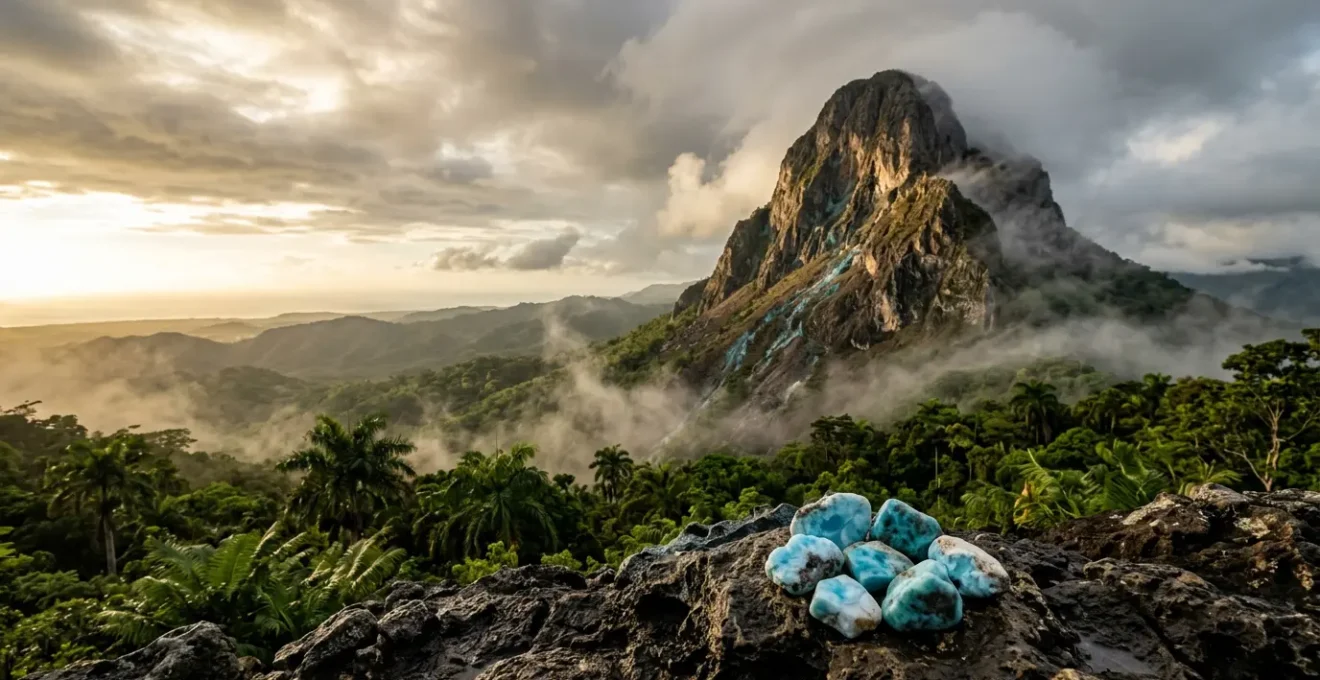
Larimar’s existence in a single location is a geological miracle, but its true mystique lies in the direct connection between its violent volcanic creation and its profound calming energy.
- The stone is a product of a unique volcanic “crucible” that occurred only once in the Bahoruco mountains, making it a true terrestrial anomaly.
- Its spiritual properties are not random; they are a metaphysical echo of its birth, balancing the fire of volcanoes with the serenity of the Caribbean Sea.
Recommendation: To truly understand Larimar, one must explore its full story—from the perilous mines where it’s born to the wellness journeys it inspires across the island.
The allure of Larimar, the “Atlantis Stone,” begins with a simple, baffling fact: it is found in only one place on Earth, a single square kilometer of a remote mountain in the Dominican Republic. As a geologist, I can explain the science—a rare confluence of volcanic vents, specific minerals, and hydrothermal fluid creating a unique blue pectolite. This explains the ‘how’. Yet, many stop there, missing the deeper truth. They see the rarity but overlook the profound meaning behind its genesis.
As a crystal healer, I see beyond the mineralogy. The common narrative focuses on its calming, cooling energy, linking it to the throat chakra and clear communication. But what if this tranquility isn’t just a passive quality? What if it is the direct, potent result of its chaotic birth? The true mystique of Larimar is this paradox: it is a stone of supreme serenity forged in volcanic fire. Its energy is a metaphysical echo of its unique origin story, a testament to balance born from terrestrial violence.
This guide delves into that duality. We will explore the geological crucible where Larimar is formed, the immense human risk involved in its extraction, and its resulting value. We will then connect this physical reality to its spiritual resonance, showing you how to distinguish the real from the fake, build a wellness journey around its energy, and safely explore the other telluric wonders of this incredible island. This is the story of a stone that is the very soul of the land from which it comes.
To fully appreciate the journey this stone represents, from the depths of the earth to its place as a spiritual talisman, this article breaks down every facet of its story. The following summary outlines our exploration into the world of Larimar and the Dominican treasures that surround it.
Summary: The Complete Guide to Larimar and the Dominican Republic’s Geological Wonders
- How Dangerous Is the Larimar Mining Process in Barahona?
- What Healing Properties Do Locals Attribute to Larimar?
- Volcanic Blue vs Sky Blue: Which Shade Is the “AAA” Grade?
- Can You Buy Rough Larimar Slabs and Export Them Legally?
- How to Take a Tour of the Larimar Mines in Bahoruco?
- How to Distinguish Real Amber from Plastic Fakes in Gift Shops?
- How to Build a Wellness Itinerary That Actually Reduces Stress?
- How to Visit the Cueva de las Maravillas and Other Caves Safely?
How Dangerous Is the Larimar Mining Process in Barahona?
Before a single piece of Larimar can be polished into a serene blue gem, it must be won from the earth through a process that is anything but tranquil. The story of Larimar is written not just in its beautiful patterns, but in the sweat and peril of the miners of Barahona. The mining conditions are a stark reminder of the “volcanic soul” of this stone; it comes from a place of intense pressure, heat, and danger. The mines are not large, industrial operations but a network of narrow, hand-dug shafts that plunge deep into the mountain.
The conditions are stark and physically demanding. An Associated Press report paints a vivid picture, noting that mud-covered men squirm through tight spaces in suffocating heat, often with minimal light and ventilation. These passages can descend as far as 120 meters (395 feet) below the surface, where the risk of collapse and asphyxiation is a constant threat.
The mines can run as deep as 120 meters (395 feet). Mud-covered men squirm through tight spaces in suffocating heat with only a string of dim lightbulbs in some parts of the passages.
– Associated Press, Fox News
This danger is not theoretical. The history of the mines is marked by tragedy, which led to increased state involvement to improve safety. Official records show that at least 30 workers have died since operations began. Specific incidents underscore the risks; in 2006, four workers died from asphyxiation, and two more were lost in a separate accident in 2013. This harsh reality—the human cost of its extraction—is intrinsically part of Larimar’s story. The tranquility it offers is born directly from this terrestrial struggle, a profound balance of chaos and calm.
What Healing Properties Do Locals Attribute to Larimar?
Once extracted from its fiery volcanic cradle, Larimar’s energy transforms. Its sky-blue patterns, reminiscent of sunlight on Caribbean waters, speak to its deep connection with the ocean and its associated sense of peace. This is the “aqueous serenity” that balances its volcanic soul. As a healer, I’ve seen its profound effect, but it’s important to separate local tradition and spiritual belief from empirical science. While some sources correctly note that the stone has no scientifically proven “magical” properties, this misses the point. Its power lies in its role as a symbolic and energetic talisman.
For those who work with crystal energies, Larimar is considered a master stone for the throat chakra, the center of communication. It is believed to help dissolve emotional blockages, promote open and honest expression, and calm heated tempers. This quality makes perfect sense when viewed through the lens of its origin: a stone born of intense heat that now brings a cooling, calming influence. It encourages you to speak your truth with clarity and compassion. Many users also report that meditating with Larimar can induce a state of deep relaxation, washing away stress and fear like the tide cleanses the sand. Before using, it’s often recommended to gently cleanse the stone in cool, running water, but avoid harsh chemicals or prolonged sunlight, which can cause its delicate color to fade.
While the spiritual meanings of crystals and special stones are a matter of belief and speculation, the confirmed scientific properties of Larimar stones do not register any magical properties.
– FinestResorts.com
This distinction between science and belief is key. Larimar’s healing properties are not a function of magic but a metaphysical resonance. It embodies the principle of balance—fire and water, chaos and peace, deep earth and open sky. Holding it is a tactile reminder that tranquility can emerge from the most turbulent of origins.
Volcanic Blue vs Sky Blue: Which Shade Is the “AAA” Grade?
Not all Larimar is created equal. The value and desirability of a piece are determined by a clear grading system, primarily based on its color. The most coveted and valuable shade is known as “Volcanic Blue.” This is not a light, sky-blue hue but a deep, intense, and almost electric blue, often interwoven with intricate white patterns that resemble a turtle’s back or sunlight dappling on the ocean floor. This ‘AAA’ grade is exceptionally rare, representing the pinnacle of Larimar quality.
The rarity of this deep blue color is directly tied to the geology of the mine. The initial discoveries of Larimar were surface-level or from shallow pits. However, as demand grew, miners had to dig deeper. It’s in these deeper, more dangerous veins that the most intensely colored pectolite is found. Twenty years ago, mining occurred at shallow depths, but now, the mine shafts now have to go more than 600 feet underground to find high-quality deposits. This geological reality means that the most beautiful “Volcanic Blue” stones are also the most difficult and perilous to extract, directly linking their immense value to the risk involved.
To understand the nuances, it’s helpful to see the grades side-by-side. The differences in saturation, pattern, and the presence of other minerals (like green or red spots) determine a stone’s classification from the highest ‘AAA’ to the more common ‘B’ grade, as detailed in this comparative quality grading system.
| Grade | Color Characteristics | Pattern Quality | Rarity |
|---|---|---|---|
| AAA (Volcanic Blue) | Deep blue, intense saturation | Intricate ‘turtleback’ patterns | Extremely rare |
| AA | Medium to deep blue | Clear patterns, minimal inclusions | Rare |
| A | Light to medium blue | Some white streaking | Common |
| B | Pale blue to whitish | Heavy white patterns, possible green/red spots | Most common |
When choosing Larimar, a higher grade like ‘AAA’ or ‘AA’ guarantees not only a more stunning visual but also a piece that represents the deepest, most potent heart of the volcanic formation. It’s the color of the abyss, not just the sky.
Can You Buy Rough Larimar Slabs and Export Them Legally?
Bringing a piece of this geological wonder home is a powerful way to stay connected to its energy. While finished jewelry is widely available, many enthusiasts and artisans are interested in purchasing rough, unpolished slabs of Larimar directly. This is indeed possible and legal, but it requires navigating the local market with awareness and respect. The mineral rights for Larimar belong to the Dominican government, but in a unique arrangement, many local miners organized a cooperative, and have entered into a 75-year lease on the mine. Buying directly from these authorized cooperatives or established, reputable shops ensures your purchase supports the local community.
Exporting Larimar for personal use is generally straightforward, but it’s crucial to follow customs regulations to avoid any issues. You are not exporting on a commercial scale, but as a tourist with a souvenir. The key is documentation and transparency. Always obtain an official receipt for your purchase that clearly states the item and its value. While there isn’t a specific ban on exporting Larimar, different countries have their own limits on the value of goods you can bring in duty-free. It’s your responsibility to know the regulations for your home country.
To ensure a smooth and ethical purchase, following a clear set of steps is vital. This checklist will help you navigate the process confidently, ensuring your piece of the Caribbean is acquired legally and fairly.
Action Plan: Legally Purchasing and Exporting Larimar
- Research Market Prices: Before arriving, research current prices for rough and polished Larimar to establish a baseline for fair value and avoid overpaying.
- Buy from Authorized Sellers: Purchase directly from the mining cooperative in Bahoruco or from established, reputable jewelry stores in cities like Santo Domingo that can provide export paperwork.
- Request Official Receipts: Always insist on an official, itemized receipt (factura) that documents your purchase. This is your primary proof for customs.
- Verify Personal Export Limits: Check the customs and import regulations of your destination country for value and weight limits on gemstones and souvenirs to avoid duties or confiscation.
- Declare at Customs: When returning home, declare your Larimar purchase at customs and present your receipts. Honesty and documentation are the best policy.
By following these guidelines, you can purchase a rough slab of Larimar, feeling its raw, untamed energy, and be confident that you are honoring its origins and the people who brought it to light.
How to Take a Tour of the Larimar Mines in Bahoruco?
For the truly adventurous soul—the geology enthusiast or spiritual traveler who wants to connect with Larimar at its source—a visit to the mines in the Bahoruco mountains is an unforgettable experience. This is not a polished tourist attraction but a journey into the rugged heart of the Dominican Republic, the very “geological crucible” where the stone is born. Several local operators and guides offer tours that take you up the winding, often rough mountain roads to the mining village.
These tours provide a firsthand look at the challenging environment. You will see the mine entrances—small holes carved into the mountainside—and meet the miners themselves. It’s a humbling experience that deepens one’s respect for every piece of Larimar. Due to safety concerns, visitors are typically not allowed deep inside the active mining shafts, but you can peer into the entrances and witness the conditions. The journey itself is part of the adventure; a high-clearance 4×4 vehicle is essential as the roads are unpaved and can be treacherous, especially after rain.
Most guided tours are safe and educational, offering insights into the entire process from extraction to the initial cutting and polishing, which often happens right in the village. It’s also the best place to buy Larimar directly from the source. A good tour will not only show you the mines but also explain the history of the cooperative and the stone’s cultural significance. When booking a tour, choose a reputable operator known for their safety standards and their respectful relationship with the mining community. This pilgrimage to the source completes the story, connecting you to the land, the people, and the stone’s powerful origin.
How to Distinguish Real Amber from Plastic Fakes in Gift Shops?
Larimar may be the Dominican Republic’s most famous blue gem, but the island is also a world-renowned source for another telluric treasure: amber. Dominican amber is prized for its clarity and the high number of fossil inclusions it contains. Furthermore, the island is home to a rare and highly sought-after blue amber, which exhibits a stunning blue-green fluorescence under UV light—a beautiful cousin to Larimar’s oceanic hue. Unfortunately, its popularity means the market is flooded with fakes made of plastic, copal (young tree resin), or glass.
As a geologist, I can tell you that distinguishing authentic amber, which is fossilized tree resin millions of years old, from a convincing fake requires a few simple, field-tested methods. You don’t need a lab—just a bit of knowledge and observation. When browsing gift shops, especially in tourist-heavy areas, applying these tests can save you from a disappointing purchase. The key is to check for properties that are unique to ancient, fossilized resin.
Here are five reliable tests to help you identify authentic Dominican amber:
- The Saltwater Test: Mix a solution of about one part salt to two parts water. Real amber is very light and will float, while most plastics, glass, and young copal will sink.
- The Hot Needle Test: Carefully heat the tip of a pin or needle and touch it to an inconspicuous spot on the piece. Real amber will release a distinct, pleasant pine or resinous scent. Plastic will melt quickly and produce an acrid, chemical smell.
- Visual Inspection: Look for imperfections. Natural amber is rarely perfect; it often contains tiny stress fractures, air bubbles, and, of course, ancient inclusions like insects or plant matter. Pieces that are perfectly clear or have perfectly placed, modern-looking insects inside are highly suspicious.
- UV Light Test: This is the definitive test for blue amber. When exposed to a UV (black) light, authentic Dominican blue amber will fluoresce a brilliant, milky blue or green. Fakes will not react in this specific way.
- Static Electricity Test: Rub the piece vigorously on a soft cloth for 20-30 seconds. Real amber will generate enough static electricity to attract small pieces of paper or hair. Most plastics will not.
By using a combination of these tests, you can confidently purchase a piece of Dominican history, ensuring your amber is a true geological treasure, not a modern imitation.
How to Build a Wellness Itinerary That Actually Reduces Stress?
A journey to the Dominican Republic, inspired by the energy of Larimar and amber, can be more than a simple vacation; it can be a true wellness retreat. However, a “wellness itinerary” that is over-scheduled and stressful defeats its own purpose. The key to a genuinely restorative trip is to adopt a “slow travel” mindset, especially in the country’s southwest region, the home of Larimar. The province of Barahona and its pristine neighbor, Pedernales, are part of a government effort to promote sustainable tourism, inviting visitors to experience some of the most beautiful and untouched seascapes in the country, including the famous Bahía de las Águilas.
Building a stress-reducing itinerary means prioritizing presence over a packed checklist. Instead of rushing from one sight to another, anchor your trip around a central intention. Let that be connecting with the island’s geological and natural energies. Start by dedicating a few days to the Barahona region. Plan your visit to the Larimar mines, but also leave ample unscheduled time to explore the surrounding nature.
A truly restorative itinerary could look like this:
- Day 1-2: Immersion in Barahona. Settle into a local eco-lodge. Take the tour to the Larimar mines, but spend the afternoon simply being—perhaps visiting a local workshop to watch artisans polish the stones.
- Day 3: Coastal Serenity. Drive the scenic coastal road towards Pedernales. Stop at the many deserted beaches. Let the blue of the ocean, a living reflection of Larimar, wash over you. Swim, read, and do nothing.
- Day 4: Bahía de las Águilas. Take a boat trip to this protected bay, often cited as the most beautiful beach in the country. Its pristine white sands and turquoise waters are the epitome of tranquility. It’s a perfect place for meditation with your chosen Larimar or amber stone.
- Day 5: Forest Bathing. Explore the cool highlands of the Sierra de Bahoruco National Park, a stark contrast to the coast. The change in altitude and environment helps reset the mind and body.
The goal is to let the land set the pace. A wellness journey is not about what you *do*, but how you *feel*. By focusing on the natural wonders that created Larimar, you build an itinerary that is deeply connected, authentic, and genuinely stress-reducing.
Key Takeaways
- Larimar’s extreme rarity is due to a one-time volcanic event, making its geology as unique as its appearance.
- The most valuable “Volcanic Blue” Larimar is found in the deepest, most dangerous parts of the mine, directly linking its value to risk.
- Authenticating Dominican gems like amber is possible with simple field tests (saltwater, hot needle) to avoid common fakes.
- A true wellness journey in the DR involves slow travel, connecting with the natural energies of the Barahona region rather than following a packed schedule.
How to Visit the Cueva de las Maravillas and Other Caves Safely?
Your geo-spiritual journey into the heart of the Dominican Republic is not complete without exploring its subterranean worlds. The island is dotted with incredible cave systems, offering a literal descent into the earth that mirrors the miners’ search for Larimar. The most famous is the Cueva de las Maravillas (Cave of Wonders), a highly accessible and well-lit cave between Santo Domingo and La Romana, renowned for its hundreds of well-preserved Taino pictographs. Visiting this cave is a journey back in time, connecting you with the island’s indigenous soul.
However, for the more adventurous explorer, there are countless other “wild” caves, particularly in the regions around the national parks. Exploring these less-developed caves requires a greater emphasis on safety and preparation. The environment inside a cave is unchanging—cool, humid, and dark—but the terrain can be treacherous, with slippery surfaces, narrow passages, and sudden drops. Proper gear is not optional; it is essential for a safe and enjoyable exploration.
Whether you are visiting a developed show cave or a wilder cavern, a basic safety checklist should always be followed. Here is the essential gear for any caving excursion in the Dominican Republic:
- Closed-toe shoes with excellent grip: Cave floors are almost always wet and slippery. Hiking boots or sturdy water shoes are ideal.
- Light, breathable long-sleeve shirt: This protects your skin from scrapes, insects, and the constant cool, damp air.
- Reusable water bottle: The high humidity can be deceiving, and it’s easy to become dehydrated.
- Headlamp or flashlight with extra batteries: This is the single most important piece of gear for any wild cave. Never rely on a single light source or your phone’s flashlight.
- Light rain jacket: Weather in the mountainous regions can change quickly, and a jacket can be useful for the cool cave temperatures.
Always go with a reputable local guide for wild caving. They know the routes, the potential hazards, and the delicate ecosystems within. By preparing properly, your descent into the earth will be a safe, profound experience, adding another layer of depth to your understanding of this geologically rich and spiritually resonant island.
Frequently Asked Questions About Larimar and Dominican Travel
Is it safe to visit the larimar mines?
If you go with an official guided tour, the experience is generally safe and highly educational. Reputable tour operators prioritize visitor safety and will not take you into dangerous, active mining shafts. The tour focuses on learning about the extraction process and the miners’ lives from a safe vantage point.
How difficult is the road to reach the mines?
The road to the mines is rough and unpaved. It is highly recommended to use a high-clearance vehicle with 4×4 capabilities. The drive can take about an hour each way from the main road, and conditions can worsen after rain. This is part of the adventure, but drivers should be experienced with difficult terrain.
What should visitors expect at the mine site?
The mine site is a working, rustic environment, not a polished tourist attraction. You will see the mine entrances, which are essentially holes in the side of the mountain. While you can peek inside to get a sense of the conditions, you will not be exploring deep underground. The main experience is witnessing the site, meeting miners, and understanding the context of where Larimar comes from.