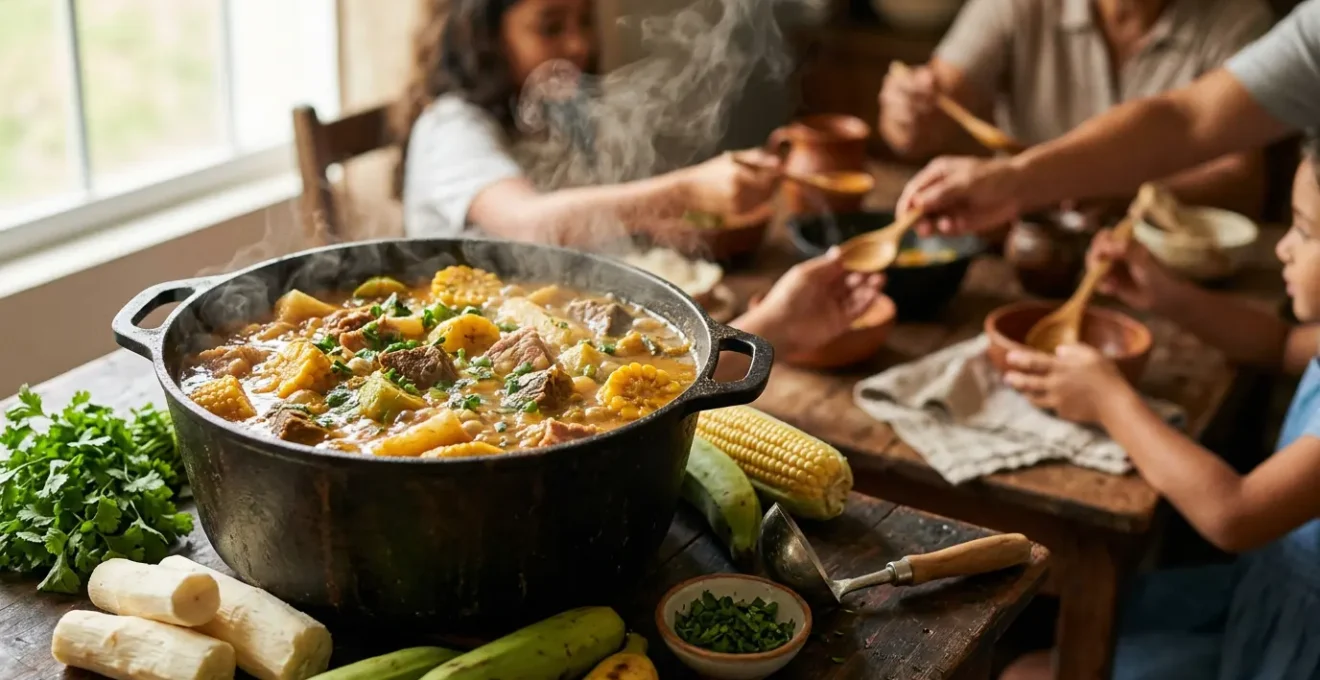
Sancocho isn’t just a meal; it’s a Dominican social institution in a bowl, acting as both a celebration centerpiece and a restorative cure.
- It blends the island’s entire history onto the plate, with ingredients from Taíno, Spanish, and African traditions.
- The famously long cooking process is a deliberate community-building ritual, not a culinary burden.
- Its consumption is tied to specific emotional and social moments like rainy days, hangovers, and family gatherings.
Recommendation: To truly understand Sancocho, seek out a home-cooked experience where the preparation ritual is as important as the final recipe.
To call Sancocho a simple stew is to call a cathedral a pile of stones. On the surface, it’s a hearty, complex broth brimming with root vegetables and a medley of meats. It’s a staple of Dominican cuisine, a dish you’ll find mentioned in every travel guide. But this description misses the point entirely. It fails to capture the sizzle of sofrito hitting a hot caldero, the low murmur of family conversation that stretches for hours, or the almost medicinal comfort found in that first spoonful. The true essence of Sancocho isn’t found in a list of ingredients, but in the living, breathing ritual that surrounds it.
While many discussions focus on its historical roots—a fascinating mix of Spanish cocido, African slow-cooking techniques, and native Taíno ingredients—they often overlook its role as a social anchor. Sancocho is the island’s unofficial answer to everything. It’s a cure for a long night of celebration, a magnet for impromptu neighborhood gatherings, and the unquestionable centerpiece of any special occasion. Understanding Sancocho is to understand the Dominican spirit: generous, communal, and deeply rooted in the idea that sharing a meal is a form of love.
So, how did a stew become the nation’s go-to remedy and its ultimate party food? The answer lies not just in what goes into the pot, but in the collective energy, time, and history that are simmered into every batch. This is the story of Sancocho not as a recipe, but as a ritual—an edible social contract that strengthens bonds, heals the weary, and celebrates life, one savory bowl at a time.
This guide delves into the cultural fabric of Sancocho, exploring the elements that elevate it from mere food to a cherished national symbol. We will uncover the secrets behind its ingredients, timing, and traditions to reveal why it holds such a special place in the heart of the Dominican Republic.
Summary: Unpacking the Ritual of Dominican Sancocho
- The 7 Meats: What Exactly Goes into a Sancocho de Siete Carnes?
- Why Are White Rice and Avocado Essential Companions to Sancocho?
- Rainy Days and Hangover Cures: When Do Locals Eat Sancocho?
- Restaurant vs Home-Cooked: Where to Get Authentic Sancocho?
- The Time Commitment: Why Does Real Sancocho Take 4 Hours?
- How Did African, Spanish, and Taino Influences Create the Creole Palate?
- What Are the “Holy Trinity” Spices of Dominican Cooking?
- How Does Cooking on a “Fogón” (Wood Fire) Change the Flavor?
The 7 Meats: What Exactly Goes into a Sancocho de Siete Carnes?
The name itself, Sancocho de Siete Carnes, hints at its status as the pinnacle of Dominican stews. This isn’t your everyday meal; it’s a declaration of festivity and abundance. While simpler versions exist for more casual days, the seven-meat Sancocho is reserved for moments that demand something truly special. It represents a culinary crescendo, a dish so lavish it becomes an event in its own right. The commitment to sourcing and preparing this many proteins transforms the cooking process from a simple task into a significant undertaking, signaling the importance of the occasion.
So what constitutes this luxurious septet? According to traditional Dominican cooking experts, the authentic recipe calls for seven types of meat from four different animals. This typically includes a combination of beef (often multiple cuts, like flank and bone-in chunks for flavor), goat, and pork (like ribs or smoked sausage), all crowned with chicken. The variety is key; each meat contributes a unique layer of flavor and texture to the broth, creating a depth that a single-protein stew could never achieve. It’s a carefully orchestrated symphony of savory notes, where each component plays a vital role in the final masterpiece.
As food writer Clara Gonzalez of Dominican Cooking notes, this version is a true showstopper. She describes it as the “deluxe version… the most complex and sophisticated Dominican sancocho.” This complexity is a point of pride. It showcases the cook’s skill and the host’s generosity, turning a humble stew into a luxurious feast meant to honor guests and commemorate a significant event. The Siete Carnes is a statement: this day is important, and we are celebrating with the best we have to offer.
Why Are White Rice and Avocado Essential Companions to Sancocho?
Sancocho is rarely, if ever, served alone. To do so would be to present an incomplete thought. The stew, in all its rich and brothy glory, demands its two lifelong companions: a bed of fluffy white rice and slices of creamy avocado. This trio is not a suggestion; it is the rule. The combination is a masterclass in balance, a textural and flavorful trinity that elevates the entire experience. It’s a perfect example of how Caribbean cuisine creates complex satisfaction from the smart pairing of simple, high-quality components.
The white rice acts as the perfect canvas. Its primary role is functional: to soak up the savory, complex broth, ensuring that not a single drop of flavor is lost. Each grain becomes a tiny vessel, delivering the essence of the Sancocho in every bite. But it also provides a neutral, starchy foundation that balances the intensity of the meats and the hearty root vegetables like yuca and plantain. The avocado, on the other hand, provides a cooling, creamy counterpoint. Its buttery texture and subtle, earthy flavor cut through the richness of the stew, offering a moment of refreshing contrast that prevents the palate from being overwhelmed.
This pairing creates what could be called a “trinity of texture”: the liquid broth, the absorbent rice, and the creamy avocado. As the blog Cooking with Books passionately exclaims, “Nothing in this world goes better with Sancocho then fresh slices of avocado sprinkled with salt!” It’s a sentiment echoed across the Dominican diaspora. This combination isn’t just about taste; it’s about creating the most satisfying mouthfeel possible, a perfect harmony of liquid, solid, and cream that defines the authentic Sancocho experience.
Rainy Days and Hangover Cures: When Do Locals Eat Sancocho?
Sancocho is a dish deeply intertwined with specific moments and moods; it’s a food of circumstance. You don’t just eat it on any random Tuesday. Its consumption is often triggered by the weather, a physical state, or a social calendar. One of the most common times to prepare this heavy, warming stew is when the sky turns gray. As the blog Cooking with Books points out, “Dominican mothers make this Sancocho recipe the minute they see a gray cloud in the sky, because Sancocho is best when it’s raining.” On a sweltering Caribbean day, a steaming bowl of Sancocho is almost unthinkable. But on a cool, rainy afternoon, it becomes the ultimate comfort food, its warmth radiating through the body and soul.
Beyond being a remedy for gloomy weather, Sancocho holds a legendary status as a “cure-all,” particularly for the aftermath of a celebration. It’s the island’s go-to hangover cure. The rich broth replenishes electrolytes, the hearty meats and vegetables provide sustenance, and the sheer warmth feels restorative. This belief is so ingrained in the culture that Sancocho has become a ritual for one specific day of the year. The tradition of serving it on New Year’s Day is widespread, offering comfort and nourishment after a long night of festivities. It is the gentle, delicious reset button needed to start the year anew.
This “levantamuertos” (raiser of the dead) reputation is a key part of its cultural identity. It’s not just about providing nutrients; it’s about providing a sense of care and restoration. Whether it’s curing a hangover, chasing away the chill of a rainy day, or simply bringing a family together, Sancocho is served when comfort is needed most. It is, in essence, a bowl of edible affection, a physical manifestation of care doled out when it matters most.
Restaurant vs Home-Cooked: Where to Get Authentic Sancocho?
For a traveler seeking the true essence of Sancocho, a fundamental question arises: should you find it in a restaurant or hope for an invitation into a Dominican home? While many excellent restaurants serve delicious Sancocho, the consensus among locals is clear: the most authentic version is almost always home-cooked. This isn’t a slight against professional chefs, but a testament to the fact that Sancocho’s soul is inextricably linked to the home and the family.
The reason lies in the nature of the recipe itself. As one case study on its cultural significance explains, regional variations of Sancocho exist throughout the Dominican Republic. More importantly, each family has its own unique recipe passed down through generations. These recipes are a form of liquid legacy, tweaked and perfected over time with personal touches—a specific blend of spices, a secret technique for browning the meat, or a preference for certain root vegetables. A restaurant, by necessity, must standardize its recipe for consistency. A home-cooked Sancocho, however, is a direct expression of a family’s history and taste. It’s this personal, unwritten element that defines its authenticity.
Furthermore, the experience surrounding home-cooked Sancocho is part of its authenticity. It is fundamentally a social dish, made for sharing. As food writer Vanessa Mota of My Dominican Kitchen beautifully puts it, “In my home, we don’t wait for a special occasion; we just call the vecinos, set extra bowls on the table, and let the sancocho do the welcoming.” This spirit of spontaneous community is the heart of the Sancocho ritual. The act of gathering, sharing stories while the stew simmers, and welcoming neighbors transforms the meal into an act of communal alchemy. This social warmth is an ingredient that a restaurant kitchen simply cannot replicate.
The Time Commitment: Why Does Real Sancocho Take 4 Hours?
In our modern world of quick fixes and 30-minute meals, the idea of a dish taking four hours—or even, according to traditional recipes, a minimum of two-plus hours—seems daunting. But for Sancocho, the long cooking time is not a flaw; it is the entire point. The time commitment is a feature, not a bug, transforming the preparation from a chore into a cherished social ritual. The hours spent simmering are hours spent connecting, making the process as meaningful as the final product.
The first reason for the lengthy process is purely culinary. To build the deep, layered flavor that defines a great Sancocho, you need time. It begins with browning the various meats to create a flavorful base. Then, the vegetables and spices are added in stages, allowing their flavors to meld slowly. The root vegetables—yuca, yautía, plantain—need time to soften and release their starches, which naturally thicken the broth to the perfect consistency. Rushing this process would result in a thin, one-dimensional soup, a pale imitation of the real thing. The slow simmer is what allows the “communal alchemy” in the pot to happen.
However, the more important reason for the time commitment is social. The long afternoon of cooking is an excuse to gather. As the authors of Dominican Cooking state, “the time it takes to prepare is the time that is best enjoyed with friends.” While the Sancocho bubbles away, families and neighbors gather to talk, play dominoes, and share stories. This communal aspect is the soul of the dish. The four hours are not spent slaving over a stove, but investing in relationships. The anticipation builds, the house fills with incredible aromas, and a “Sancocho state of mind”—one of comfort, patience, and community—settles over everyone. The stew is just the delicious culmination of a day spent together.
How Did African, Spanish, and Taino Influences Create the Creole Palate?
Sancocho is more than a dish; it’s a history lesson in a bowl. Each ingredient tells a story, acting as a flavor-as-chronicle of the diverse cultures that shaped the Dominican Republic. The island’s Creole palate is a direct result of the culinary collision between the indigenous Taíno people, Spanish colonizers, and enslaved Africans. Sancocho is perhaps the most delicious and tangible artifact of this fusion, a dish where every component can be traced back to a different continent and a different chapter of the island’s past.
The dish’s lineage can be traced back to a 15th-century Spanish stew. As historical sources like Britannica explain, Sancocho likely evolved from the Spanish *cocido*, a hearty stew of meats and chickpeas. This culinary blueprint was brought to the Americas by Spanish colonizers. However, once on the island, it began to merge with the local foodways. The Taíno people contributed their staple root vegetables, or *víveres*, such as yuca (cassava) and yautía, which replaced the chickpeas and gave the stew its characteristic thick, starchy body. This was the first layer of cultural fusion.
The final, crucial layer came from West Africa. Enslaved Africans brought with them not only ingredients like the plantain but also slow-cooking techniques, perfectly suited for tenderizing tough cuts of meat and melding flavors over a low fire for hours. This method is the heart of Sancocho’s preparation. As writer Elisa Irvolino eloquently summarizes, “Each ingredient tells a story of the island: the African influence in the plantains, the Taíno tradition of root crops like yuca, and the Spanish love for hearty meats.” This blend created something entirely new—a uniquely Dominican dish that honors all apects of its complex heritage in every single spoonful.
What Are the “Holy Trinity” Spices of Dominican Cooking?
While the meats and root vegetables form the body of Sancocho, its soul comes from a foundational blend of aromatics and spices. To talk about Dominican cooking is to talk about sofrito, sazón, and adobo. While not a literal “trinity,” these three components form the backbone of flavor for countless dishes, and Sancocho is no exception. Understanding them is key to understanding the distinct, savory, and deeply aromatic taste that defines the Dominican palate.
The flavor journey begins with sofrito, a base of finely diced aromatics that are gently sautéed to start the cooking process. This is not a dried spice mix but a fresh, vibrant foundation. Typically, it consists of onions, garlic, cubanelle peppers, and a generous amount of fresh cilantro. This mixture is the first thing to hit the hot oil in the *caldero* (the traditional heavy-bottomed pot), releasing an incredible aroma that signals the start of something delicious. It creates the first layer of savory depth upon which all other flavors are built.
Next come the dry seasonings. Sazón is a pre-made spice blend whose name literally means “seasoning.” While commercial versions are popular, many families have their own mix. It usually includes coriander, cumin, garlic powder, and, crucially, annatto (or *bija*), which imparts Sancocho’s characteristic golden-orange hue. Adobo is another all-purpose seasoning, a salt-based blend that often includes black pepper, oregano, and turmeric. Together, Sazón and Adobo provide a complex, earthy, and savory profile that is unmistakably Dominican. Finally, the dish is finished with fresh herbs like more cilantro and culantro (a more pungent cousin) for a burst of brightness at the end. It’s this careful layering of fresh and dry seasonings that gives Sancocho its profound and unforgettable flavor.
Action Plan: Mastering the Sancocho Flavor Base
- Sofrito base: Begin by sautéing a fresh mixture of onions, garlic, peppers, and cilantro to build the foundational flavor.
- Sazón seasoning: Incorporate a blend of coriander, cumin, and annatto to add earthy depth and signature color.
- Adobo seasoning: Season the meats with a mix of salt, black pepper, oregano, and garlic powder for a robust savory profile.
- Fresh herbs: Finish the stew with fresh cilantro and culantro to add a final layer of brightness and aroma.
- Dominican oregano: Ensure you use pungent Dominican oregano, not its milder Mediterranean cousin, for an authentic taste.
Key Takeaways
- Sancocho is a social event, not just a meal; its value is measured in community as much as flavor.
- The long, slow cooking process is intentional, designed to foster connection and conversation.
- The ingredients are a “liquid legacy,” with each component telling a part of the island’s Taíno, Spanish, and African history.
How Does Cooking on a “Fogón” (Wood Fire) Change the Flavor?
For the ultimate Sancocho experience, one final element can elevate the dish from exceptional to transcendent: the fire. Cooking Sancocho on a *fogón*, or a traditional wood-fire pit, is more than just a rustic cooking method; it’s a ritual that profoundly changes both the flavor of the stew and the nature of the gathering. While modern stoves are convenient, they cannot replicate the unique character that an open flame imparts. This practice is a cherished tradition, a nod to the ancestral way of cooking that is still revered for the superior results it produces.
The most immediate impact is on the flavor. The wood smoke itself acts as an ingredient, infusing the stew with subtle, aromatic compounds that add a layer of complexity impossible to achieve indoors. This smoky essence complements the rich meats and earthy root vegetables perfectly. Furthermore, as a detailed analysis of its cultural significance highlights, the slower, less direct heat of a wood fire is ideal for creating the prized *sancocho prieto*—a darker, richer, and more concentrated version of the stew. The embers provide a steady, low heat that allows the flavors to meld over many hours without scorching.
But just as with the time commitment, the choice to use a fogón is as much about the social dynamic as it is about the taste. Cooking outdoors transforms the event into a full-blown communal affair. As Britannica notes, it is a tradition across several Latin American countries for “families to gather outside and cook sancocho over an open wood fire pit.” Tending the fire, adjusting the heat, and stirring the large pot becomes a shared responsibility and a focal point for the gathering. The ritual of cooking around the flames is as important as the final dish itself, cementing Sancocho’s status as a food that is meant to be created and enjoyed together, under an open sky.
To truly experience the Dominican Republic, you must experience Sancocho not just as a meal, but as the welcoming, restorative, and celebratory ritual it is. The next time you have the opportunity, look beyond the menu and seek out the gathering, the shared pot, and the story simmering within.